
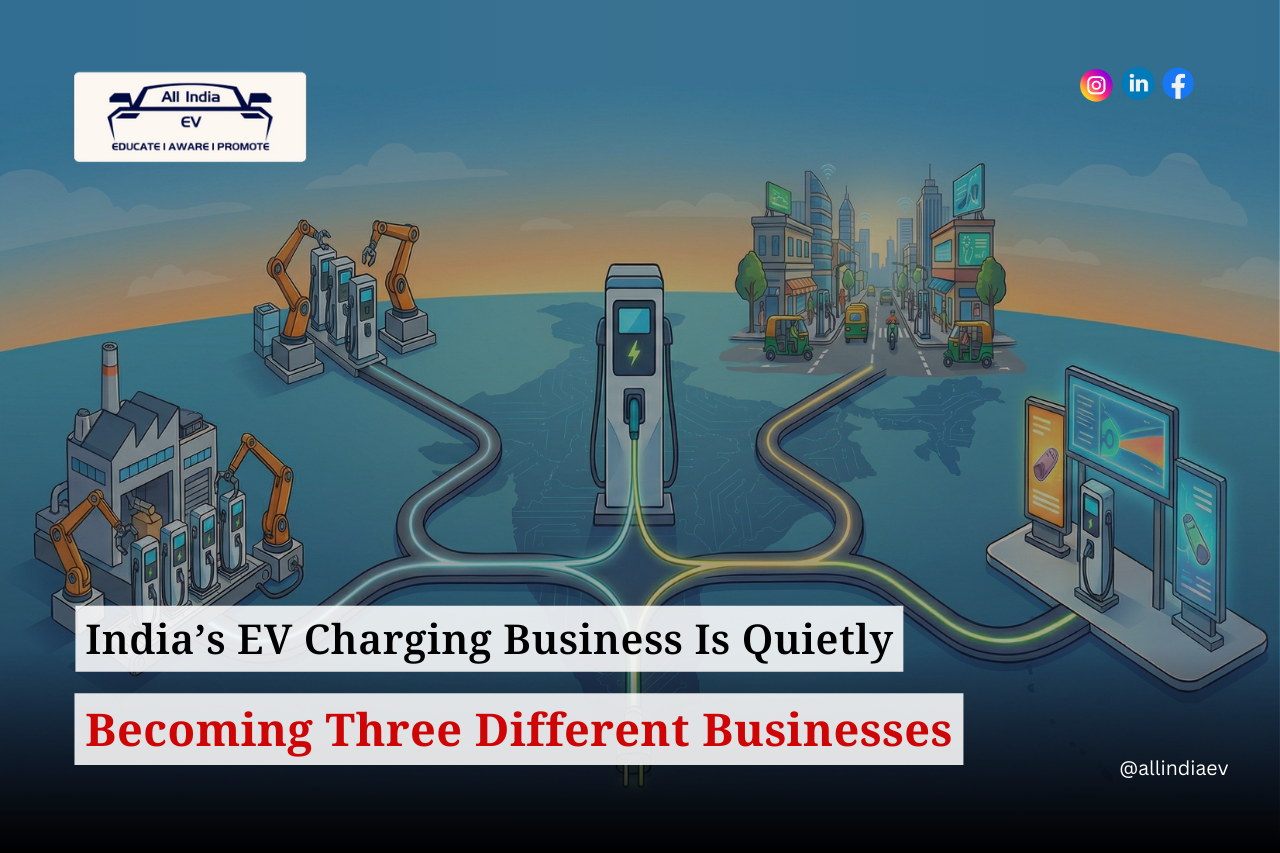

Hardware manufacturing, city concessions, and “charging-as-media” are diverging and that changes the winners.
If you’re still thinking “EV charging market = chargers + app”, you’re reading India 2022. The last week’s news flow suggests India 2026 is breaking into three distinct charging businesses:
- Manufacturing-led charging hardware (power electronics, onboard chargers, DC fast chargers)
- Concession-led public charging (DBFOM, city rights, long-tenure contracts)
- Monetisation-led charging real estate (advertising rights, brand surfaces, high-footfall locations)
These are not the same business model. They don’t share the same unit economics, risk profile, or scaling logic. And the most interesting bit: some players are now stacking two of these together.
What happened (facts that matter)
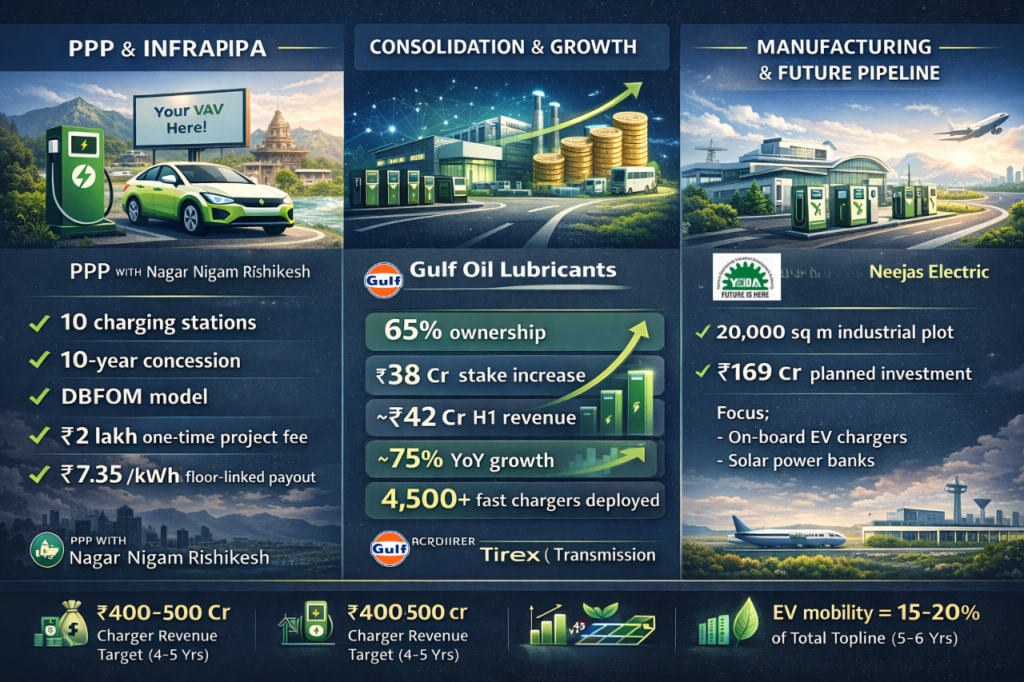
- Cash Ur Drive Marketing secured a PPP project from Nagar Nigam Rishikesh to develop EV charging stations with advertising rights.
- Under the project, it will set up 10 charging stations on a 10-year concession under a DBFOM model.
- Commercial terms disclosed include a one-time project fee of ₹2 lakh and a floor-linked payout of ₹7.35 per kWh, payable quarterly (post agreement finalisation).
- Gulf Oil Lubricants approved a 14% stake increase in Tirex Transmission for ~₹38 crore, taking total ownership to 65%.
- Tirex reported ~₹42 crore revenue in the first half of the fiscal year, up 75% from the prior period (as reported).
- Gulf Oil acquired control of Tirex in 2023 for ~₹103 crore.
- Gulf Oil’s stated ambition: ₹400–500 crore charger business revenue in 4–5 years, and EV mobility contributing 15–20% of total top line in 5–6 years.
- Tirex has deployed 4,500+ fast-charging units, with products ranging 30 kW to 360 kW (as per the report).
- YEIDA issued an LoI to Neenjas Electric for a 20,000 sq m industrial plot near Noida International Airport; project investment stated ~₹169 crore, focused on manufacturing on-board EV chargers and solar power banks.
The thesis (what this means structurally)
India’s charging layer is professionalising into a “real infrastructure” sector, and that changes the scoreboard:
- Cities will increasingly treat charging as a concession + compliance asset (permits, right-of-way, urban design).
- OEM and fleet charging will pull the market toward hardware capability, uptime, and service response.
- Prime locations will convert charging stations into monetisable urban touchpoints, where kWh is only one revenue stream.
Why this matters (3 angles)
More EV News
1) Market/strategy implication
The Rishikesh PPP is a signal that municipalities are ready to package charging with monetisation rights. This is a big deal because it creates a logic where a charging operator can underwrite capex not only from utilisation, but from advertising inventory too. That can make “low-utilisation early years” survivable. But it also introduces a new execution truth: you now need to be good at infra ops + media ops. Not many teams are.
2) Technical/infra implication
Manufacturing moves (Tirex scaling, Neenjas’ onboard charger focus) indicate the market is shifting from “install chargers” to “build power electronics capacity”. That’s where real defensibility forms:
- thermal management,
- reliability under Indian voltage quality,
- serviceability,
- component sourcing,
- and firmware controls.
For CPOs and fleets, this is the difference between a charger that looks impressive on launch day and one that quietly delivers uptime for years.
3) Policy/capital implication
As concessions and manufacturing ramp, capital will start pricing risk differently:
- Concession models bring stable tenures but regulatory and local compliance complexity.
- Manufacturing models bring scale upside but supply-chain and warranty liabilities.
- Media-led monetisation can improve cashflow but requires advertiser demand and inventory discipline.
In short: the funding pitch is no longer “India charging is growing”. It’s “which charging business are you actually in, and can you execute that specific playbook?”
Execution Risk Ledger (real-world breakpoints)
- Utilisation reality check: without demand clusters (fleets, corridors), station economics wobble fast.
- Power availability and upgrades: sites fail when upstream capacity isn’t secured or load grows faster than planned.
- O&M latency: the killer KPI is mean-time-to-repair; poor field response kills trust and repeat usage.
- Concession friction: local approvals, signage rules, ad inventory compliance, and municipal coordination can slow rollout.
- Hardware quality drift at scale: as manufacturing scales, component substitutions and QC slippage show up as downtime and warranty disputes.
Who wins / who gets squeezed
Who wins
- Charger OEMs and integrators who deliver reliability + service infrastructure (not just shipments).
- Operators who can bundle revenue streams (kWh + site monetisation) without compromising uptime.
Who gets squeezed
- Pure app-layer aggregators without control over uptime and service.
- Small operators expanding fast without power upgrades, spares strategy, and field ops discipline.
Operator actions (next 90 days)
- [CPO] Split your playbook: concession sites vs fleet sites vs corridor sites need different KPIs and rollout logic.
- [Fleet] Demand SLA clauses tied to uptime and repair times, not just “installed capacity”.
- [OEM] Qualify charger partners on service readiness and failure analytics, not just price and lead time.
- [DISCOM] Publish a standard process for load sanctions/upgrades for public charging sites to reduce rollout friction.
- [Investor] Underwrite “service moat”: spares, field teams, MTTR, remote diagnostics, warranty management.
- [Policymaker] Standardise municipal concession frameworks so charging doesn’t become 100 different city rulebooks.
Questions for the Ecosystem
- Should Indian cities package charging as concessions more aggressively, like parking and street furniture?
- Will charging economics be saved more by utilisation growth or by non-kWh monetisation (ads, retail partnerships)?
- Do we need a national uptime reporting standard for public charging networks?