

All India EV | The 9AM Show | Midweek Brief
- The Week in Numbers
- Lens 1: Capital
- GreenCell Mobility: institutional money backs the bus operator model
- Hyundai’s $15.5 billion: automotive investment with EV relevance
- Lens 2: Supply
- Energy in Motion: dedicated capacity for electric freight
- Tata–Stellantis: Indian vehicle technology goes global
- Lens 3: Demand
- Passenger EVs: choice widens across buyer priorities
- Double-digit EV penetration? A forecast worth tracking
- Commercial and real-world use: small deployments, useful data
- Lens 4: Policy
- Payment security is becoming the bus market’s backbone
- Claims Ledger
- What to Watch Next
- The AIEV Intelligence View
Capital is arriving, factories are opening and showrooms are filling. The harder test is what reaches the road.
India’s EV industry opened the week with movement on almost every front at once. An international development fund backed an electric bus operator. A new heavy truck plant opened near Pune. Tata and Stellantis widened their technology partnership. Hyundai committed $15.5 billion to India. Volvo and MG added fresh choices for car buyers.
Read individually, each is good news. Read together, they pose a sharper question:
How effectively can India turn investment commitments, manufacturing capacity and wider product choice into vehicles operating on the road?
This edition sorts the week through the All India EV Four Lenses: Capital, Supply, Demand and Policy. It closes with a Claims Ledger separating what is on record from what is announced or forecast.
The Week in Numbers
- $35 million: Impact Fund Denmark’s investment in GreenCell Mobility
- 1,200 to 4,500: GreenCell’s targeted electric bus fleet expansion, across 100+ cities
- 150: New electric buses flagged off in Delhi on 13 October
- 7% to 17%: CRISIL’s expected rise in electric bus share of new registrations, last fiscal to next fiscal
- ₹500 crore: First-phase investment in Energy in Motion’s Talegaon truck plant (of ₹1,000 crore planned)
- $15.5 billion: Hyundai Motor Group’s India programme for 2026–2032
- ₹1.26 crore: Launch price of the Volvo EX90
- 10%: JSW MG Motor’s expected EV share of passenger-vehicle sales by year-end
Lens 1: Capital
GreenCell Mobility: institutional money backs the bus operator model
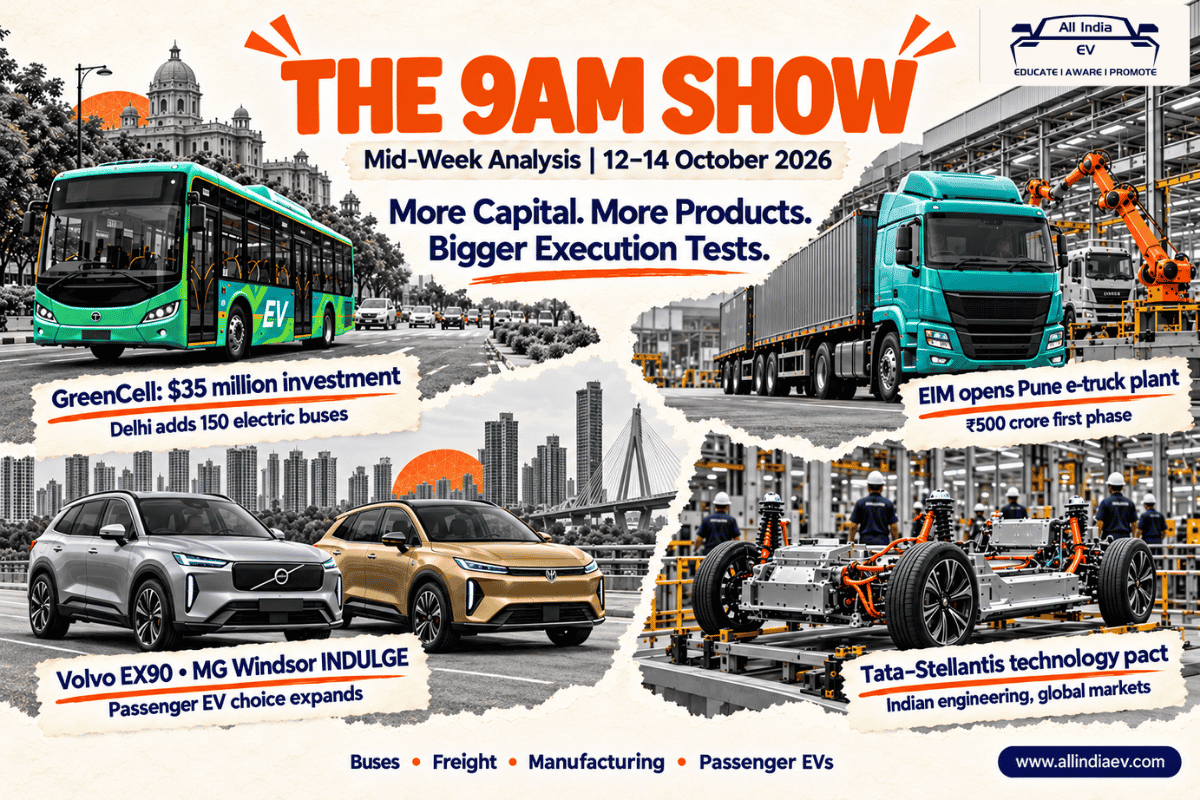
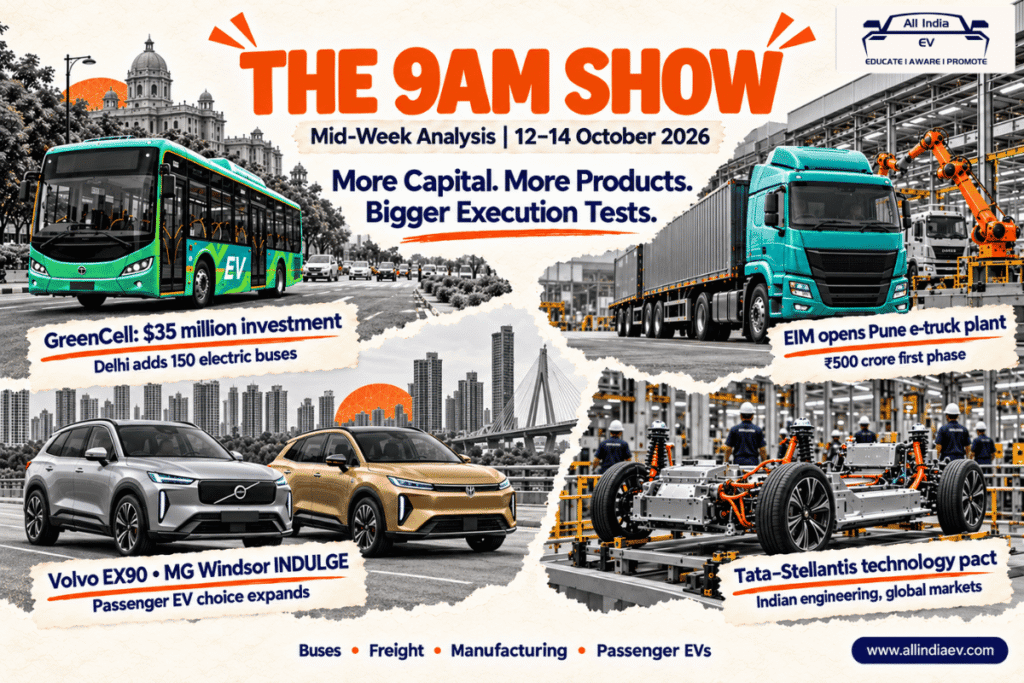
Impact Fund Denmark announced a $35 million investment in GreenCell Mobility, supporting the company’s ambition to grow from approximately 1,200 electric buses to 4,500 across more than 100 Indian cities.
Why it matters: The story here is not the fleet target but the investor. Development finance institutions underwrite operating risk over long horizons. Their participation signals that the electric bus operating business, not just the vehicle, is becoming financeable.
The execution test is operational: timely payments from transport authorities, vehicle availability, maintenance discipline and dependable daily service across a fleet nearly four times its current size.
Hyundai’s $15.5 billion: automotive investment with EV relevance
Hyundai Motor Group announced a $15.5 billion investment programme for India covering 2026–2032, spanning manufacturing expansion, R&D, supplier localisation and future technologies across the group’s Indian ecosystem.
Read it carefully: This is an automotive commitment, not an EV allocation. No EV-specific share has been disclosed.
Why it still matters: Large automotive investments build capabilities EV manufacturing also needs: engineering talent, testing infrastructure, supplier development and production scale. The EV-specific impact will become clear only as Hyundai and Kia disclose individual product programmes, component localisation plans and technology investments.
Lens 2: Supply
Energy in Motion: dedicated capacity for electric freight
Energy in Motion opened an electric heavy commercial vehicle facility in Talegaon, Pune, with a first-phase investment of ₹500 crore within a planned ₹1,000 crore commitment in Maharashtra. The company reports initial capacity of 5,000 vehicles per shift annually, alongside battery-pack assembly and testing.
Why it matters: Electric trucking has had a supply problem as much as a demand problem. Dedicated capacity strengthens the supply side of freight electrification.
The execution test: Capacity is not the same as deliveries. Fleet operators buy on payload, route suitability, financing, service response and vehicle availability. The milestone to watch is how quickly installed capacity converts into customer deliveries and sustained fleet utilisation.
Tata–Stellantis: Indian vehicle technology goes global
Tata Motors Passenger Vehicles, Tata Passenger Electric Mobility and Stellantis expanded their partnership into advanced technology and product collaboration. Stellantis will gain access to Tata’s vehicle architecture and product technology, supporting development of vehicles in India for international markets. Specific electric models have not been announced.
Why it matters: India’s role in this deal is not as a market but as an engineering source. Platform collaboration of this kind can create development work, localisation opportunities and new business for Indian suppliers.
Details to watch: the architectures selected, the powertrain mix and the production commitments attached to the agreement.
Lens 3: Demand
Passenger EVs: choice widens across buyer priorities
Volvo launched the EX90 electric SUV at ₹1.26 crore, a new flagship for India’s luxury EV segment. The Ultra variant carries a 106 kWh battery, dual-motor all-wheel drive and a claimed 625 km WLTP range.
MG introduced the Windsor INDULGE Edition at approximately ₹18 lakh, adding styling and rear-seat comfort features while retaining the 38 kWh battery and claimed 332 km range.
Why it matters: These launches sit at opposite ends of the market, but they share a direction. Manufacturers are competing less on battery size alone and more on the complete ownership proposition: comfort, refinement, brand and after-sales support. That is what a maturing market looks like.
Double-digit EV penetration? A forecast worth tracking
JSW MG Motor’s sales director, Lakshmi Ram Kumar Subbaraj, said EVs could reach or exceed 10% of India’s passenger-vehicle sales by year-end, citing wider model availability, improving ranges and ownership schemes such as Battery-as-a-Service and buyback programmes.
Read it carefully: This is an executive forecast from a company with a strong commercial interest in EV adoption, not a reported figure.
Why it matters: A single double-digit month would be a milestone. Sustaining that share across subsequent months would be the real evidence of a shift in buying behaviour. The indicators to track: retail volumes, adoption across price bands, geographic spread and demand after the festive season.
Commercial and real-world use: small deployments, useful data
Green Drive Mobility deployed four electric vehicles for More Retail’s Bengaluru–Mysuru operations, covering approximately 400 km daily across intercity and mid-mile routes, according to the company.
The Indian Army and Ultraviolette are undertaking a 40-day, approximately 4,850 km expedition on the X-47 electric motorcycle, across the Himalayas, the Gangetic plains and Northeast India.
Why it matters: Small deployments show where businesses are actually putting EVs into regular work. Structured routes make utilisation, operating cost and reliability measurable. The Himalayan expedition’s most valuable output would be published data on reliability, energy consumption, temperature effects and service needs. Evidence, not imagery, is what builds rider confidence.
Lens 4: Policy
Payment security is becoming the bus market’s backbone
Delhi flagged off 150 new electric buses on 13 October, another deployment milestone in the capital’s public transport transition.
CRISIL expects electric buses to account for approximately 17% of new bus registrations next fiscal, up from 7% last fiscal, supported by government procurement, operational subsidies and payment security measures.
Why it matters: CRISIL’s emphasis on payment security is the most important policy signal of the week. Bus electrification in India runs on gross-cost contracts, where operators depend on authorities paying on time. Reducing that revenue uncertainty is what turns fleet expansion from a policy ambition into a bankable business. It also connects directly to the GreenCell investment: capital follows predictable cash flows.
Claims Ledger
All India EV separates what is on record from what companies announce and what executives or analysts expect.
On record (observed event or published price)
- Delhi flagged off 150 electric buses on 13 October
- Volvo EX90 launched at ₹1.26 crore
- MG Windsor INDULGE Edition introduced at approximately ₹18 lakh
- Energy in Motion facility opened in Talegaon, Pune
Company-reported or announced (not independently verified)
- Impact Fund Denmark: $35 million into GreenCell Mobility
- GreenCell fleet target: 4,500 buses across 100+ cities
- Energy in Motion: ₹500 crore first phase, ₹1,000 crore planned, 5,000 vehicles per shift annually
- Hyundai Motor Group: $15.5 billion for 2026–2032 (automotive, not EV-specific)
- Tata–Stellantis: expanded technology collaboration (no EV models named)
- Volvo EX90: 625 km WLTP range (claimed); MG Windsor: 332 km range (claimed)
- Green Drive Mobility: four EVs, approximately 400 km daily
- Indian Army and Ultraviolette: 40-day, approximately 4,850 km expedition
Forecast or estimate
- CRISIL: electric buses at approximately 17% of new bus registrations next fiscal
- JSW MG Motor: EVs at 10% or more of passenger-vehicle sales by year-end
What to Watch Next
The next phase will be judged through four measurable outcomes:
- Capital: How much committed investment reaches operating assets?
- Supply: How much announced capacity becomes customer deliveries?
- Deployment: How reliably do vehicles perform in daily service?
- Demand: How much sales growth holds beyond the festive peak?
The AIEV Intelligence View
This week did not show an industry short of ambition. It showed an industry entering its proof phase.
The money is increasingly institutional. The factories are increasingly dedicated. The products are increasingly differentiated. What remains unproven is conversion: dollars into operating fleets, capacity into deliveries, launches into sustained demand.
The headline numbers this week were large. The numbers that will matter are the ones that arrive in six to twelve months: buses in service, trucks delivered, and EV share holding after the festive season.
For India’s EV industry, execution will determine how much of this week’s momentum becomes lasting growth.
All India EV | The 9AM Show Tracking the developments shaping India’s electric mobility market.
Subscribe to this newsletter for the Midweek Brief every Thursday, and follow All India EV Intelligence for data-led coverage of India’s electric mobility transition.
Which of this week’s developments do you think will convert fastest into vehicles on the road? Share your view in the comments.
#ElectricVehicles #EVIndia #ElectricBuses #ElectricTrucks #EVInvestment #SustainableMobility #AllIndiaEV