
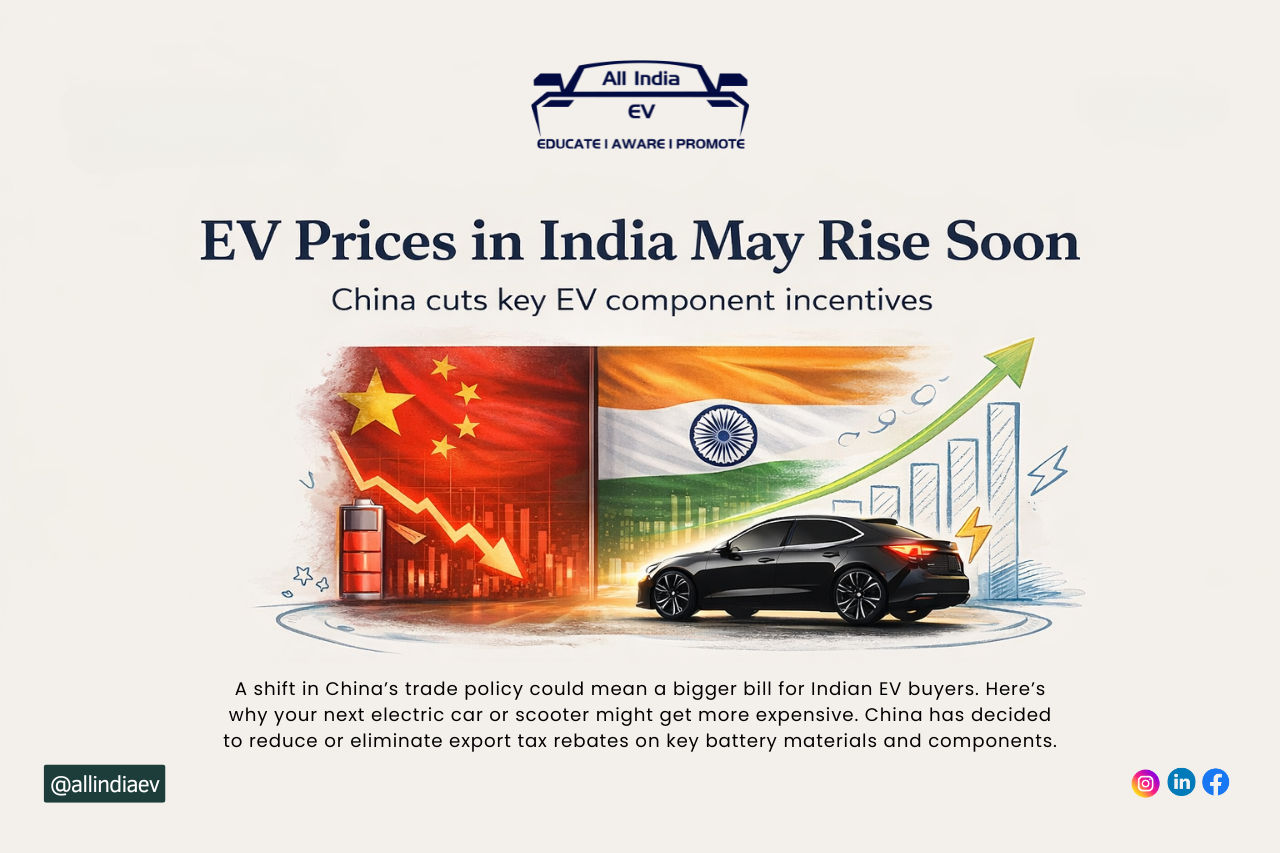

China will cut export tax rebates on lithium-ion batteries from 9% to 6% from April 1, with plans to withdraw the incentive entirely within a year.
Electric vehicle (EV) prices in India are likely to climb in the coming months following a significant policy change by China that has rattled global battery costs and supply chains. The shift comes at a time when India’s EV market is expanding rapidly and industry incentives are tightening, potentially squeezing margins for both manufacturers and buyers alike.
China Cuts Export Tax Rebates A Blow to EV Costs
China, the world’s largest producer of lithium-ion batteries and related components, has announced a reduction in export tax rebates on lithium-ion batteries from 9% to 6% effective April 1, 2026. The plan is to phase out this incentive entirely within the next year.
This policy change, announced on 8 January 2026, directly impacts Indian EV makers, who rely heavily on Chinese suppliers such as BYD and CATL for batteries and other critical parts. Lithium-ion batteries typically account for 30–40% of an EV’s total cost. Even a small price shift translates into meaningful cost increases for manufacturers, which could in turn be passed on to consumers.
Industry watchers say the rebate reduction and eventual removal may come just as the Indian EV sector begins to lose some of its price advantage over traditional petrol and diesel vehicles.
Cost Pressures Amid Rising Lithium Prices
In addition to the incentive cut, global lithium prices have surged sharply over the past year. This price rise adds further pressure to manufacturers already grappling with thinner margins. Indian automakers and EV component makers could find it harder to absorb the extra cost.
Analysts warn that unless companies find alternate battery sourcing options or increase domestic production, Indian EV prices will likely reflect these cost pressures. In the near term, EV prices particularly for passenger electric cars and two-wheelers could see noticeable increases.
More EV News

India’s EV Market: Growth with Caution
India’s electric vehicle market has been on an accelerated growth path, with EV sales expanding across two-wheelers, three-wheelers and passenger vehicles. According to recent data, the sector’s growth has been supported by government incentives such as the FAME (Faster Adoption and Manufacturing of Electric Vehicles) scheme, state subsidies and tax waivers in several regions.
However, global supply chains and policy shifts in other countries pose risks. China’s dominance in battery manufacturing has offered cost advantages to Indian EV assemblers, but changing incentives and geopolitical trade issues including recent disputes at the World Trade Organization involving EV incentive programs could alter that dynamic.
Industry Reaction and Future Outlook
Automakers and analysts are now assessing how to navigate these emerging cost headwinds. Some industry voices suggest that greater localisation of battery production and parts manufacturing in India could help alleviate dependence on Chinese imports and protect domestic pricing.
In parallel, India’s Union Budget 2026 discussions are expected to address supply chain resilience and development of EV components domestically, with policymakers seeking to bolster local manufacturing and reduce external reliance.
What This Means for Buyers
For Indian EV customers, the immediate impact may be higher sticker prices on new electric cars and two-wheelers, unless manufacturers choose to absorb some of the additional costs. Potential buyers are advised to monitor announcements from OEMs and central/state governments for any updated incentives or support measures aimed at cushioning the price impact.