
All India EVAll India EVAll India EV
Notification
Font ResizerAa
  • Home
  • EV News
  • EV Launch
  • Market Insights
  • Investments & Funding
  • Guest Articles
  • EV Engineering
  • Contact
Reading: Kazam at 100,000+: Building Smarter, Sustainable, and Global EV Charging Solutions
Share
All India EVAll India EV
Font ResizerAa
  • Home
  • EV News
  • EV Launch
  • Market Insights
  • Guest Articles
  • EV Engineering
  • Contact
Search
  • Home
    • Home 1
    • Home 2
    • Home 3
    • Home 4
    • Home 5
  • Home
  • Categories
    • Electric
  • Categories
  • Shows
    • Rap
  • More Foxiz
    • Blog Index
    • Contact
  • Bookmarks
    • Customize Interests
    • My Bookmarks
  • More Foxiz
    • Blog Index
    • Sitemap
Have an existing account? Sign In
Follow US
EV charging
Home » Blog » Kazam at 100,000+: Building Smarter, Sustainable, and Global EV Charging Solutions
EV News

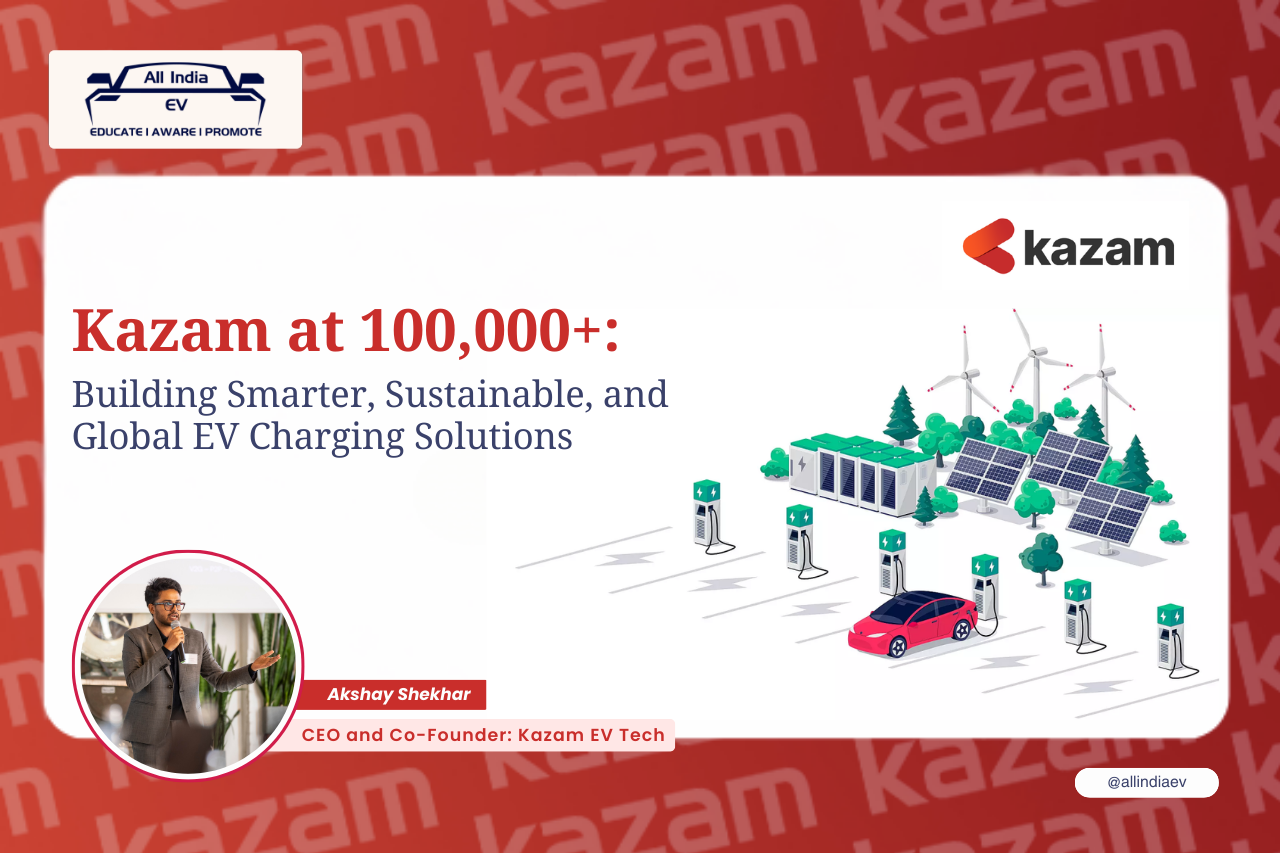
Kazam at 100,000+: Building Smarter, Sustainable, and Global EV Charging Solutions

Sunita
By
Sunita
Last updated: 4 September 2025
Share
7 Min Read
SHARE

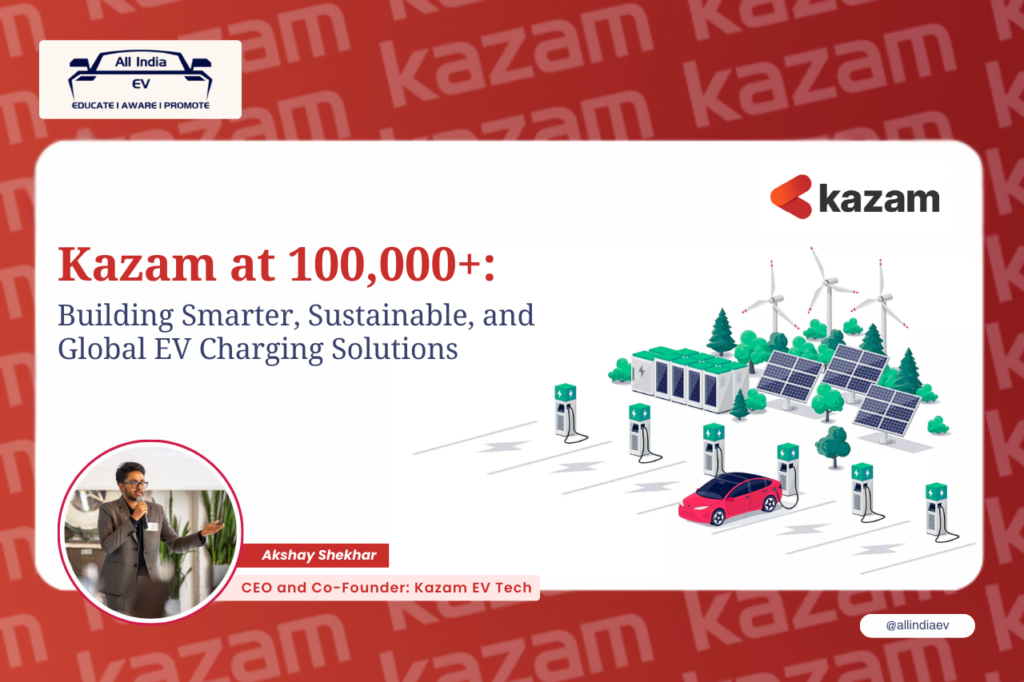
Our extensive charging network generates rich data streams that we analyze to optimize operations across multiple dimensions

With 100,000+ charge points now live, how will Kazam ensure sustained uptime and user trust, especially in tier-2/3 cities where servicing and power stability can be tricky?

Sustainability is integrated throughout our operational framework. Working with bus depots, CPOs, and OEMs has taught us that demand-side flexibility is crucial for effective energy management.

We implement dynamic load balancing systems that help reduce energy costs while optimizing grid stability.

Our solutions include Time-of-Day (ToD) scheduling consultancy, helping depots and fleet operators structure their charging to minimize costs during peak tariff periods.

For comprehensive fleet management, we offer integrated routing and scheduling systems that automatically coordinate vehicle deployment with optimal charging windows.

Our in-house hardware incorporates safety features for voltage fluctuation protection and renewable energy integration capabilities, supporting both rooftop solar and grid-connected renewable sources.

More EV News
PDEU Welcomes Gujarat's first Vanadium Flow Battery Plant
PDEU Welcomes Gujarat’s First Vanadium Flow Battery Plant
Ola Electric Sells 19,000 Units in August 2023
Montra Electric to Unveil State-of-the-Art eHCV (Trucks) Manufacturing Facility in Manesar
MHI’s EV Taskforce Initiates Battery Swapping Policy Consultation In India
Orbis Unveils HaloDrive: High-Efficiency Axial Flux Motor for Commercial EVs

We’ve also developed Kazam Buzz, a peer-to-peer energy trading platform that’s already facilitating active trading of surplus solar energy, enabling users to monetize excess generation while supporting grid stability and addressing the duck curve challenge.


How is Kazam leveraging the massive charging data—from peak loads to fleet vs. personal use— to drive predictive maintenance, dynamic pricing, and energy optimization?

Our extensive charging network generates rich data streams that we analyze to optimize operations across multiple dimensions.

We track usage patterns, peak demand periods, and differentiate between fleet and individual user behaviors to inform our strategies.

This data enables predictive maintenance algorithms that identify potential equipment issues before they cause downtime, reducing service disruptions and operational costs.

For pricing optimization, we use real-time demand analytics to implement dynamic tariff structures that balance grid load while maintaining affordability.

Our energy optimization systems analyze consumption patterns to help both individual users and fleet operators schedule charging during off- peak hours, reducing costs and grid strain.


Beyond CO₂ offset numbers, how is Kazam embedding sustainability into daily operations— like renewable integration, grid-friendly scheduling, or energy-efficient hardware?

As we moved on to work with OEMs setting up charging operations, CPOs using our software, and building charging solutions with bus depots, we understood that demand side flexibility was an important part of managing energy demand for utilities.

Through this we are able to reduce energy costs for bus depots by not only managing their energy with dynamic load balancing, but by identifying ToD and non -ToD hours and consulting depots on how to structure their charging schedule to reflet lower operating costs with not only energy, but overall operations as well, through offerings like routing and scheduling of EV fleets where the routes of travel and scheduling of charging would be taken care of automatically.

Our hardware also being built in-house has levels of safety incorporated into it to account for voltage fluctuations, and has the ability to incorporate solar either from rooftop solar, or from the grid supply.

We have developed solutions for CPOs, OEMs, Bus depots and more to integrate renewable energy into their operations.

We have also recently developed a peer to peer energy trading platform for users to sell their surplus solar energy to their neighbours called Kazam buzz, which is currently operational and piloting in Lucknow.


As EV adoption accelerates, what role do you see Kazam playing in enabling V2G (Vehicle-to-Grid) or energy trading models within India’s evolving UEI framework?

We’re already implementing grid resilience technologies through our depot partnerships, focusing on demand-side flexibility that benefits both grid stability and customer economics.

Our systems help facilities optimize their charging schedules using ToD pricing structures, significantly reducing electricity costs while supporting grid balancing.

Kazam Buzz represents our entry into energy trading, addressing India’s duck curve challenge by facilitating peer-to-peer solar energy transactions.

With approximately 10GW of rooftop solar capacity already installed across India, our platform has the potential to significantly increase renewable energy utilization in the national grid mix.

As the UEI framework evolves, we’re positioned to expand these capabilities toward full V2G implementation, leveraging our existing infrastructure and data analytics capabilities to enable bi-directional energy flows that benefit both EV owners and grid operators.


Given your recent international ambitions, how will the learnings from India’s 100,000+ charge points shape your global strategy—especially in Southeast Asia and other emerging EV markets?

As a leading player in EV infrastructure in the global south, Kazam has developed deep technological expertise in accelerating EV transitions within developing economies. India’s rapid EV adoption – with over 5 million electric two-wheelers and extensive charging infrastructure – demonstrates the potential for emerging markets to achieve transformative growth when supported by the right technology solutions.

Southeast Asian markets like Thailand, Indonesia, and Vietnam are experiencing their own EV momentum, and we’re positioned to support their unique transition pathways through our comprehensive software platform. Beyond basic charging statistics, our solution focuses on intelligent energy management, helping operators optimize grid integration and reduce operational costs across diverse market conditions.

Our Operations & Maintenance module is particularly valuable – it helps CPOs maintain strict SLAs with charger OEMs while providing strategic consultation on infrastructure scaling and deployment. This combination of energy optimization and operational excellence, proven across India’s varied economic and geographic landscape, positions us to help emerging economies worldwide accelerate their EV transitions by addressing the specific challenges of developing market infrastructure efficiently and cost-effectively.

Join All India EV Community

Click here for more such EV Updates

Hyundai Powers Up India's EV Future with 600-Station Charging Network
Hyundai Powers Up India’s EV Future with 600-Station Charging Network
India’s Electric Future: Two-Wheelers Lead the Charge
Exploring BYD’s 1000kW Charger: A Leap Toward EV Convenience
Reducing GST on Swappable Batteries: A Practical Step Toward India’s EV Goals
Hero MotoCorp and Ather Energy Partner for India’s Biggest EV Charging Network

Sign Up For Daily Newsletter

Be keep up! Get the latest breaking news delivered straight to your inbox.
Loading
By signing up, you agree to our Terms of Use and acknowledge the data practices in our Privacy Policy. You may unsubscribe at any time.
Share This Article
Facebook Whatsapp Whatsapp LinkedIn Copy Link Print
Leave a Comment

Leave a Reply Cancel reply

Your email address will not be published. Required fields are marked *

Follow US
XFollow
InstagramFollow
YoutubeSubscribe
LinkedInFollow
Haryana cabinet approves new rules: No petrol, diesel vehicles for cab aggregators in NCR
21 May 2026
Ultraviolette and Bolt.Earth Expand Type-6 DC Fast Charging Infrastructure Across India
Ultraviolet and Bolt. Earth Expand Type-6 DC Fast Charging Infrastructure Across India
21 May 2026
What: India’s finance ministry has directed public sector banks, insurers, and financial institutions to reduce operational spending and accelerate adoption of electric vehicles across official fleets. The move is part of a wider austerity push linked to rising global economic uncertainty and fuel-related risks. The Number: The directive impacts major public institutions including State Bank of India, Bank of Baroda, and Life Insurance Corporation of India, covering millions of employees and thousands of operational vehicles nationwide. The Impact: The policy signals a new phase of institutional fleet electrification in India, where EV adoption is now being tied directly to fiscal discipline, fuel import management, and public-sector operational efficiency. The Core News India’s finance ministry has formally instructed state-run financial institutions to implement strict expenditure controls while simultaneously accelerating EV adoption for official transport operations. The directive from the Department of Financial Services asks organisations to replace petrol and diesel vehicles used at head offices and branch operations with electric vehicles “as far as possible.” The order comes amid growing concern over the economic impact of prolonged geopolitical instability in West Asia, which threatens to increase crude oil prices, widen India’s import bill, and pressure the rupee. Alongside the EV transition mandate, the government has also pushed virtual meetings, reduced foreign travel, and tighter administrative spending controls across public-sector institutions. For India’s EV ecosystem, the directive is strategically important because it expands demand visibility beyond state transport undertakings and government departments into the financial sector itself. PSU banks and insurers operate one of the country’s largest distributed office networks, including regional offices, branch fleets, field operations, and administrative mobility services. Even a phased transition could create a sizeable procurement pipeline for electric passenger vehicles, charging infrastructure providers, and fleet management companies. Breaking Down the Update • The Department of Financial Services issued the austerity and EV adoption directive to PSU banks, insurers, and financial institutions. • The government wants petrol and diesel vehicles used in official operations to be progressively replaced by EVs wherever operationally feasible. • The policy push follows Prime Minister Narendra Modi’s appeal for fuel conservation and controlled discretionary spending amid global energy uncertainty. • The directive also mandates greater use of video conferencing to reduce travel-related operational expenditure. • The move could indirectly support domestic EV OEMs, leasing firms, and charging infrastructure operators through institutional procurement demand. • The banking and insurance sector may emerge as a new enterprise fleet electrification category in India’s EV transition roadmap. How PSU banks EV adoption will help Indian EV Market The expansion of PSU banks EV adoption could create a strong institutional demand layer for India’s electric mobility sector. Public sector banks and insurers operate thousands of branch offices across urban, semi-urban, and rural India. Their transition to EV fleets can generate predictable procurement volumes for domestic automakers, especially in the electric sedan, compact SUV, and commercial mobility segments. Beyond vehicle sales, the policy may also accelerate deployment of workplace charging infrastructure at bank headquarters, zonal offices, and regional branches. This can support charger utilisation economics while helping normalise EV infrastructure in tier-2 and tier-3 cities. Another important impact is signalling. When large state-linked financial institutions adopt EVs as operational assets rather than pilot projects, it improves confidence across the broader enterprise mobility market. Private banks, NBFCs, and insurance firms could eventually follow similar fleet transition models to reduce long-term fuel and maintenance costs. PSU banks EV adoption also aligns with India’s larger energy security strategy. Lower petroleum consumption in institutional fleets directly supports efforts to reduce crude import dependence while stabilising operational expenditure during periods of volatile global oil prices. Conclusion & Next Steps The government’s push toward PSU banks EV adoption reflects a broader shift where EV deployment is increasingly being linked with macroeconomic resilience rather than only sustainability targets. Execution, however, will depend on procurement timelines, charging infrastructure readiness, and operational suitability across
India directs state-run banks, insurance firms to cut costs, shift to EVs
21 May 2026
All India EV: Edition 49
What all happened in April 2026?
Click Here
All India EV

Daily EV Industry updates for you…

Categories

  • EV News
  • EV Launch
  • Investments & Funding
  • Market Insights
  • Guest Articles
  • EV Engineering

Quick Links

  • Community
  • Content Services
  • Branding Services
  • My EV Charger
  • Substack

© Developed and Managed by “The Energy Log”

Welcome Back!

Sign in to your account

Username or Email Address
Password

Lost your password?

Not a member? Sign Up