
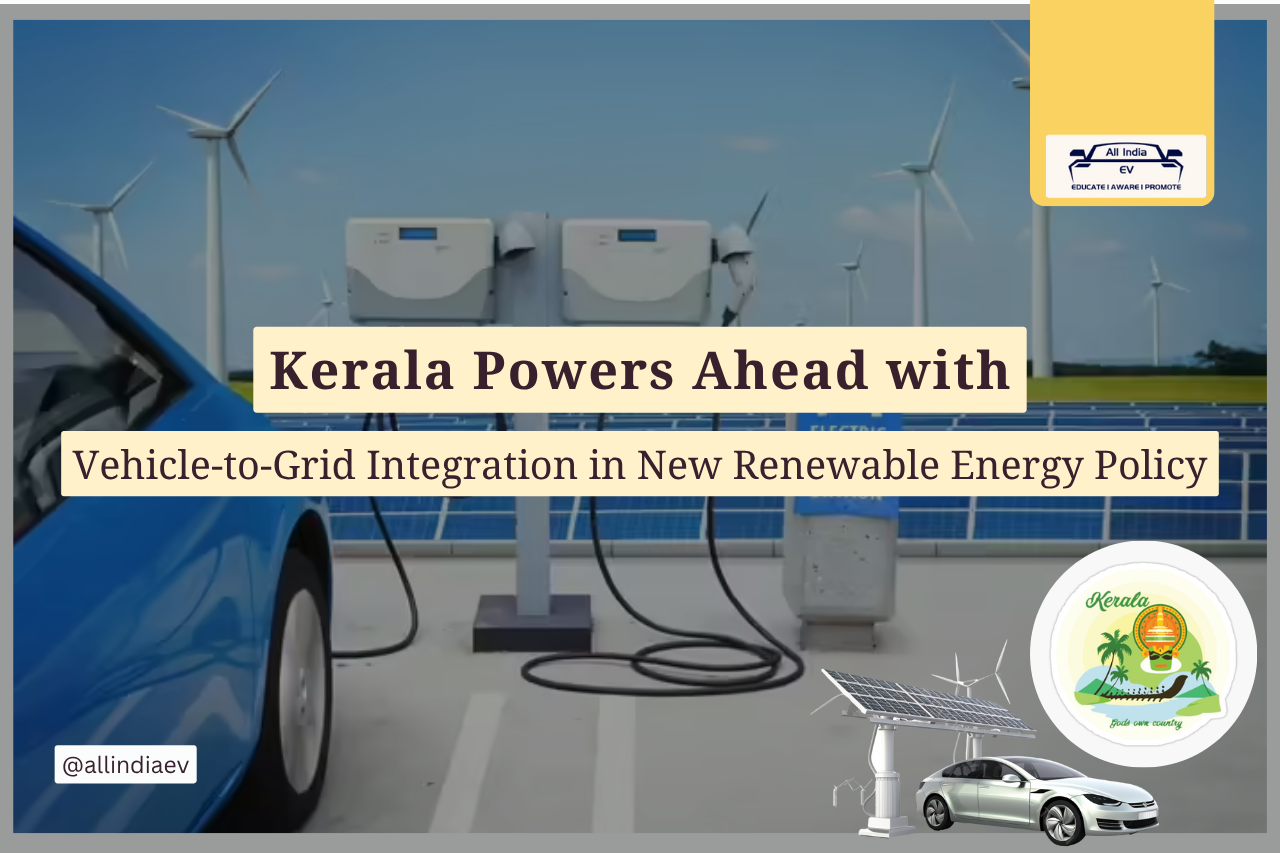


Kerala Sets ₹10 per Unit Tariff for Energy Export from Vehicle-to-Grid (V2G) Systems Under New Renewable Energy Regulations
Kerala has taken a major step toward modernizing its power ecosystem by officially including vehicle-to-grid (V2G) technology in its new renewable energy regulations. The Kerala State Electricity Regulatory Commission (KSERC) has issued a regulatory framework enabling bi-directional energy flow between electric vehicles (EVs) and the power grid, marking a first-of-its-kind move in the State’s renewable energy roadmap.
Vehicle-to-Grid (V2G): The Future of Smart EV Charging in India
V2G to Offer ₹10 Per Unit Tariff During Peak Hours
Under the KSERC (Renewable Energy and Related Matters) Regulations, 2025, notified on November 5, the Commission has proposed a tariff of ₹10 per unit for electricity exported from V2G systems to the grid during peak demand hours.
The new rules officially recognize EVs as mobile energy storage units, allowing owners to supply power back to the grid and help balance electricity loads during high-demand periods. This step is expected to strengthen Kerala’s renewable energy infrastructure and support grid stability in a state increasingly dependent on distributed solar power.
Special Time-of-Use Tariff and Dynamic Prici
The regulations mandate the introduction of a special Time-of-Use (ToU) tariff to encourage EV owners to participate in V2G operations.
More EV News

“Dynamic pricing mechanisms shall be explored to compensate EV owners based on real-time grid conditions,” the Commission stated.
This means EV users could earn varying rates for exporting energy depending on grid demand and power supply availability, creating a smart, flexible energy marketplace.
Kerala’s Growing Focus on V2G Pilots
Kerala’s push for V2G adoption comes amid multiple pilot programs already underway. In July 2025, the Kerala State Electricity Board (KSEB) signed an MoU with IIT Bombay to test V2G systems through a two-phase pilot project. Around the same time, the Agency for New and Renewable Energy Research and Technology (ANERT) installed a demo V2G charging station at its headquarters in Thiruvananthapuram to raise public awareness about the technology.
These pilots have provided key insights into the technical feasibility and public response to grid-interactive EV charging — setting the stage for wider implementation.
Rights and Responsibilities Defined
The regulations clarify that all EV owners will have the right to export stored energy from their vehicles through authorized V2G-enabled charging stations.
Distribution licensees, on their part, are required to:
- Facilitate seamless grid integration of V2G-capable vehicles.
- Deploy smart meters and monitoring systems to track bi-directional power flow.
- Ensure transparent energy accounting and settlement mechanisms.
All stakeholders — including EV owners, charging operators, and utilities — are eligible to participate in this system, fostering a collaborative clean-energy network.
Implementation and Duration
The KSERC will soon issue detailed procedures for implementing V2G participation, including energy accounting, settlement rules, and verification protocols. These will be finalised after pilot studies conducted by distribution licensees or designated agencies.
The new renewable energy regulations will remain in force until March 31, 2030, giving Kerala a clear timeline to scale up V2G technology and build a resilient, decentralized power grid.With this move, Kerala becomes one of India’s first states to formally recognize and regulate vehicle-to-grid integration, setting a benchmark for EV-driven energy innovation and smart grid modernization in the country.
Comment by Author:
Kerala’s inclusion of vehicle-to-grid (V2G) integration in its renewable energy regulations marks a defining moment in India’s clean energy journey. By officially recognizing EVs as mobile power assets, the state is transforming vehicles from simple modes of transport into active contributors to grid stability and energy resilience.
The ₹10 per unit peak-hour tariff and dynamic pricing mechanisms highlight a forward-thinking approach that rewards EV owners while supporting grid flexibility. As Kerala pioneers this model, it sets the stage for smart, decentralized energy systems that blend mobility, technology, and sustainability — a blueprint the rest of India can look to replicate.