


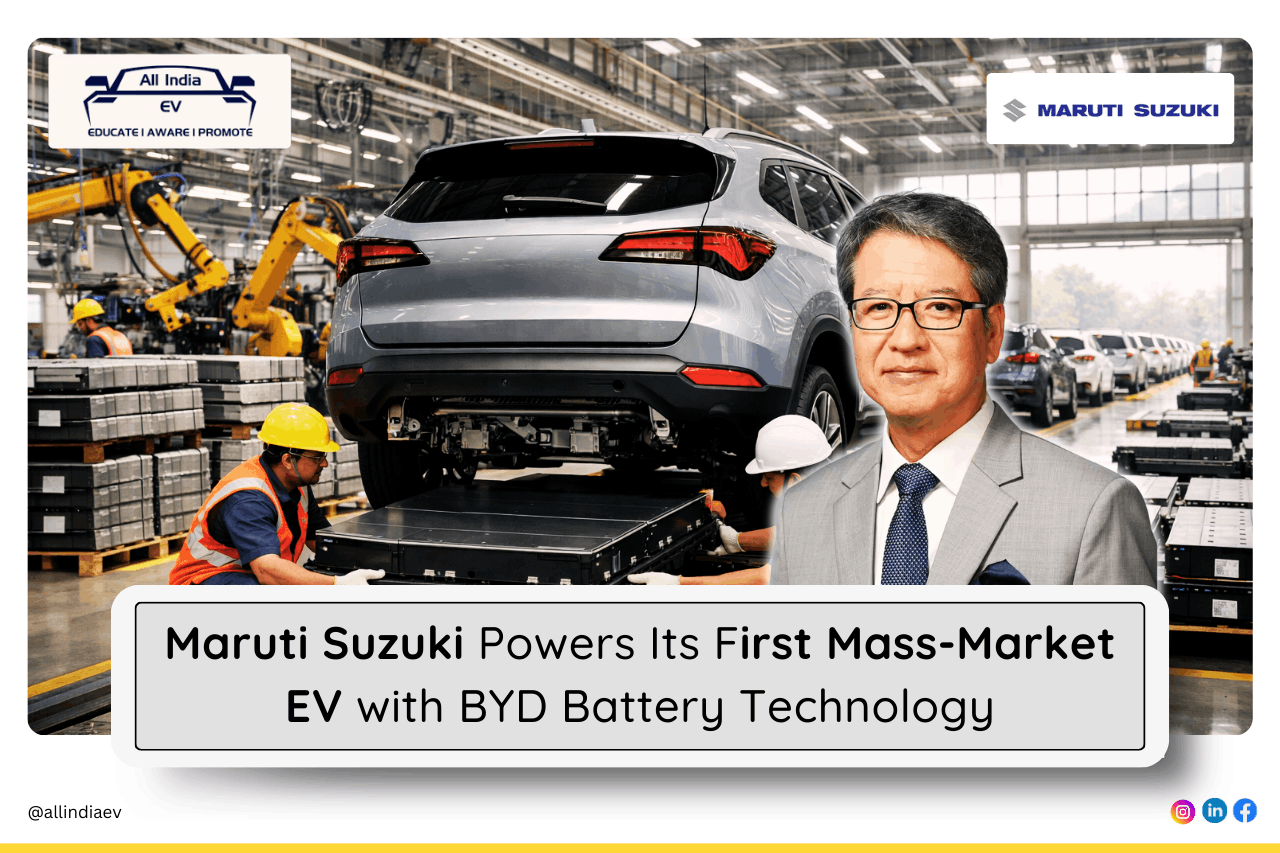
Maruti Suzuki relies on BYD technology for its first mass market EV, marking a notable shift in the company’s long-standing localisation-first strategy as it enters India’s mainstream electric passenger vehicle segment. The move centres on battery packs sourced from BYD, whose Blade battery architecture is widely known for its lithium iron phosphate chemistry, safety profile, and durability focus.
The development is significant because Maruti Suzuki has historically built its passenger vehicle success around affordability, scale, vendor localisation, and products tailored for Indian buyers. But in EVs, battery technology is the core performance layer, shaping cost, range, safety, charging behaviour, and long-term ownership economics. By leaning on an established battery technology partner instead of building everything from scratch, Maruti appears to be accelerating its EV entry with a lower technology lag.
This also aligns with the commercial rollout of the e VITARA, Maruti Suzuki’s first electric SUV in India. The company has already announced the model with 49 kWh and 61 kWh battery pack options, a claimed driving range of up to 543 km, and Battery-as-a-Service pricing aimed at reducing the upfront purchase cost for Indian buyers.
From an industry standpoint, the story is bigger than one supplier tie-up. It reflects the current reality of the EV value chain, where battery cell manufacturing, battery pack engineering, and scale economics remain concentrated in a few global players. India is expanding its local battery and cell manufacturing ambitions, but large-scale, globally competitive EV battery capability is still evolving. In that context, Maruti’s decision looks less like a retreat from localisation and more like a pragmatic bridge strategy to enter the market with proven technology.
For Maruti Suzuki, the combination could be commercially powerful: its deep retail reach, service network, financing strength, and mass-market brand trust paired with a battery technology platform already proven internationally. If executed well, this could help the company compete more effectively in a fast-maturing Indian electric SUV market.
More EV News

How This Will Help the Indian EV Market
This development could help the Indian EV market in a very practical way: it may speed up mass-market EV adoption instead of keeping electric mobility limited to premium or early-adopter buyers. Maruti Suzuki has one of the widest sales and service networks in the country, and when a company with that scale enters EVs seriously, the category itself becomes more mainstream.
The second benefit is technological benchmarking. If proven battery systems like BYD’s Blade architecture are used in a mass-market Indian EV, it can raise customer expectations around battery safety, durability, and range. That matters because Indian consumers are still cautious about battery life, resale value, and real-world reliability. A better product experience can reduce psychological barriers to EV adoption.
Third, this move may indirectly push the domestic ecosystem to move faster. Local battery manufacturers, component suppliers, and policymakers will all feel greater pressure to improve speed, scale, and competitiveness. In many industries, temporary dependence on global technology often acts as a transition stage before localisation deepens.
Finally, this could expand the market for charging, financing, battery subscription, after-sales diagnostics, and fleet use cases. In simple words, when India’s biggest car brand enters EVs with stronger technology backing, the entire ecosystem gets a jolt of momentum. It is not just about one vehicle launch. It is about making EVs feel more normal, reachable, and trustworthy for the next wave of Indian buyers.