
All India EVAll India EVAll India EV
Notification
Font ResizerAa
  • Home
  • EV News
  • EV Launch
  • Market Insights
  • Investments & Funding
  • Guest Articles
  • EV Engineering
  • Contact
Reading: EV Charging Stations in India 2025: State-Wise Trends, Growth Drivers & Key Challenges
Share
All India EVAll India EV
Font ResizerAa
  • Home
  • EV News
  • EV Launch
  • Market Insights
  • Guest Articles
  • EV Engineering
  • Contact
Search
  • Home
    • Home 1
    • Home 2
    • Home 3
    • Home 4
    • Home 5
  • Home
  • Categories
    • Electric
  • Categories
  • Shows
    • Rap
  • More Foxiz
    • Blog Index
    • Contact
  • Bookmarks
    • Customize Interests
    • My Bookmarks
  • More Foxiz
    • Blog Index
    • Sitemap
Have an existing account? Sign In
Follow US
EV Charging Stations
Home » Blog » EV Charging Stations in India 2025: State-Wise Trends, Growth Drivers & Key Challenges
EV News

EV Charging Stations in India 2025: State-Wise Trends, Growth Drivers & Key Challenges

Sunita
By
Sunita
Last updated: 17 November 2025
Share
9 Min Read
SHARE

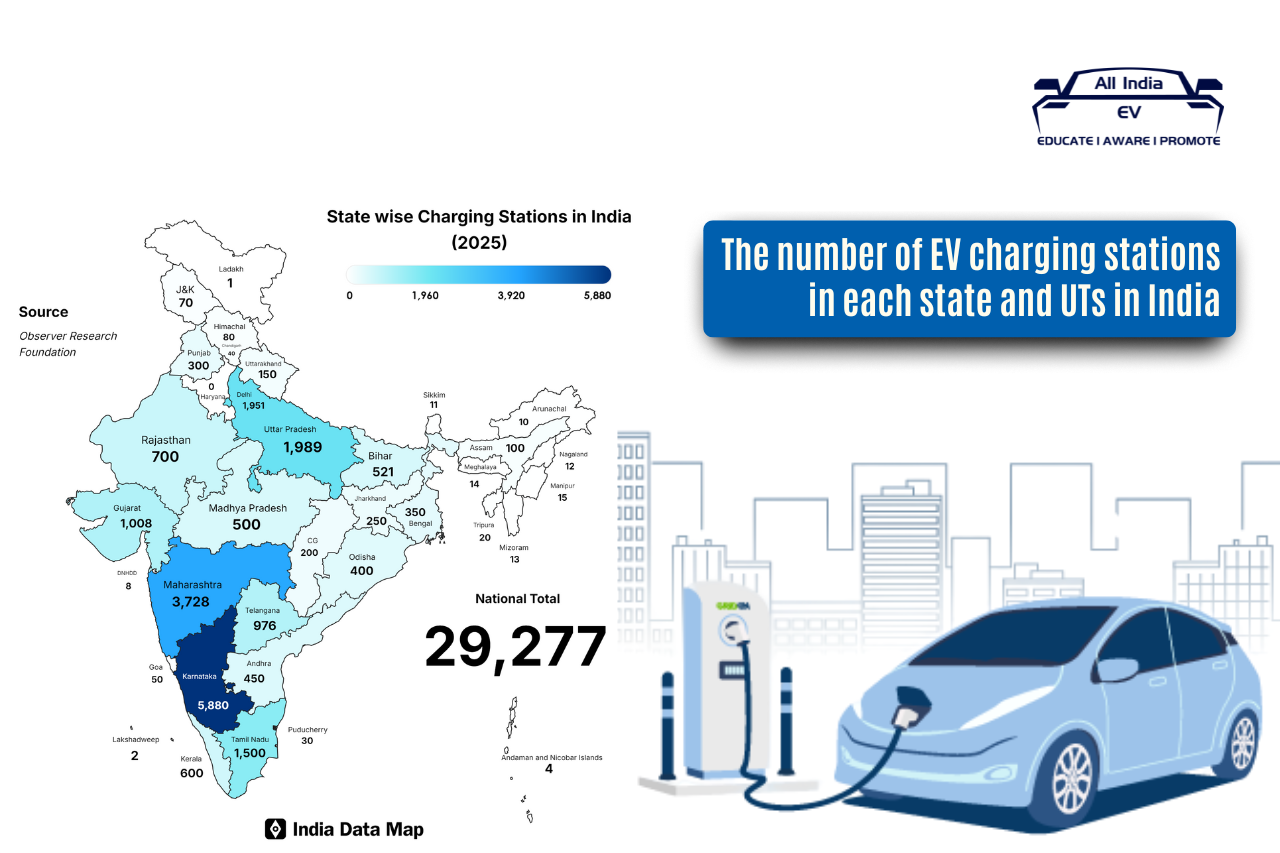
India Has 29,277 EV Charging Stations: Karnataka Leads Growth as Policies and Investments Drive Expansion Despite Infrastructure Gaps

Contents
  • Karnataka Leads India With 5,880 Charging Stations
  • Maharashtra: 3,728 EV Charging Stations, Ranking 2nd Nationwide
  • Uttar Pradesh: 1,989 Chargers — Yet India’s Highest EV Sales
  • Delhi: Smallest Region but Among the Top Five
  • Southern States Outperform: Tamil Nadu & Telangana Surge Ahead
    • Tamil Nadu (1,500 chargers)
    • Telangana (976 chargers)
    • Comment by Author

India’s electric vehicle transition is accelerating at an unprecedented pace, with 29,277 public EV charging stations installed as of November 2025 — a fourfold jump from just 6,586 stations in 2023. This rapid expansion, powered by government schemes such as PM E-DRIVE and FAME III, along with private investments exceeding ₹10,000 crore, signals a nationwide shift toward cleaner mobility.

The latest state-wise breakdown reveals strong progress in the southern and western regions, while remote and economically weaker states continue to lag. Karnataka leads India, followed by Maharashtra, Uttar Pradesh, and Delhi — together accounting for nearly half of the country’s public charging infrastructure.

Despite this encouraging progress, India’s EV-to-charger ratio remains 1:235, far below the global standard of 1:20, highlighting an urgent need to expand charging access, especially as the country witnesses 19 lakh EVs sold annually.

Experts estimate that current charging infrastructure has already helped reduce carbon emissions in major cities by 20% and cut fuel imports by ₹5,000 crore each year. As EV adoption is expected to touch 30% market penetration by 2030, the availability, density, and affordability of charging stations will become central to India’s mobility and climate goals.


Karnataka Leads India With 5,880 Charging Stations

Karnataka holds the highest number of EV charging stations in India (5,880), reflecting a 15% YoY increase driven by its aggressive 2025 EV Policy, which mandates chargers every 3 km in Bengaluru.

Key reasons behind Karnataka’s dominance:

More EV News
Which State Takes the Lead? A Comparative Analysis of India's Electric Vehicle Revolution in 2023
Surging Growth in E2W Battery Management: Expected to Reach $5.6 Billion by 2031
India to Revise EV Policy as Tesla Prepares for Market Entry
Emobi Teams Up with Musashi and Honda Power Pack Energy for Electric Scooters
TPEM and JLR collaborate to develop ‘Avinya’ series of electric vehicles
Battery Smart Hits 50 Million Battery Swaps Milestone
  • ₹1,500 crore investment through PPPs with Tata Power and Statiq.
  • Major emphasis on high-traffic corridors like Bengaluru–Mysuru Expressway.
  • Infosys and other IT giants electrifying fleets, adding nearly 50,000 EVs annually.
  • Bengaluru’s 1.3 crore registered vehicles emit 4 million tonnes of CO₂ annually, pushing the state to scale infrastructure rapidly.
  • BESCOM’s grid upgrades ensure 99% uptime, far higher than the national average of 85%.
  • Favourable EV environment attracts FDI, including BYD’s ₹10,000 crore EV plant.

However, 80% of stations remain concentrated in urban zones, leaving rural areas underserved — a challenge Karnataka plans to address in the 2026 expansion roadmap.


Maharashtra: 3,728 EV Charging Stations, Ranking 2nd Nationwide

Maharashtra continues to be a major EV hub, with 3,728 operational charging stations, heavily concentrated in Mumbai–Pune.

Highlights of Maharashtra’s EV charging push:

  • 22 million urban commuters rely on EV-friendly networks amid traffic costs worth ₹98,000 crore annually.
  • The 2025 Policy eliminates road taxes for EVs and mandates charging points in all new buildings.
  • Charging installations are growing at 1,000 units per month.
  • Adani Electricity is rolling out 500 solar-powered fast chargers to boost green energy use.
  • Urbanization drives demand, with 45% of the population living in cities.
  • Charging network contributes to 15% reduction in air pollution along Mumbai’s busiest routes.

Yet, the gap between regions is stark:

  • Mumbai alone hosts 2,000+ chargers,
  • while Vidarbha has just 200.

To address regional disparities, HPCL and other partners are retrofitting 1,000 fuel stations into EV chargers, targeting 5,000 total chargers by 2026.

Maharashtra also reports strong economic gains — EV charging proximity has increased real-estate values by 25% and created ₹500 crore in annual service revenue.


Uttar Pradesh: 1,989 Chargers — Yet India’s Highest EV Sales

In a surprising trend, Uttar Pradesh ranks 3rd with 1,989 stations, but leads India in EV sales at 19%, creating a mismatch between demand and available infrastructure.

Key insights:

  • UP hosts over 4 lakh EVs, heavily straining the charger network.
  • Lucknow and Noida account for nearly 60% of the state’s chargers.
  • The state has allocated ₹800 crore for grid expansion, particularly for fast-charging.
  • Rural corridors remain under-developed, causing range anxiety for two-wheeler users.
  • UP provides upstream subsidies on transformers, reducing installation cost by 40%.
  • EV-to-charger ratio stands at 135:1, better than Bihar’s 300:1 but still inadequate.

Industrial hubs like Agra are attracting new EV manufacturing activity, with Hero Electric planning 200 new stations, linking charging infrastructure to jobs and industrial growth.


Delhi: Smallest Region but Among the Top Five

Delhi, with 1,951 stations across just 1,484 sq. km, has the highest charger density in India — approximately one station per 3 sq. km.

Factors powering Delhi’s rapid growth:

  • EV Policy 2.0 waives electricity duty and simplifies charger installation.
  • Around 500 new stations are added annually despite severe land constraints.
  • NCR integration enhances inter-state EV movement, connecting with Haryana’s expanding network.
  • Delhi’s stations support over 2 lakh EVs while reducing petrol consumption by 30%.
  • Mitigating poor air quality (AQI 400+) drives urgency — chargers correlate with an 18% drop in local emissions.

Challenges remain, especially 40% downtime due to power overloads. Delhi is now testing AI-driven monitoring to predict and prevent faults.

The city has also introduced women-only charging bays, increasing female EV ownership by 10%.


Southern States Outperform: Tamil Nadu & Telangana Surge Ahead

Southern India continues to dominate the EV manufacturing and charging ecosystem.

Tamil Nadu (1,500 chargers)

A rising powerhouse, Tamil Nadu’s charging network supports:

  • Chennai’s port-linked logistics.
  • Requirement for fast chargers every 25 km on major highways.
  • 7% share of national EV sales.
  • EV Policy offering 50% subsidy on charging installations.
  • Partnership with IOCL to add 300 new highway chargers.
  • Manufacturing zones like Hosur, home to TVS, operating 100+ chargers dedicated to three-wheeler fleets.

Tamil Nadu’s ₹5,000 crore PLI scheme is attracting global players such as Foxconn, generating 20,000 jobs tied to EV manufacturing and infrastructure.

Telangana (976 chargers)

Hyderabad continues to scale EV charging with:

  • Support from GITEX innovation funds.
  • Solar-integrated chargers helping reduce operating costs by 25%.
  • Consistent growth in two-wheeler and commercial EV segments.

Both states benefit from coastal access but face monsoon-driven deployment delays of up to 10% each year.


India’s EV Charging Roadmap: What’s Next?

India has made strong progress, but the road ahead remains challenging:

  • A 1:20 EV-to-charger ratio is essential for reliable mobility.
  • Rural and tier-II cities need urgent expansion.
  • Smart-grid upgrades and renewable-powered charging must scale faster.
  • Unified national payment, roaming, and pricing standards will improve user experience.

As India marches toward 30% EV adoption by 2030, charging availability will shape not only mobility but also employment, urban planning, energy security, and climate action for its 1.4 billion citizens.


Comment by Author

India’s EV charging landscape in 2025 reflects both remarkable progress and widening gaps. While leading states such as Karnataka, Maharashtra, Uttar Pradesh, and Delhi have built strong urban-centric networks, rural connectivity, affordability, and nationwide charger density remain critical challenges. 

The momentum from government policies, private investments, and rising EV adoption signals a positive trajectory, but India must now accelerate uniform infrastructure growth to avoid bottlenecks. Achieving a globally competitive 1:20 EV-to-charger ratio, expanding renewable-powered charging, and strengthening grid reliability will ultimately determine how effectively the nation transitions to clean mobility in the coming decade.

Join All India EV Community

Click here for more such EV Updates

Loading
IOCL and Panasonic Forge Partnership to Manufacture Lithium-Ion Cells
BS6, CNG & EV Commercial Vehicles to Enter Delhi from Nov 1: CM Rekha Gupta Announces Major Clean Air Push
India’s KABIL Begins Lithium Exploration in Argentina to Strengthen EV Supply Chain
Charging Clusters Seen as Key to Accelerating India’s EV Adoption: Industry Experts
EV Insurance Demand Surges 16x in 3 Years, Delhi-NCR Leads Market Share

Sign Up For Daily Newsletter

Be keep up! Get the latest breaking news delivered straight to your inbox.
Loading
By signing up, you agree to our Terms of Use and acknowledge the data practices in our Privacy Policy. You may unsubscribe at any time.
Share This Article
Facebook Whatsapp Whatsapp LinkedIn Copy Link Print
Leave a Comment

Leave a Reply Cancel reply

Your email address will not be published. Required fields are marked *

Follow US
XFollow
InstagramFollow
YoutubeSubscribe
LinkedInFollow
EV push could raise import bill faster than it cuts crude oil dependence initially
15 May 2026
Musashi India signs LOI with Kinetic Green for 2W EV powertrain supply
15 May 2026
What: Eicher has completed a Kashmir-to-Kanyakumari (K2K) endurance run using its fully loaded Eicher Pro X EV commercial truck, positioning the campaign as a real-world validation of electric logistics capability in India. The company claims the vehicle became the first and fastest electric commercial vehicle to complete the route under loaded operating conditions. The Number: The Eicher Pro X EV covered over 4,000 km in six days across diverse terrain and temperature conditions ranging from approximately -2°C to 40°C, while setting four India Book of Records milestones during the journey. The Impact: The Eicher Pro X EV Kashmir Kanyakumari run directly addresses one of the biggest concerns in India’s electric commercial vehicle segment — operational reliability over long distances. The campaign also highlights the growing viability of public charging infrastructure for commercial EV deployment. The Core News VE Commercial Vehicles, through its Eicher Trucks and Buses division, has launched a proof-focused electric mobility campaign centred around the Eicher Pro X EV’s successful Kashmir-to-Kanyakumari expedition. The campaign, branded around the “#XpertHaiTohPossibleHai” initiative, is aimed at demonstrating practical commercial EV readiness instead of relying solely on specification-based marketing claims. The vehicle reportedly completed the Srinagar-to-Kanyakumari route while operating under fully loaded conditions, travelling through highways, plains, ghats, urban corridors, and varying climate zones. Eicher stated that the vehicle depended on public charging infrastructure accessed through the MyEicher App ecosystem during the expedition. The company used third-party validation through the India Book of Records to independently verify route compliance, charging stops, distance covered, and operational conditions. The campaign reflects a broader shift underway in India’s commercial EV industry, where manufacturers are increasingly focusing on operational economics, fleet confidence, uptime assurance, and infrastructure reliability rather than only announcing vehicle launches. Long-haul and mid-mile logistics remain one of the most difficult electrification segments due to concerns around charging availability, payload impact, range predictability, and route downtime. Eicher’s demonstration appears strategically designed to reduce these concerns for fleet operators evaluating electric truck adoption. Breaking Down the Update • The Eicher Pro X EV completed a Kashmir-to-Kanyakumari expedition under loaded commercial operating conditions • The journey covered more than 4,000 km in six days across multiple terrain conditions • Eicher claims the run established four India Book of Records milestones • Public charging infrastructure was used throughout the route via the MyEicher App ecosystem • The campaign focused on proving operational reliability instead of conventional promotional messaging • The route included highways, mountainous regions, urban corridors, and coastal stretches • The initiative targets commercial fleet operators evaluating electric logistics deployment • The campaign aligns with India’s broader decarbonisation and green logistics objectives How Eicher Pro X EV Kashmir Kanyakumari run will help Indian EV Market The Eicher Pro X EV Kashmir Kanyakumari run could become an important reference point for India’s electric commercial vehicle sector because it focuses on real operational validation instead of controlled test conditions. One of the largest barriers to electric truck adoption in India has been fleet operator hesitation around range reliability, charging access, payload capability, and uptime consistency during long-distance movement. By completing a loaded multi-state logistics route using public charging infrastructure, Eicher is attempting to demonstrate that electric commercial vehicles can gradually move beyond short urban delivery applications into more demanding logistics operations. This is particularly important for India’s mid-mile and intra-city freight segments, where electrification potential remains significant but operational confidence is still developing. The campaign also indirectly highlights improvements in India’s charging infrastructure ecosystem. Commercial EV adoption depends heavily on charger availability, route planning tools, energy management systems, and service support networks. Demonstration runs like this help validate ecosystem readiness for fleet operators who typically evaluate vehicles based on total operational efficiency rather than environmental positioning alone. If more OEMs begin showcasing real-world logistics deployment data instead of laboratory claims, the Indian commercial EV sector could move faster toward practical fleet electrification and wider private-sector adoption. Conclusion & Next Steps The Eicher Pro X EV Kashmir Kanyakumari run reflects a growing maturity in India’s electric commercial vehicle market, where operational proof is becoming more valuable than launch announcements alone. The next challenge will involve scaling charging reliability, lowering fleet transition costs, and ensuring consistent uptime performance under commercial deployment conditions. As electric logistics adoption expands, real-world validation exercises like this are likely to become increasingly important for fleet decision-making across India’s freight sector
Eicher sets new EV benchmark with K2K campaign
15 May 2026
All India EV: Edition 49
What all happened in April 2026?
Click Here
All India EV

Daily EV Industry updates for you…

Categories

  • EV News
  • EV Launch
  • Investments & Funding
  • Market Insights
  • Guest Articles
  • EV Engineering

Quick Links

  • Community
  • Content Services
  • Branding Services
  • My EV Charger
  • Substack

© Developed and Managed by “The Energy Log”

Welcome Back!

Sign in to your account

Username or Email Address
Password

Lost your password?

Not a member? Sign Up