

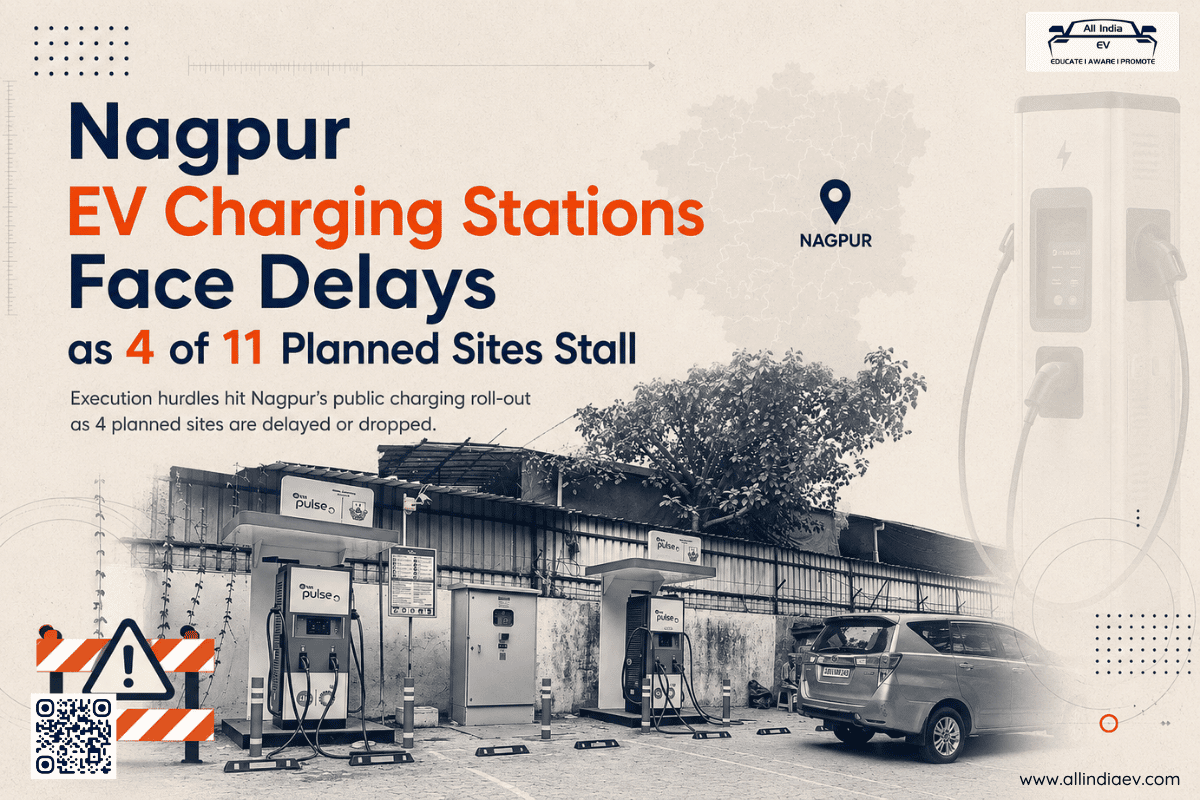
Nagpur’s public EV charging rollout has hit an execution problem, with 4 of the 11 planned charging station sites either delayed or dropped, exposing the gap between charging announcements and actual on-ground implementation.
The issue matters because Nagpur has often been projected as one of the cities moving toward stronger electric mobility adoption. But as this case shows, identifying land on paper is only the first step. Public charging infrastructure still depends on site viability, power connectivity, land-use approvals and operator readiness before a charger actually becomes usable.
According to the reported update, the Nagpur Municipal Corporation’s EV charging station plan has run into hurdles at four proposed locations, reducing the pace of rollout. That means nearly 36% of the originally planned sites are no longer progressing as expected.
What Happened in Nagpur?
Nagpur Municipal Corporation had planned EV charging stations at 11 locations. However, multiple sites reportedly faced issues related to practical execution.
In public charging projects, such delays generally emerge from a few recurring bottlenecks:
- site suitability problems
- electricity connection and transformer readiness
- limited space for vehicle access and parking
- vendor or concessionaire issues
- changes in land-use feasibility
- low expected utilisation at specific locations
In Nagpur’s case, the fact that 4 sites are no longer moving smoothly suggests that the city’s charging rollout is being filtered by real-world constraints rather than policy intent alone.
That is exactly why charger pipelines should always be tracked in stages:
announced → approved → tendered → under installation → operational
For the EV industry, “planned sites” and “live stations” are not the same thing.
Why This Story Matters Beyond Nagpur
At one level, this is a city-specific infrastructure delay.
At another level, it reflects a bigger national issue: India’s EV charging story is still heavily shaped by execution quality, not just ambition.
Many cities announce charging expansion targets, but actual deployment often slows down once the project reaches engineering and utility coordination stages.
This becomes especially important for urban public charging.
Unlike private home charging, a public charging station requires:
- reliable power supply
- accessible entry and exit movement
- parking discipline
- commercial viability
- hardware uptime
- and regular maintenance
If any one of these fails, the charger may exist physically but still fail functionally.
That is why the Nagpur development is worth tracking. It shows that public charging scale-up is still a project-management challenge as much as an infrastructure challenge.
The Bigger Question: How Many Sites Go Live?
For All India EV, the headline is not only that four sites have stalled.
The bigger question is:
How many of the original 11 stations will actually become operational, and by when?
That is the more useful KPI for readers, investors, charger companies and policymakers.
India’s public charging market does not need only more announcements. It needs higher conversion from planned locations to functioning assets.
Nagpur’s case is therefore a reminder that the EV charging industry should be assessed not by sanctioned points or identified land parcels, but by commissioned chargers with working uptime.
In that sense, this is not merely a Nagpur story. It is a small but important snapshot of the real state of urban EV charging execution in India.