


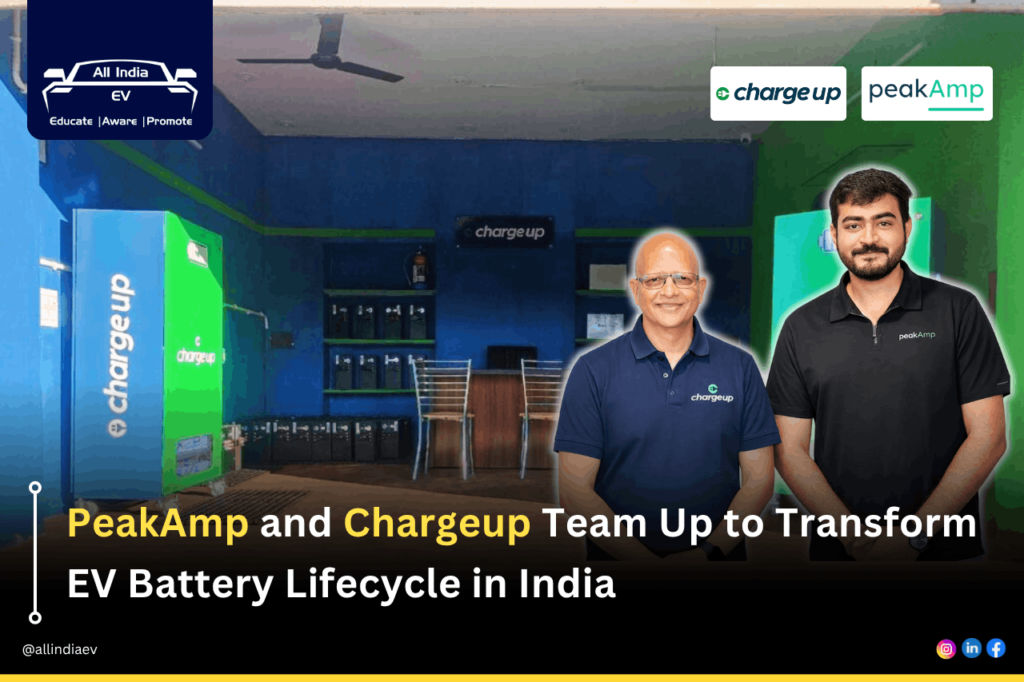
What: PeakAmp and Chargeup have partnered to build a more structured EV battery lifecycle management system in India, covering procurement, testing, grading, repurposing, and recycling.
The Number: A key part of the partnership is Chargeup’s battery passport system, which will enable real-time, tamper-proof tracking of battery health, usage history, and material composition.
The Impact: The tie-up is designed to improve traceability, reduce dependence on manual testing, and strengthen battery circularity as India’s EV market scales.

The Core News
PeakAmp, which focuses on end-of-life EV battery management, has partnered with Chargeup to strengthen battery circularity and lifecycle management in India’s growing electric mobility market. Under the partnership, PeakAmp will act as the technical partner for Chargeup, supporting the handling of battery packs emerging from Chargeup’s battery financing operations. This will include procurement, testing, grading, repurposing, and recycling.
According to the companies, the collaboration is meant to introduce a more structured end-to-end framework for EV battery lifecycle management, an area that is becoming more important as battery leasing and financing models expand in India. PeakAmp said the timing is relevant because leasing-led EV growth also increases the need for better visibility into how batteries are used, reused, and eventually recycled.
A central feature of the partnership is the integration of Chargeup’s battery passport system. The system is expected to track battery health, usage history, and material composition in real time through tamper-proof records, helping improve compliance, traceability, and decision-making on second-life use and recycling. Both companies said the initiative will combine digital intelligence with operational execution, while reducing reliance on manual testing.
Breaking Down the Update
- Partnership focus: PeakAmp and Chargeup are collaborating on EV battery lifecycle management in India.
- PeakAmp’s role: PeakAmp will serve as the technical partner.
- Operational scope: The work will cover procurement, testing, grading, repurposing, and recycling of battery packs.
- Source of batteries: These battery packs will come from Chargeup’s battery financing operations.
- Digital layer: Chargeup’s battery passport system will be integrated into the framework.
- What the passport tracks: It records battery health, usage history, and material composition in real time.
- Why it matters: The companies say it will improve traceability, compliance, and reuse/recycling decisions while reducing reliance on manual testing.
- Market context: The partnership comes as battery leasing models scale rapidly in India.
How this will help Indian EV Market
This partnership matters because India’s EV transition is not only a manufacturing story or a sales story. It is also becoming a battery governance story. As more EVs enter the market, more battery packs will eventually need to be tracked, evaluated, repurposed, and recycled in a structured way. Without that backend system, the market risks building EV scale without building lifecycle discipline. This is where the PeakAmp-Chargeup partnership becomes relevant.
More EV News

For the Indian EV market, the biggest value lies in traceability. A battery passport system that captures battery health, usage history, and material composition can help the ecosystem make better decisions about whether a pack should continue in mobility use, move into second-life applications, or go to recycling. That improves not just compliance, but also asset value recovery and financial visibility. In a market where battery leasing and financing are expanding, that kind of data layer can become very important.
This also helps India’s broader circular economy ambitions. Battery recycling and second-life use cannot scale efficiently if every battery has to be manually inspected without clean digital history. A more structured lifecycle framework can reduce uncertainty for financiers, operators, recyclers, and OEM-linked ecosystem players. In simple terms, this is the kind of quiet infrastructure that makes EV growth more sustainable. It may not be as visible as a vehicle launch, but it helps build the rules, records, and recovery systems that a mature EV market will eventually need.
Conclusion & Next Steps
The PeakAmp-Chargeup partnership highlights an important shift in India’s EV story: the market is beginning to pay more attention to what happens after battery deployment, not just before sale. The next thing to watch will be whether more battery financing, swapping, and fleet-led EV businesses adopt similar lifecycle tracking systems, because that is where battery circularity in India may start becoming operational rather than just conceptual.
Read More: Catch up on All India EV’s related coverage on India’s evolving commercial EV subsidies and battery swapping policies at All India EV