

How tax waivers and charger rollouts reshape buyer behavior but strain execution capacity
- The Revenue Trade-Off: Strategic Subsidy or Fiscal Gamble?
- Fleet Electrification Targets: Government First, But What About Commercial?
- Charging Infrastructure: Expansion Goals vs. Operational Viability
- Scrappage & Old Fleet Renewal: A Policy That Isn’t Talked About Enough
- The Local Industry Dimension: Policy without Manufacturing Anchors
- A Deeper Policy Paradox: Target vs. Trajectory
- Conclusion — What Senior Decision-Makers Should Pause On
The Revenue Trade-Off: Strategic Subsidy or Fiscal Gamble?
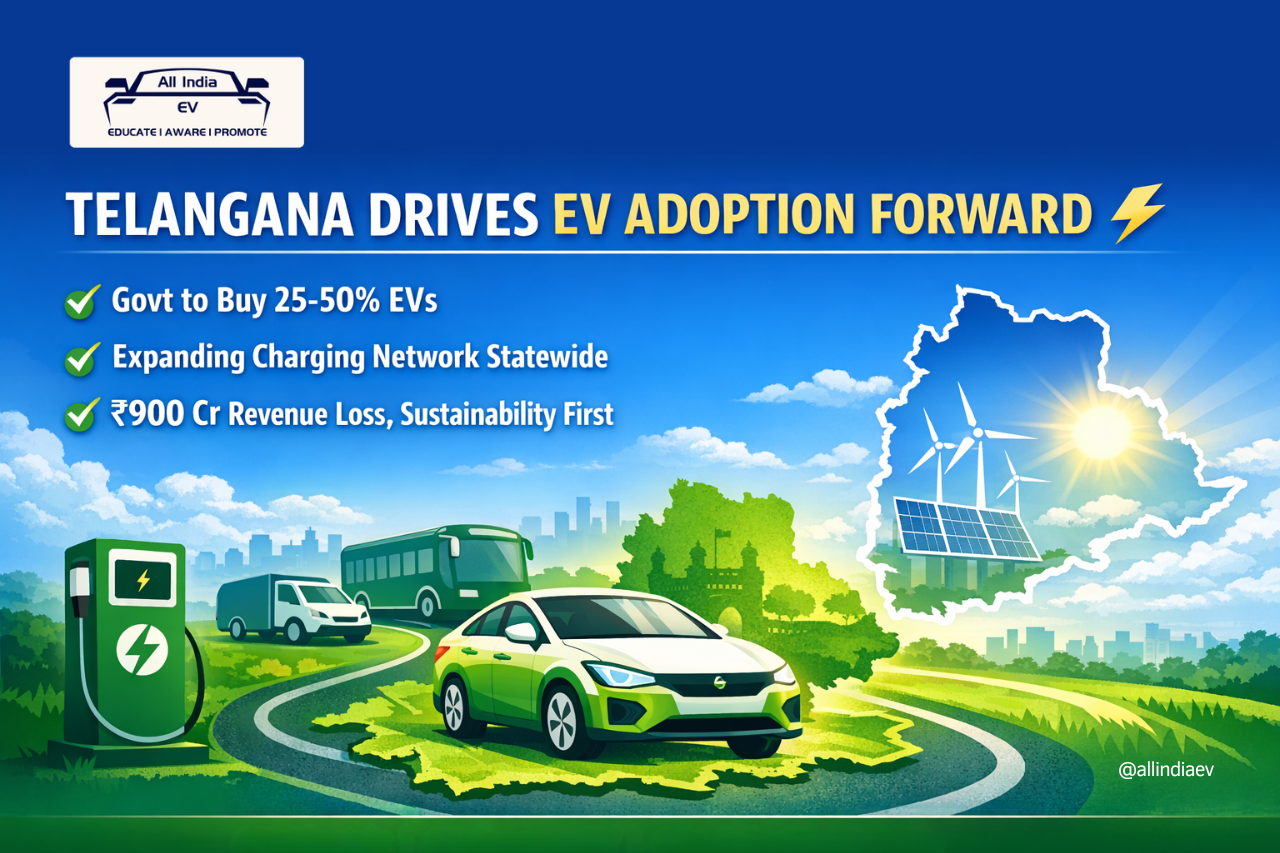
Telangana’s 100% waiver of road tax and registration — now projected to cost the exchequer ~₹900 crore — is being celebrated as a bold accelerator of EV adoption.
But why does this matter?
Tax exemptions are blunt instruments: they shift cost from buyers to the state, but they don’t inherently create demand where the use case is weak. Real adoption catalysts — such as reduced total cost of ownership (TCO), reliable charging access, and financing options — are far more nuanced.
The fiscal question:
- Is Telangana subsidising adoption or subsidising registration?
- Does the lost tax revenue translate into measurable increases in daily EV kilometres, fleet electrification, or operational cost savings for consumers?
Without strong telemetry on post-purchase utilisation, Telangana risks converting fiscal capacity into ownership vanity metrics rather than mobility transformation.
Second-order risk: Other states may imitate this model, entrenching a race to the bottom on tax incentives that underfund the more expensive — and essential — parts of ecosystem build-out like charging grids, grid upgrades, and workforce training.
Fleet Electrification Targets: Government First, But What About Commercial?
Telangana is moving to procure EVs for 25–50% of its own vehicle purchases, and is even contemplating mandates for IT, pharma, and educational institutions.
More EV News

This is important because fleet electrification — especially for controlled operators — does create predictable utilisation patterns that help amortise infrastructure and reduce operating costs.
But the execution gap looms:
- Do current charging plans match the anticipated energy draw of these fleets?
- Are charging stations optimised for duty cycles (fast turnaround at depots) instead of occasional public use?
- Is the grid ready for concentrated demand peaks in business parks and institutional campuses?
A superficial mandate without a load-balanced deployment enabled by grid architecture and load forecasting risks operational brittleness — where fleets sit idle for want of power, undermining confidence in electrification.
Charging Infrastructure: Expansion Goals vs. Operational Viability
The policy is expanding charging infrastructure across collectorates, communities, and tourist spots through REDCO.
Key questions seldom asked in public discourse:
- Who will run and maintain these chargers?
Public infrastructure is notoriously under-utilised when there’s no commercial incentive or service SLA for uptime. - Is there an interoperable roaming standard?
If EV drivers must download multiple apps or unlock different networks, utilisation — especially by non-local drivers — will stagnate. - What about the underlying energy source?
Charging infrastructure without a clear renewable energy menu and demand-side management plan risks shifting pollution from tailpipes to thermal power plants.
Charging planning shouldn’t be geographic tick-boxes — it must be integrated with power systems planning, distribution transformer capacity upgrades, and consumer payment systems.
Scrappage & Old Fleet Renewal: A Policy That Isn’t Talked About Enough
Telangana’s introduction of an EV-linked scrappage incentive is noteworthy — but the devil is in the definition.
- Are only legacy ICE vehicles targeted?
- Will commercial three-wheelers and last-mile delivery bikes be eligible?
- How will enforcement work in informal segments that dominate India’s mobility?
Unless scrappage incentives are meticulously calibrated with replacement cost subsidies, financing, and resale market support, the program may end up recycling old vehicles into junkyards without securing their replacement with functional EVs.
The Local Industry Dimension: Policy without Manufacturing Anchors
The Telangana EV & ESS policy — originally intended to catalyse a local EV manufacturing ecosystem — has struggled to draw large OEM commitments.
Despite occasional headline MoUs (e.g., smart city and EV taxi plans by foreign investors), there’s little evidence that a viable component manufacturing cluster has taken off. That matters because:
- Local component production drives down cost and reduces supply chain risk.
- It unlocks competitive export opportunities — essential if India’s EV ambitions are to transcend internal consumption.
Currently Telangana still lags in integrating manufacturing strategy with adoption incentives. This disconnect means vehicles come from outside the ecosystem and external shocks (e.g., battery price volatility) flow straight through to end users.
A Deeper Policy Paradox: Target vs. Trajectory
Telangana’s EV policy reads like a marketing roadmap — incentives, waivers, and targets — but not like an operations playbook. A few cases in point:
- Grid readiness and charging reliability: Absent a transparent capacity build-out plan, adoption may be constrained by ‘range anxiety’ driven less by distance and more by reliability lapses (equipment downtime, payment friction, etc.).
- Demand articulation: Current measures assume price sensitivity is the key barrier — but consumer behavior data increasingly shows service quality, resale value, and financing flexibility matter more at scale.
- Cross-sector integration: Transport electrification impacts freight logistics, power demand curves, urban planning, and waste management (used battery flows). Policies are still siloed, with tax incentives disconnected from these downstream systems.
Conclusion — What Senior Decision-Makers Should Pause On
Telangana’s EV policy has vision. It has political commitment. But it has yet to show a systems blueprint that connects:
- Fiscal incentives → operational demand creation
- Charging infrastructure → grid and market economics
- Fleet mandates → commercial viability
- Adoption goals → industrial ecosystem anchoring
Making Telangana a role model will require moving beyond tax giveaways and into the gritty architecture of execution: energy systems, data flows, financing ecosystems, and market design.The real question for leaders reading this is not whether subsidies work — but whether this policy architecture will survive execution stress without creating stranded assets, fiscal imbalance, or operational lock-ins that favour the few over the many.