


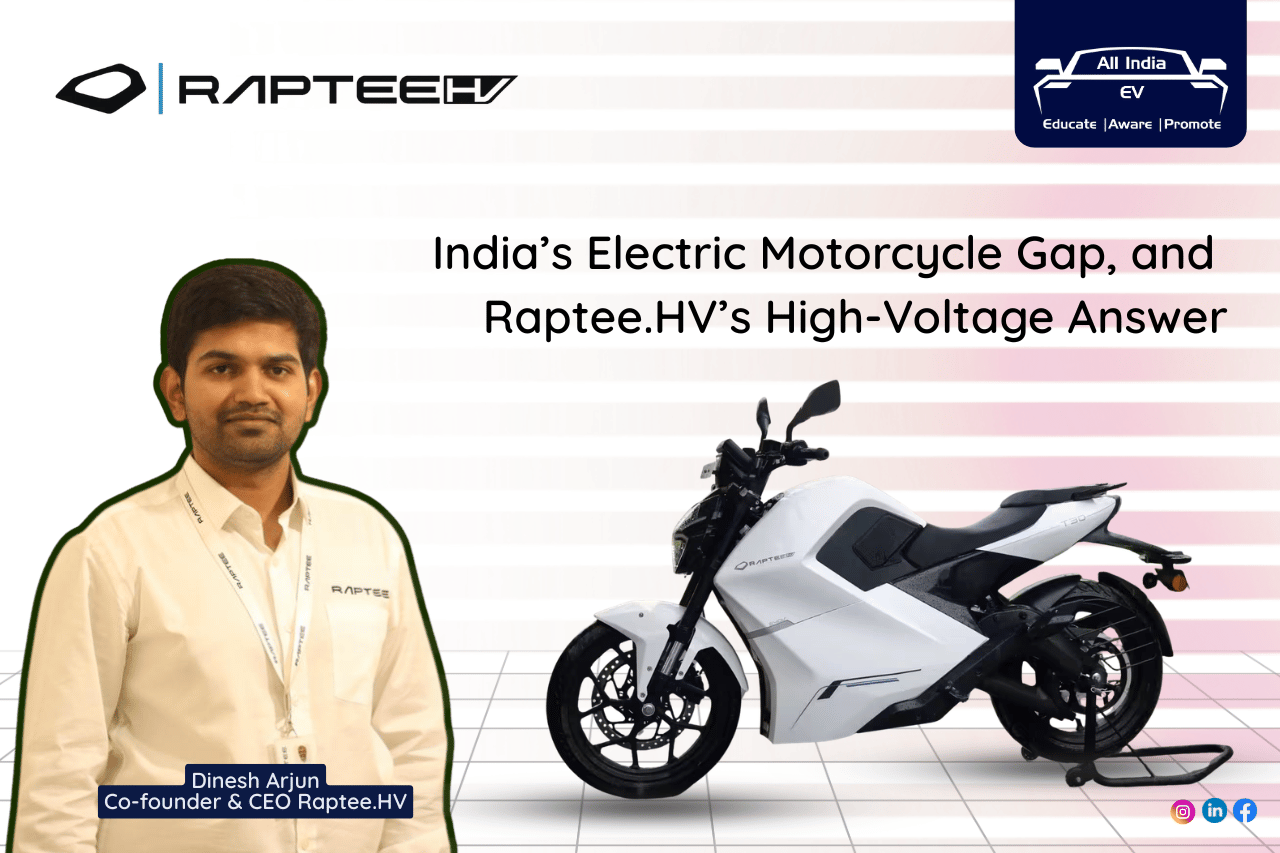
We reached out to the Chennai-based startup Raptee.HV to understand what “electric car DNA” in a motorcycle actually means and why they think the EV two-wheeler market has been solving the wrong problem.
India’s electric two-wheeler market has a confidence problem. Not in numbers, registrations have climbed, policy tailwinds are real, and the infrastructure conversation has matured.
The problem is more instinctive: for a generation of riders who grew up chasing the rev limiter on a 200cc bike, the EV pitch has never quite landed. Scooters are sensible. Scooters are practical. For many in the 20–35 bracket, they’re simply not the point.
Raptee.HV, a Chennai-based electric motorcycle startup, believes it has found the thread worth pulling. We reached out to the team with a set of detailed questions, on architecture, charging, long-distance viability, and the rider they’re actually building for.

What Does Raptee.HV “Electric Car DNA” Actually Mean?
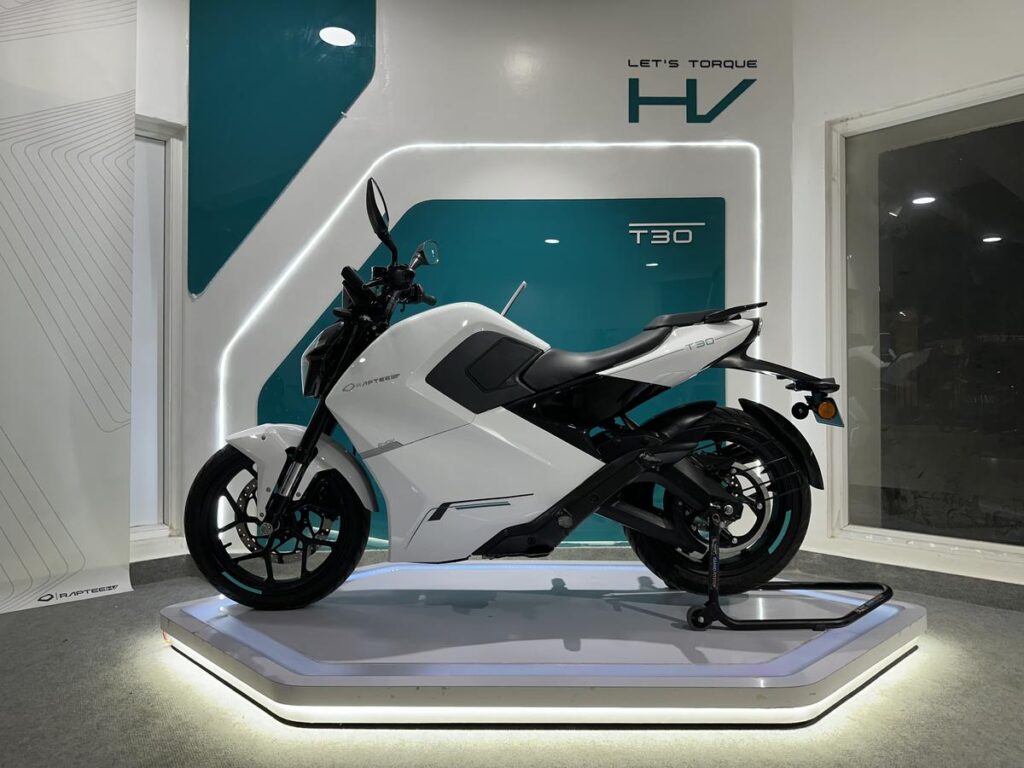
When Raptee.HV describes the T30 as carrying “electric car DNA,” it sounds like a marketing line. We pressed them on what it means technically.
The answer is rooted in voltage. Most electric two-wheelers in India today run on low-voltage platforms, a choice that keeps costs down but caps performance, charging speed, and battery longevity. Raptee went the other way. The T30 uses a high-voltage architecture of the kind that has powered electric cars but has largely skipped the two-wheeler segment entirely.
The physics is direct: keep voltage low and you need proportionally higher current to deliver the same power, more heat, more component stress, more energy wasted. Push voltage higher and you get better efficiency, faster charging, more consistent performance, and a longer-lived battery. It’s the foundational reason electric cars outperformed expectations while electric two-wheelers remained largely confined to city commuting. Raptee’s move is a deliberate attempt to close that gap.
Forty Thousand Stations, No Adapter
The most persistent friction in EV adoption isn’t range — it’s the charger you can’t use. Proprietary networks and brand-locked connectors have quietly undermined the EV value proposition for years.
More EV News
Raptee built the T30 around CCS2, the same connector used by electric cars at public DC fast chargers across India. The practical implication: T30 riders can access over 40,000 public charging points already in operation, with no adapters and no manufacturer-specific apps required.
On charging times, Raptee told us that 20–80% takes roughly 36 minutes under ideal fast-charging conditions, and around 30–35 minutes at a high-output charger. In the worst case, AC charging only, it stretches to about an hour for 80%. In either scenario, the time typically aligns with a natural rest stop, making it a feature of the journey rather than an interruption.
7,530 Kilometres in 19 Days
Arguments about architecture mean little without evidence. Raptee’s All-India ride, 7,530 km in 19 days, is worth examining closely.
The T30 was designed for urban use. The long-distance run was an experiment to find out what CCS2 compatibility actually unlocked on the open road. Around 90% of the journey used public DC fast chargers, with EV Joints and PlugShare used to plan stops. What the team found was that charging fit naturally into the rhythm of the ride, an 80% charge typically took about as long as a short break.
Most significantly, no noticeable battery degradation was observed across the entire journey. For a high-voltage system pushed through demanding real-world conditions across multiple climate zones, that’s the difference between a technology that works in a press release and one that works on a highway.
Defining the Gap
We asked Raptee to define, in plain terms, the gap they’re filling. Their answer: the biggest gap is the widespread belief that EVs mean slow charging and poor performance, and the fact that most electric two-wheelers have done little to challenge it.
India’s EV two-wheeler story is largely a scooter story. That’s not a criticism, the scooter segment serves a vast and legitimate market. But it has left an opening for the rider who bought a motorcycle because it made them feel something, and who remains unconvinced an EV will do the same.
Raptee’s argument is that the infrastructure barrier is already weaker than people think. Over 40,000 CCS2 stations exist across India today. The real gap is a vehicle category that hasn’t yet given performance-oriented riders a credible reason to switch. That’s what they’re building for.
The Bigger Picture
By building on CCS2 and a high-voltage platform, Raptee has tied its fate to the public charging ecosystem rather than trying to build a proprietary one. Every new DC fast charger installed for an electric car is, quietly, also a charger for the T30. As India’s network grows, that bet gets stronger.
For readers tracking where India’s electric two-wheeler market is heading, Raptee represents something that has been rare in this space: a manufacturer that started with the infrastructure reality, then built a motorcycle around it.
Whether the market rewards that approach remains to be seen. But 7,530 km on the odometer is a reasonable start.
What we asked Dinesh Arjun, founder & CEO of Raptee.HV?
What’s the biggest myth about EV motorcycles you want to kill?
The biggest myth is that EV motorcycles are slow and can’t match petrol bikes. Our 7,530 km All-India ride with the T30 showed that EV motorcycles can deliver strong performance while making long-distance travel practical with India’s growing charging network.
======
You’ve spoken about DC fast charging (20–80% in ~36 minutes). What’s the real-world version across different public chargers: best case, typical case, worst case?
The 20–80% charging time of about 36 minutes is based on ideal fast-charging conditions. In the best case, when plugged into a high-power DC fast charger delivering full output, the bike can charge in roughly 30–35 minutes. In a worst-case scenario, when only AC charging is available, it can take around an hour to reach 80%. Even then, the charging time generally aligns with a short break during the ride, making long-distance travel practical.
======
If a 28-year-old who loves an ICE 200–300cc bike test rides your motorcycle, what will they miss instantly, and what will they love instantly?
Riders might miss the traditional engine sound, but they’ll truly love the thrill and performance of T30. The T30 offers strong performance, seamless riding mode transitions, and a refined riding experience that feels engaging. At the same time, practical features such as charging station locators and connected technology make ownership more convenient. The result is a motorcycle that retains the excitement riders expect while adding the simplicity and intelligence that electric mobility can offer.
======
When your bike plugs into car chargers, how do you think about queues, compatibility, and rider experience so it doesn’t become a “theory feature”?
Charging on public car chargers only works if it is practical in everyday conditions, not just in theory. That’s why we designed the motorcycle to be fully compatible with the CCS2 standard used by most public DC fast chargers in India, allowing riders to simply plug in without any adapters or special infrastructure. During our long-distance ride, we also found that charger availability across cities and highways was better than expected. With apps like EV Joints and PlugShare to check charger status and plan stops in advance, charging naturally fits into a rider’s journey much like taking a short break making the experience convenient and predictable.
======
If you could change one thing in India’s EV policy or charging rollout to accelerate electric motorcycles, what would it be and why?
If I could change one thing, it would be to encourage the development of vehicles that are compatible with widely available public charging infrastructure and support faster charging. Policies should push both vehicle design and R&D towards open charging standards and technologies that enable quicker charging. This would make electric motorcycles far more practical for everyday use and long-distance travel, ultimately accelerating adoption across the country.
Catch up on All India EV’s related coverage on India’s evolving commercial EV subsidies and battery swapping policies at All India EV