


Korean Breakthrough Makes Lithium-Metal Batteries Safer for EVs with Solvent-Free Tech to Prevent Dendrites and Surface Damage
In a major advancement for electric vehicle (EV) battery technology, a South Korean research team has developed a revolutionary transfer printing method that applies protective layers onto lithium metal anodes—dramatically improving battery safety, efficiency, and scalability.
Led by Dr. Jungdon Suk at the Korea Research Institute of Chemical Technology (KRICT), the team’s innovation addresses one of the most critical limitations of lithium-metal batteries: dendrite formation. These needle-like structures cause short circuits, explosions, and reduced battery life, making commercial adoption a challenge despite lithium-metal’s tenfold capacity advantage over conventional lithium-ion batteries.
A Game-Changing Solvent-Free Coating Method
Traditionally, lithium-metal batteries have relied on wet-coating processes that use organic solvents, which risk damaging lithium surfaces and introducing contaminants. In contrast, KRICT’s new transfer printing process is entirely solvent-free, allowing uniform, damage-free protective coatings over large areas—ideal for industrial-scale production.
The researchers created two innovative protective films:
- A dual-layer of alumina (Al₂O₃) and gold (Au)
- A hybrid ceramic-polymer film made of Al-LLZO and solid polymer
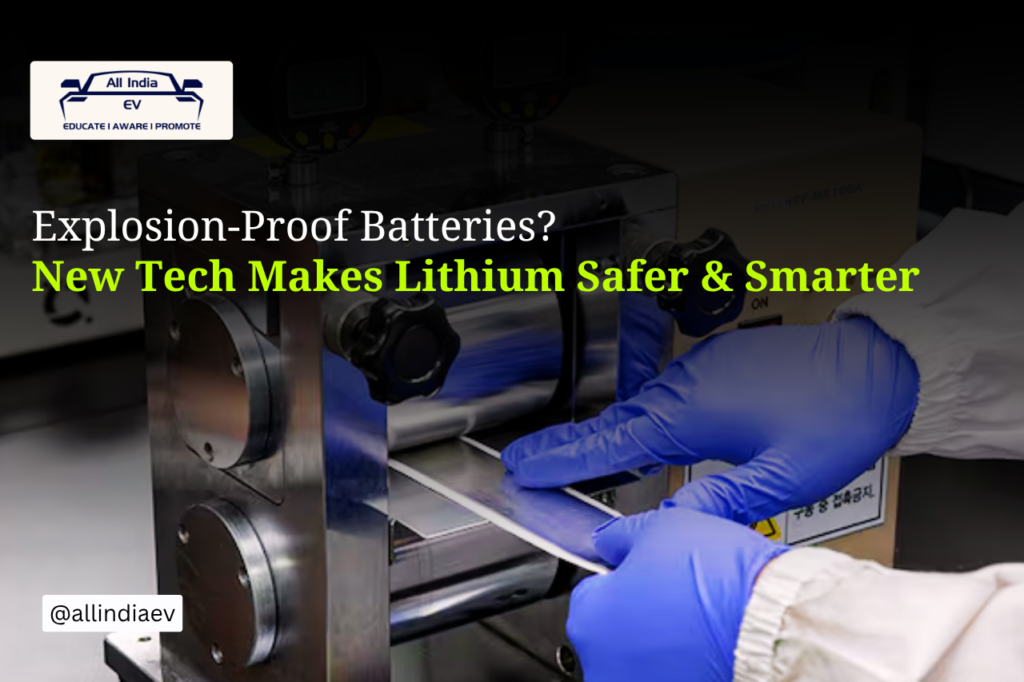
These films were laminated onto lithium metal using a roll-based transfer printing process, marking the first successful use of this method in lithium battery manufacturing. The protective layers are first formed on a separate substrate and then transferred under pressure, ensuring precise application and reduced lithium degradation.
Enhanced Safety and Performance in Testing
In performance trials, the hybrid-protected lithium anodes demonstrated exceptional results:
More EV News

- 81.5% capacity retention after 100 cycles
- High Coulombic efficiency of 99.1%
- Low overpotential of 55.34 mV
- 74.1% capacity retention under high-rate discharge (within 9 minutes)
These metrics more than doubled the stability compared to unprotected lithium cells and showed strong potential for high-performance applications like EVs and energy storage systems (ESS).
Scalability and Commercial Promise
One of the most remarkable outcomes of the study was the successful transfer of hybrid protective films over a 245 × 50 mm area with a thickness of just 5 μm—proving the process is scalable for commercial production. The method improves cycling performance, suppresses dendrites, and enhances the uniform flow of lithium ions at the electrode-electrolyte interface.
A Step Forward for Next-Gen EV Batteries
Dr. Suk emphasized that the process tackles the dual issues of interface instability and manufacturing limitations that have long hampered lithium-metal battery development. KRICT President Dr. Young-Kuk Lee added that the technology could significantly boost Korea’s position in the global battery race.
Published in the high-impact journal Energy Storage Materials (IF: 20.2), the findings are expected to influence not only lithium-metal battery R&D but also the development of solid-state and lithium-sulfur batteries, two major frontiers in EV energy storage.
What This Means for India’s EV Future
With Indian automakers increasingly exploring next-gen battery platforms to power future electric vehicles, advancements like this could play a vital role in ensuring safer, faster-charging, and higher-capacity batteries. As India accelerates its EV transition, global innovations like KRICT’s transfer printing technology may soon find relevance in domestic production lines, driving the country closer to its clean mobility goals.