


India’s agricultural sector is the beating heart of its economy, employing over half of its workforce and serving as the primary source of livelihood for millions.
For decades, the mechanization of Indian farms has been synonymous with the rhythmic, thumping roar of the diesel tractor. It was the machine that ushered in the Green Revolution, multiplying yields and transforming barren lands into breadbaskets.
However, as the world stands on the precipice of a climate crisis and volatile energy markets, the very machinery that built modern Indian agriculture is now threatening its sustainability.
Today, India is at an inflection point. The transition to electric mobility has largely been defined by two-wheelers weaving through urban traffic and electric buses silently cruising city streets.
But the next, and arguably most consequential, frontier for India’s EV revolution lies beyond the city limits. It lies in the soil.
The electrification of heavy agricultural machinery is not just a technological upgrade; it is an economic and environmental imperative. Here is why the era of the electric tractor has arrived, the policy tailwinds driving it, and how indigenous deep-tech innovators like Bullwork Mobility are leading the charge.
Market Size, Fuel Economics, and the True Cost of Diesel
To understand the sheer scale of the opportunity, one must first look at the massive footprint of the Indian tractor industry.
More EV News

India is the largest tractor market in the world.
In FY 2025-26, the Indian market witnessed sales of more than a million units, and it is projected to grow at a Compound Annual Growth Rate (CAGR) of 6.37% through 2033.
While this represents a triumph of farm mechanization, it also represents an escalating dependency on imported fossil fuels.
The Economic Drain of Diesel
A typical 40 HP tractor consumes ~4 litres of diesel per hour. At ~1,000 operating hours a year, that means ~4,000 litres annually, translating into nearly INR 4 lakh per year in diesel costs alone.
At scale, this becomes a major burden: diesel tractors are estimated to account for ~7.4% of India’s annual diesel consumption and ~60% of total agricultural fuel use.
For a country that imports over 80% of its crude oil, this creates both a national import burden and direct financial pressure on farmers, whose margins are already thin.
The Environmental Toll
Diesel-based farm mechanization also carries a heavy environmental cost, emitting CO2, CO, hydrocarbons, NOx, and particulate matter.
Studies suggest that without a technology shift, PM2.5 and NOx emissions from agricultural machinery could rise by ~4 to 5 times over the next two decades.
Tighter TREM norms may reduce emissions, but they also raise tractor costs through expensive exhaust-treatment systems. In the long run, the real solution is not cleaner diesel, but eliminating the diesel engine itself.
The Policy Push: Catalyzing the Electric Tractor Revolution
Recognizing the dual threats of fuel dependency and environmental degradation, the Indian policy landscape is undergoing a massive paradigm shift. Between 2020 and 2025, India’s EV sector attracted over USD 25.6 billion in investments, supported by forward-looking central and state policies. Now, this policy machinery is pivoting to encompass agricultural and heavy mobility.
The cornerstone of agricultural equipment policy in India is the Sub-Mission on Agricultural Mechanization (SMAM). Initiated by the Ministry of Agriculture and Farmers Welfare, SMAM aims to make modern farming tools accessible to all. Under this scheme, farmers can avail subsidies ranging from 40% to 50% on the purchase of agricultural machinery.
For Custom Hiring Centers (CHCs) and Farm Machinery Banks, this subsidy can go up to an incredible 80% to 100%.
As electric tractors enter the market, SMAM is becoming a critical vehicle for their adoption. By subsidizing the initial purchase cost—which is the primary barrier to EV adoption—SMAM effectively levels the playing field, allowing farmers to bypass the “green premium” and immediately start reaping the benefits of radically lower operational costs.
However the system has been slow to push the EV tractors, they do not have the same speed as it was done with FAME I and II for the Passenger and Commercial Vehicles.
Recently they have taken the first step towards this by releasing the testing codes IS 19262: 2025 ‘Electric Agricultural Tractors — Test Code’ on Dec 25th of 2025.
This becomes a blueprint by which EV tractors can be tested at Budni and thus they will be eligible for Subsidies under SMAM.
Central and State-Level EV Mandates Furthermore, the broader EV ecosystem is lending its weight. With the evolution of national subsidy frameworks like PM e-DRIVE and FAME-III, there is a concerted effort to include heavy-duty and off-highway commercial vehicles in the electrification mandate.
At the state level, EV policies are aggressively paving the way. States like Madhya Pradesh and Jharkhand have recently rolled out updated EV policies that offer 100% exemptions on road tax and vehicle registration fees for early EV adopters.
Some states are also providing interest-free or heavily subsidized loans for EV purchases, effectively dismantling the high-interest rates (often 15–33% for commercial vehicles) that previously offset the total cost of ownership advantages of EVs.
By transitioning to electric tractors, villages have the potential to integrate with decentralized solar microgrids, turning rural India from a passive consumer of imported diesel into a self-sufficient, low-carbon energy ecosystem.
The Policy Battlefield: TREM V, Subsidies, and the 6-Year Delay
Recognizing the environmental cost of diesel farm machinery, the Ministry of Road Transport and Highways issued draft rules on February 27, 2026 to tighten tractor emission standards under TREM Stage-V. From October 1, 2026, these norms are proposed to apply to higher-power tractor categories, with stricter limits on CO, HC, NOx, and particulate matter, tested through NRSC and NRTC cycles.
However, legacy diesel tractor makers are pushing to delay TREM V by another 6 years. The reason is simple: compliance requires costly systems such as SCR and DPF, which would make diesel tractors more expensive. This keeps cheaper but more polluting machines in the market, while the true environmental cost remains invisible to farmers.
The problem is deeper because subsidies for electric tractors are still moving slowly. So while stricter diesel norms are being resisted, EV support for agriculture is also lagging. In effect, both the regulatory push and the financial incentive are delayed, keeping farmers tied to high diesel costs and outdated technology.
Bullwork Mobility: Engineering the Zero-Emission Fields of Tomorrow
While policies create the framework, it is up to deep-tech innovators to deliver the hardware. This brings us to the vanguard of India’s heavy EV revolution: Bullwork Mobility.
Based out of Bengaluru, Bullwork Mobility is a pioneering Indian deep-tech OEM that is completely rewriting the legacy of heavy machinery.
While many early attempts at electric tractors involved simply retrofitting an electric motor onto a decades-old diesel chassis, Bullwork recognized that true innovation requires a blank slate. They engineer their machines entirely from the ground up.
The Beast 9696E: Uncompromised Power
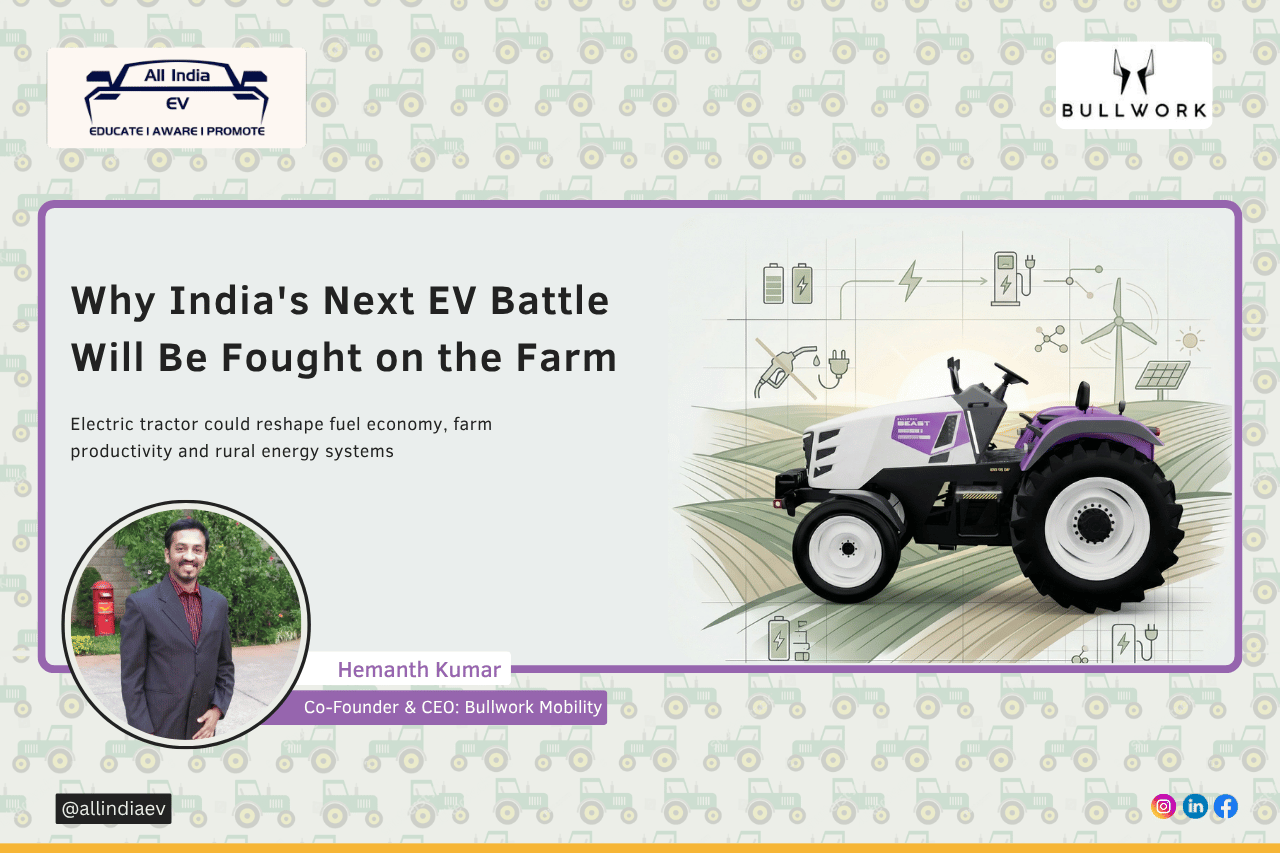
At the forefront of Bullwork’s portfolio is their flagship electric tractor: The Beast 9696E. Designed to go head-to-head with traditional diesel tractors, the Beast is engineered to dominate the fields without burning a single drop of diesel.
Traditional diesel engines are slow-revving; they require time to build power and are notoriously inefficient at varied loads.
The Beast, powered by high-torque electric motors, provides 100% of its massive torque instantly. Whether it is deep-soil tilling, hauling heavy loads, or operating power take-off (PTO) implements, the power delivery is smooth, silent, and brutal.
Equipped with a massive 96 kWh battery architecture and capable of 2-hour fast charging, the Beast ensures that “range anxiety” has no place on the farm.
The Brains Behind the Brawn: The Bh.ai Platform
What truly separates Bullwork Mobility from legacy manufacturers is the intelligence embedded in their machines.
At the core of their lineup is the proprietary Bh.ai platform—an advanced, in-house electrical architecture featuring smart drive-by-wire technology, IoT connectivity, and precision control. Bullwork’s machines are autonomous-ready.
This means that as Indian agriculture scales, these machines can be programmed for precision farming, operating with pinpoint accuracy to maximize crop yields while minimizing human labor in hazardous conditions.
Every single Beast tractor deployed in the field is capable of offsetting up to 10,000 kg of CO₂ emissions annually. It removes localized PM2.5 and NOx pollution, ensuring that the soil remains untainted by oil spills and the air remains breathable for the farmers walking behind the plow.
Read More: Catch up on All India EV’s related coverage on India’s evolving commercial EV subsidies and battery swapping policies at All India EV