


India’s EV charging ecosystem is being built by a diverse generation of professionals, engineers, strategists, operators, who understand that infrastructure is the true backbone of adoption.
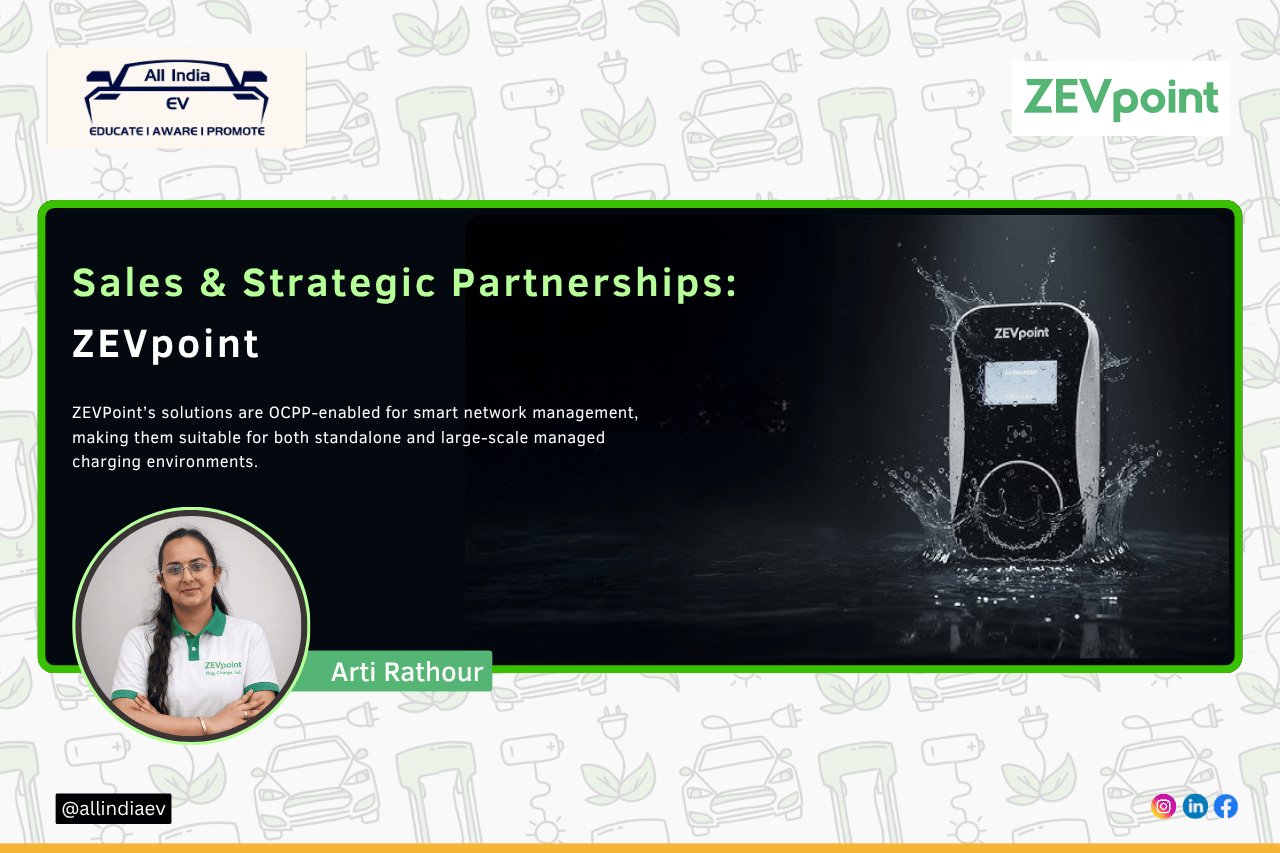
Among them is a name making quiet but consequential moves: a sales and marketing leader at ZEVPoint, the Gurugran-headquartered EV charging solutions company whose product portfolio spans portable AC chargers to 240 kW DC fast chargers.
In this ShEV conversation, she traces her path from an EV retrofitting internship to consulting the country’s largest corporates on charging infrastructure, and tells us why confidence, curiosity, and the right environment are the three ingredients every woman entering this industry needs.
About ZEVPoint
ZEVPoint is an Indian EV charging hardware and solutions company offering a comprehensive portfolio, from portable AC chargers (Aveo series, 3.6–11 kW) and wall-mount AC chargers (Polar and Duos series, 7.5–22 kW) to DC fast chargers (Navigator 30, Nova 60/120/240 kW).
The company serves corporates, fleet operators, residential societies, and hospitality clients, providing end-to-end charging infrastructure deployment and consulting. ZEVPoint’s solutions are OCPP-enabled for smart network management, making them suitable for both standalone and large-scale managed charging environments.
Tell us about your journey into the EV space: What motivated you to enter this sector, and what moment or experience made you realize this was your path?
My journey into the EV space began with a deep interest in sustainable mobility. I started with an internship focused on retrofitting ICE two-wheelers into electric vehicles, which gave me hands-on exposure to the practical side of electrification.
More EV News
That experience was a turning point—it helped me see both the potential and the urgent need for EV adoption.
Realizing the environmental impact of traditional transportation, along with the growing gap in charging infrastructure, made it clear that I wanted to contribute to building a cleaner, more accessible mobility ecosystem.
What’s your current role and key responsibilities?
Currently, I lead sales and marketing for EV charging solutions at ZevPoint, where I work closely with corporates, residential societies, and infrastructure partners to expand EV charging networks.
My role also involves consulting clients on how to setup charging infrastructure tailored to different scenarios queries, ensuring they receive the right solutions for their requirements.
What makes this role dynamic is the balance between strategy and execution. While I focus on identifying growth opportunities, partnerships, and market positioning, I also stay actively involved on the ground operations, ensuring seamless experience. This hands-on approach keeps me closely connected to real-world challenges and helps translate strategy into impactful execution.
Which EV technologies or trends excite you the most right now?
Charging infrastructure related developments excites me the most, especially the shift toward faster-charging experiences both at home and outside.
I try to follow industry Developements like the recent case of flash charging being introduced, allowing charging in 9-10 minutes. The infra and the technology that went behind this speed is something i get curious about. And such solutions at. scale,along with accessibility and reliability of charging will define the overall user experience.
My recent interest is in energy self sufficiency at home and for vehicle needs as well. There’s also growing potential in powering chargers with solar energy, making the ecosystem more sustainable. Looking ahead, technologies like Vehicle-to-Grid (V2G) and renewable energy integration will play a key role in building a more efficient and future-ready EV ecosystem.
What are the biggest challenges you’ve faced as a woman in the EV industry, and how did you navigate them?
The EV and infrastructure space is still largely male-dominated, especially in on-ground roles. At times, I’ve faced situations where customers were hesitant to trust my technical knowledge or decisions initially.
I navigated this by focusing on clear communication, confidence, and consistently delivering results. Over time, trust builds through actions.
I believe persistence and self-belief are key—once you prove your capability, people begin to see you for your work, not your gender.
Also most important is, to choose your environment where you can get the support, people who help you out, learn more, make mistakes and allow you to even participate in more areas than just your role. that is what i like about zevpoint also more than anything else.
Trust is built through actions. Once you demonstrate your capability, people begin to see you for your work, not your gender.
Could you share a project, initiative, or milestone you’re especially proud of?
One of the most fulfilling parts of my journey has been contributing to EV adoption not just through individual installations, but by enabling entire ecosystems to transition toward electric mobility.
Over the past year, I’ve had the opportunity to work on a series of diverse and large-scale deployments that reflect how rapidly the EV landscape is evolving in India.
From deploying a 60 kW DC fast charger for Bank of Baroda, supporting high-speed, public-facing infrastructure, to working closely with Amazon on installing 100+ EV charging units for their last-mile delivery fleet, each project has come with its own unique challenges and learnings.
In the corporate space, collaborating with organizations like Amazon and NVIDIA, Bank of Baroda has been equally rewarding. These projects involved large scale installations, helping create EV-ready campuses for employees and fleet operations. It’s exciting to see how forward-thinking companies are actively investing in sustainable infrastructure.
At the same time, some of the most impactful work has been closer to communities—partnering with RWA societies to make residential spaces EV-ready and working with hospitality brands like Fortune ITC, wyndham, Westin etc. to integrate charging solutions into their guest experience.
These initiatives play a crucial role in normalizing EV adoption in everyday life.
But I still enjoy, conversing with people who have bought EVs, learning about their driving experiences. And being obsessed with charger performance, i keep asking for feedbacks on what they liked, what they hate etc. that helps me think what can be done in order to improve their overall experience with EVs.
What stands out across all these projects is not just the scale, but the shift in mindset. We’re moving from standalone installations to building a connected, accessible charging network. Being part of that transition, where infrastructure directly enables behavior change, is something I take immense pride in.
Where do you see the Indian EV landscape heading in the next ~3–5 years?
India’s EV landscape is already growing at a rapid pace so we can actually. We have already seen a strong EV adoption in two wheelers and three wheelers, probably we will see a bit of consolidation and hopefully optimization of charging ports so that there can be a universal charger for two wheelers, like electric cars have.
And now in electric cars,with almost all Indian OEMs now joining the race including Maruti Suzuki we are already seeing a boom in adoption here as well.
I’m particularly optimistic about growth in overall ev charging infrastructure across different channels like RWAs, corporates, hotels along with the highway corridors.
We have already seen some examples of integration between renewable energy and EV charging, making the ecosystem more sustainable. The shift is already happening—it’s just going to scale much faster from here.
We are moving from standalone installations to building a connected, accessible charging network. Infrastructure directly enables behaviour change.
What advice would you give to young women looking to build careers in clean mobility and EV technology?
My advice would be to step in with confidence and curiosity. The good thing about EV industry is everyone is learning right now, we are probably just 8-9 year old industry so there is immense room for everyone to try out different things, make mistakes, take on different roles as well.
So Ask questions, Focus on building your technical knowledge.
Most importantly, don’t let stereotypes limit you from taking on technical roles as well—your work and expertise will define your place in the industry.
Outside of work, what sparks your creativity or keeps you energized?
Outside of work, I enjoy travelling, trying out various activities for a little bit of thrill. I love to follow movies so i spend my time unwinding with them.
Read More: Catch up on All India EV’s related coverage on India’s evolving commercial EV subsidies and battery swapping policies at All India EV