
All India EVAll India EVAll India EV
Notification
Font ResizerAa
  • Home
  • EV News
  • EV Launch
  • Market Insights
  • Investments & Funding
  • Guest Articles
  • EV Engineering
  • Contact
Reading: 5 mutual funds charging up on EV stocks in 2025
Share
All India EVAll India EV
Font ResizerAa
  • Home
  • EV News
  • EV Launch
  • Market Insights
  • Guest Articles
  • EV Engineering
  • Contact
Search
  • Home
    • Home 1
    • Home 2
    • Home 3
    • Home 4
    • Home 5
  • Home
  • Categories
    • Electric
  • Categories
  • Shows
    • Rap
  • More Foxiz
    • Blog Index
    • Contact
  • Bookmarks
    • Customize Interests
    • My Bookmarks
  • More Foxiz
    • Blog Index
    • Sitemap
Have an existing account? Sign In
Follow US
Home » Blog » 5 mutual funds charging up on EV stocks in 2025
Market Insights

5 mutual funds charging up on EV stocks in 2025

Ankit Sharma
By
Ankit Sharma
ByAnkit Sharma
Follow:
Last updated: 3 March 2025
Share
8 Min Read
SHARE
5 mutual funds charging up on EV stocks in 2025

5 mutual funds charging up on EV stocks in 2025

India’s electric vehicle (EV) sector is experiencing rapid growth, and mutual funds are increasingly backing this trend by investing in EV stocks in 2025. Let’s explores five key mutual funds that are leading the charge in 2025, highlighting their strategies and the EV companies they support.

Contents
  • 5 mutual funds charging up on EV stocks in 2025
  • 5 mutual funds charging up on EV stocks in 2025
    • ▶️ Bandhan Transportation and Logistics Fund: A Sector-Focused Investment Opportunity
    • ▶️ Aditya Birla SL Transportation and Logistics Fund: A Strategic Investment in Mobility
    • ▶️ HDFC Defence Fund: A Sectoral Bet with EV Exposure
    • ▶️ HDFC Transportation and Logistics Fund
    • ▶️ UTI Transportation & Logistics Fund: A Sector-Focused Investment Opportunity

This information can help readers understand market trends and the future of sustainable transportation in India.

5 mutual funds charging up on EV stocks in 2025

▶️ Bandhan Transportation and Logistics Fund: A Sector-Focused Investment Opportunity
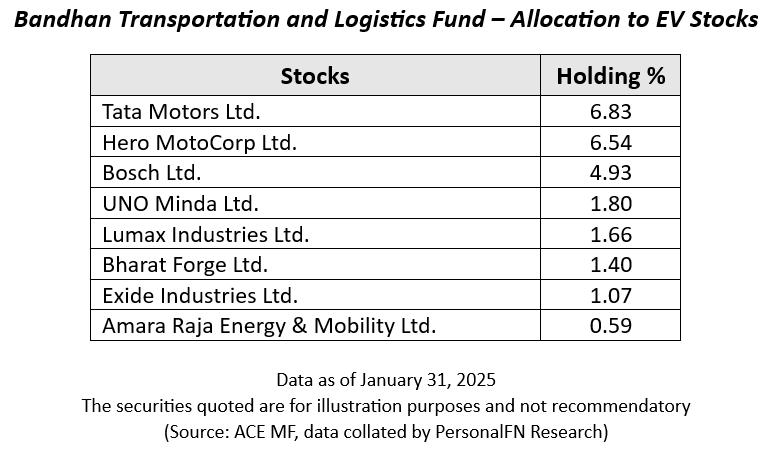
Introduced in October 2022, the Bandhan Transportation and Logistics Fund is dedicated to investing in companies operating within India’s dynamic transportation and logistics sector. The fund adopts a multi-cap approach, strategically distributing its investments across different market capitalizations. As of January 2025, its portfolio consists of 59.89% in large-cap stocks, 9.13% in mid-cap stocks, and 23.33% in small-cap stocks.

A key holding in the fund is Tata Motors Ltd., representing 6.83% of the portfolio. With a market presence valued at USD 37 billion, Tata Motors is a global leader in automobile manufacturing, offering a diverse range of vehicles, including passenger cars, SUVs, commercial trucks, buses, pickups, and defense vehicles.

The fund also maintains significant exposure to India’s evolving electric vehicle (EV) sector, investing in top EV-related companies such as Hero MotoCorp Ltd., Bosch Ltd., Bharat Forge Ltd., and Exide Industries Ltd.. As of now, EV-focused stocks constitute 24.81% of the fund’s total assets, reflecting its commitment to capitalizing on the future of sustainable mobility.

With its sector-specific focus and diversified allocation strategy, Bandhan Transportation and Logistics Fund presents an opportunity for investors seeking exposure to India’s growing transportation and logistics landscape.


▶️ Aditya Birla SL Transportation and Logistics Fund: A Strategic Investment in Mobility
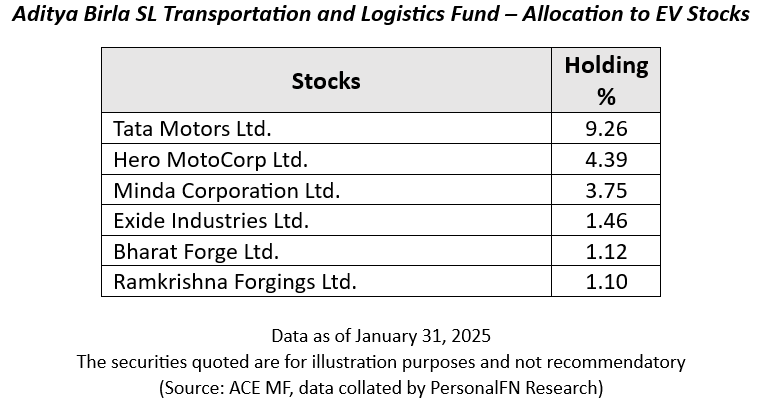
Introduced in November 2023, the Aditya Birla SL Transportation and Logistics Fund focuses on investing in companies aligned with the transportation and logistics sector. The fund’s portfolio is diversified, with 66.37% allocation to large-cap stocks, 9.95% to mid-cap stocks, and 20.95% to small-cap stocks.

More EV News

Electric Scooter sales hit best in first 7 months of FY2024
How BluSmart is working for Sustainable Mobility in UAE
Hindustan Zinc and JNCASR Partner on Zinc-Based Battery Tech
India’s EV Revolution: Surging Growth, Government Initiatives, and Industry Expectations for 2024-25 Budget
Greaves Electric Mobility Is Quietly Winning India’s EV Game, And Most People Haven’t Noticed

A key highlight of the fund is its 21.08% allocation to electric vehicle (EV) stocks, with Tata Motors Ltd. holding the highest share at 11.75%. By strategically investing in companies across automotive, logistics, and allied industries, the fund aims to capitalize on the growing electrification trend within the mobility sector.

With a current Assets Under Management (AUM) of ₹1,430.20 crore, the scheme provides investors with exposure to both traditional and emerging players in the EV and transportation ecosystem, positioning itself as a potential avenue for long-term growth.


▶️ HDFC Defence Fund: A Sectoral Bet with EV Exposure
Launched in June 2023, the HDFC Defence Fund is designed to build a portfolio predominantly comprising equity and equity-related securities of companies operating in the defence and allied sectors. Given its recent entry into the market, the fund lacks an extensive performance history, making it essential for investors to assess their risk tolerance and investment suitability before committing.

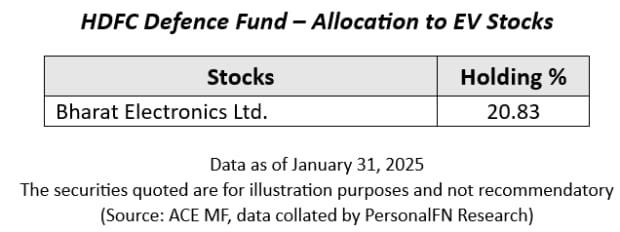
While the fund primarily focuses on the defence sector, it also maintains a notable allocation to electric vehicle (EV) stocks. As of now, approximately 20.83% of the fund’s exposure is in Bharat Electronics Ltd. (BEL)—a key player in India’s defence and electronics industry that is actively expanding into the EV ecosystem.

BEL is developing cutting-edge battery management systems, charging infrastructure, and power electronics components vital for electric vehicles. With India’s accelerating shift towards EV adoption, BEL’s expertise in energy storage and power solutions positions it as a strong contender in the indigenous EV technology space.

As of January 2025, the fund’s asset allocation includes 47.74% in large-cap stocks, 9.79% in mid-cap stocks, and 39.60% in small-cap stocks. Investors should note the fund’s significant exposure to small-cap stocks, which tend to be more volatile. Given this, potential investors should carefully evaluate their risk appetite before investing in the scheme.


▶️ HDFC Transportation and Logistics Fund

The HDFC Pru Transportation and Logistics Fund is a thematic mutual fund that focuses on investing in a select portfolio of equity and equity-related instruments within the transportation and logistics sector.

As of January 2025, the fund manages an AUM of ₹1,278.31 crore. Its current allocation includes 52.72% in large-cap stocks, 15.03% in mid-cap stocks, and 23.57% in small-cap stocks.

The fund has a notable 16.52% allocation to electric vehicle (EV) stocks, with the highest exposure—5.40%—to Bosch Ltd.. Bosch is actively working with original equipment manufacturers (OEMs) to supply key components for electric two-wheelers, passenger vehicles, and commercial EVs. Its emphasis on localization and R&D in India aligns with the country’s shift towards sustainable mobility.

Additionally, the scheme holds investments in industry leaders such as OLA Electric Mobility Ltd., Gabriel India Ltd., and Endurance Technologies Ltd.. Since its launch in October 2022, the fund lacks a long-term performance history. Investors should evaluate their risk appetite and investment goals before committing to this scheme.


▶️ UTI Transportation & Logistics Fund: A Sector-Focused Investment Opportunity
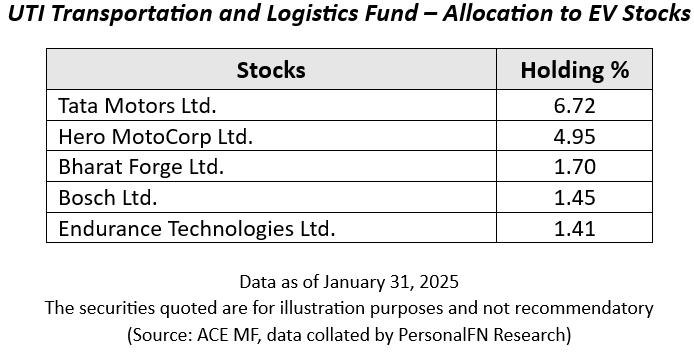
The UTI Transportation & Logistics Fund is a sectoral mutual fund that primarily invests in companies operating in the transportation and logistics industry. Launched in April 2004, the fund has grown steadily and currently manages assets worth ₹3,333.95 crore (as of January 2025).

This scheme follows a multi-cap investment approach, strategically distributing its portfolio across market capitalizations:

  • Large-cap allocation: 73.79%
  • Mid-cap allocation: 9.20%
  • Small-cap allocation: 12.19%

A notable feature of the fund is its significant exposure to electric vehicle (EV) stocks, reinforcing its commitment to future-ready transportation trends. Key holdings in the EV sector include:

  • Tata Motors Ltd. – 6.72%
  • Hero MotoCorp Ltd. – 5%

Overall, 16.23% of the fund’s assets are invested in EV-related stocks, reflecting its focus on emerging opportunities in sustainable mobility.

With its strong market presence and a forward-looking approach, the UTI Transportation & Logistics Fund offers investors exposure to a rapidly evolving sector that is set to play a crucial role in the future of mobility and logistics.


Join All India EV Community

Click here for more such EV Updates

Tata Motors and the Future of Electric Vehicles: Embracing the ACTI.eV Platform
Top EV Battery Manufacturers: Market Share Analysis 2024
What is V2G technology and why it is important?
Ola Electric Dominates EV Industry with 205 Patents in 2022-23
Karnataka EV Ecosystem: Powering the Future

Sign Up For Daily Newsletter

Be keep up! Get the latest breaking news delivered straight to your inbox.
Loading
By signing up, you agree to our Terms of Use and acknowledge the data practices in our Privacy Policy. You may unsubscribe at any time.
Share This Article
Facebook Whatsapp Whatsapp LinkedIn Copy Link Print
Leave a Comment

Leave a Reply Cancel reply

Your email address will not be published. Required fields are marked *

Follow US
XFollow
InstagramFollow
YoutubeSubscribe
LinkedInFollow
What: India’s finance ministry has directed public sector banks, insurers, and financial institutions to reduce operational spending and accelerate adoption of electric vehicles across official fleets. The move is part of a wider austerity push linked to rising global economic uncertainty and fuel-related risks. The Number: The directive impacts major public institutions including State Bank of India, Bank of Baroda, and Life Insurance Corporation of India, covering millions of employees and thousands of operational vehicles nationwide. The Impact: The policy signals a new phase of institutional fleet electrification in India, where EV adoption is now being tied directly to fiscal discipline, fuel import management, and public-sector operational efficiency. The Core News India’s finance ministry has formally instructed state-run financial institutions to implement strict expenditure controls while simultaneously accelerating EV adoption for official transport operations. The directive from the Department of Financial Services asks organisations to replace petrol and diesel vehicles used at head offices and branch operations with electric vehicles “as far as possible.” The order comes amid growing concern over the economic impact of prolonged geopolitical instability in West Asia, which threatens to increase crude oil prices, widen India’s import bill, and pressure the rupee. Alongside the EV transition mandate, the government has also pushed virtual meetings, reduced foreign travel, and tighter administrative spending controls across public-sector institutions. For India’s EV ecosystem, the directive is strategically important because it expands demand visibility beyond state transport undertakings and government departments into the financial sector itself. PSU banks and insurers operate one of the country’s largest distributed office networks, including regional offices, branch fleets, field operations, and administrative mobility services. Even a phased transition could create a sizeable procurement pipeline for electric passenger vehicles, charging infrastructure providers, and fleet management companies. Breaking Down the Update • The Department of Financial Services issued the austerity and EV adoption directive to PSU banks, insurers, and financial institutions. • The government wants petrol and diesel vehicles used in official operations to be progressively replaced by EVs wherever operationally feasible. • The policy push follows Prime Minister Narendra Modi’s appeal for fuel conservation and controlled discretionary spending amid global energy uncertainty. • The directive also mandates greater use of video conferencing to reduce travel-related operational expenditure. • The move could indirectly support domestic EV OEMs, leasing firms, and charging infrastructure operators through institutional procurement demand. • The banking and insurance sector may emerge as a new enterprise fleet electrification category in India’s EV transition roadmap. How PSU banks EV adoption will help Indian EV Market The expansion of PSU banks EV adoption could create a strong institutional demand layer for India’s electric mobility sector. Public sector banks and insurers operate thousands of branch offices across urban, semi-urban, and rural India. Their transition to EV fleets can generate predictable procurement volumes for domestic automakers, especially in the electric sedan, compact SUV, and commercial mobility segments. Beyond vehicle sales, the policy may also accelerate deployment of workplace charging infrastructure at bank headquarters, zonal offices, and regional branches. This can support charger utilisation economics while helping normalise EV infrastructure in tier-2 and tier-3 cities. Another important impact is signalling. When large state-linked financial institutions adopt EVs as operational assets rather than pilot projects, it improves confidence across the broader enterprise mobility market. Private banks, NBFCs, and insurance firms could eventually follow similar fleet transition models to reduce long-term fuel and maintenance costs. PSU banks EV adoption also aligns with India’s larger energy security strategy. Lower petroleum consumption in institutional fleets directly supports efforts to reduce crude import dependence while stabilising operational expenditure during periods of volatile global oil prices. Conclusion & Next Steps The government’s push toward PSU banks EV adoption reflects a broader shift where EV deployment is increasingly being linked with macroeconomic resilience rather than only sustainability targets. Execution, however, will depend on procurement timelines, charging infrastructure readiness, and operational suitability across
India directs state-run banks, insurance firms to cut costs, shift to EVs
20 May 2026
Uttar Pradesh To Get 714 New EV Charging Stations Under Centre’s Rs 500 Crore Infrastructure Push
20 May 2026
China’s EV slowdown could trigger the industry’s biggest global reset
20 May 2026
All India EV: Edition 49
What all happened in April 2026?
Click Here
All India EV

Daily EV Industry updates for you…

Categories

  • EV News
  • EV Launch
  • Investments & Funding
  • Market Insights
  • Guest Articles
  • EV Engineering

Quick Links

  • Community
  • Content Services
  • Branding Services
  • My EV Charger
  • Substack

© Developed and Managed by “The Energy Log”

Welcome Back!

Sign in to your account

Username or Email Address
Password

Lost your password?

Not a member? Sign Up