

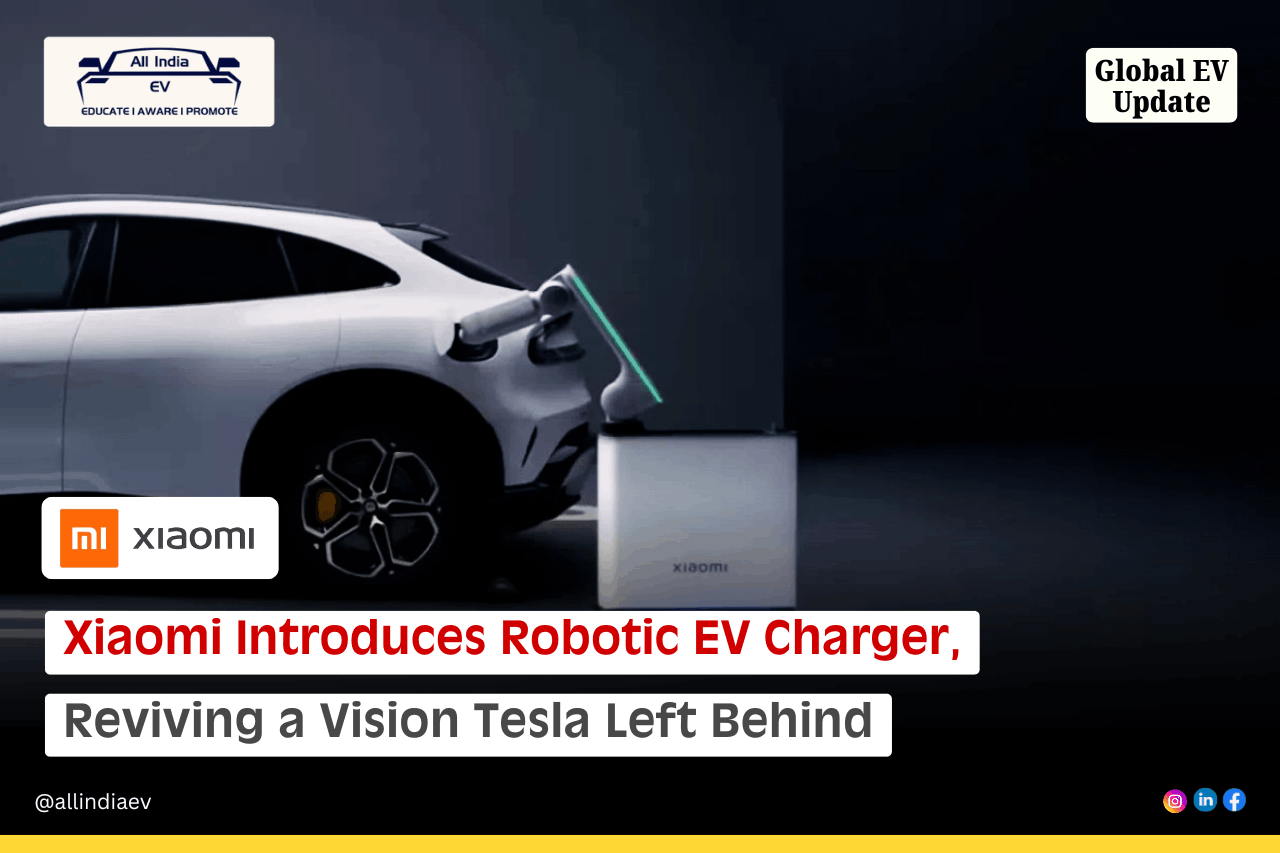

What: Xiaomi has unveiled a home-charging robotic arm that can automatically plug in and unplug an electric vehicle without driver intervention, bringing autonomous home charging closer to commercialization.
The Number: 152 mm – the reported width of the robotic charging unit, designed to fit into compact residential parking spaces. Xiaomi is targeting a Q4 2026 market launch.
The Impact: The technology could remove one of the last manual steps in EV ownership while preserving the efficiency advantages of wired charging over wireless charging systems.

The Core News
Xiaomi’s robotic EV charger marks a significant step toward fully automated home charging for electric vehicles. The company recently demonstrated a robotic charging arm capable of detecting a vehicle’s charging port, automatically connecting the charging cable, and disconnecting it once charging is complete. The solution is positioned as part of Xiaomi’s broader smart mobility and connected-home ecosystem.
The announcement is particularly notable because it revives a concept that Tesla explored more than a decade ago. Tesla showcased its well-known “snake charger” prototype in 2015 but never commercialized the technology. Xiaomi’s approach appears focused on practical residential deployment, combining AI-based vision recognition, automated charging-port interaction, and smartphone-based remote control.
More EV News

Beyond convenience, the development highlights a growing industry trend toward autonomous charging infrastructure. As EVs increasingly adopt automated parking, advanced driver assistance systems, and connected services, charging automation is emerging as the next logical step. Xiaomi joins a growing list of companies, including Hyundai, Li Auto, Aito, and Star Charge, that are actively exploring robotic charging technologies.
Breaking Down the Update
• Xiaomi robotic EV charger can automatically connect and disconnect the charging cable.
• The system uses AI-based visual recognition technology for precise charging-port alignment.
• The robotic arm is designed specifically for residential charging environments.
• Xiaomi claims the demonstrated functionality is production-ready and not merely a concept showcase.
• The company expects commercial availability during the fourth quarter of 2026.
• The charger integrates with Xiaomi’s “Human-Car-Home” ecosystem for remote monitoring and control.
• The solution maintains the efficiency advantages of plug-in charging compared with wireless charging alternatives.
Way Forward
The success of Xiaomi’s robotic EV charger will ultimately depend on pricing, reliability, compatibility across vehicle platforms, and ease of installation. If Xiaomi can deliver a commercially viable product in Q4 2026, it could create a new category within premium home EV charging infrastructure and accelerate the industry’s move toward fully autonomous vehicle ownership experiences.
Read More: Catch up on All India EV’s related coverage on India’s evolving commercial EV subsidies and battery swapping policies at All India EV