


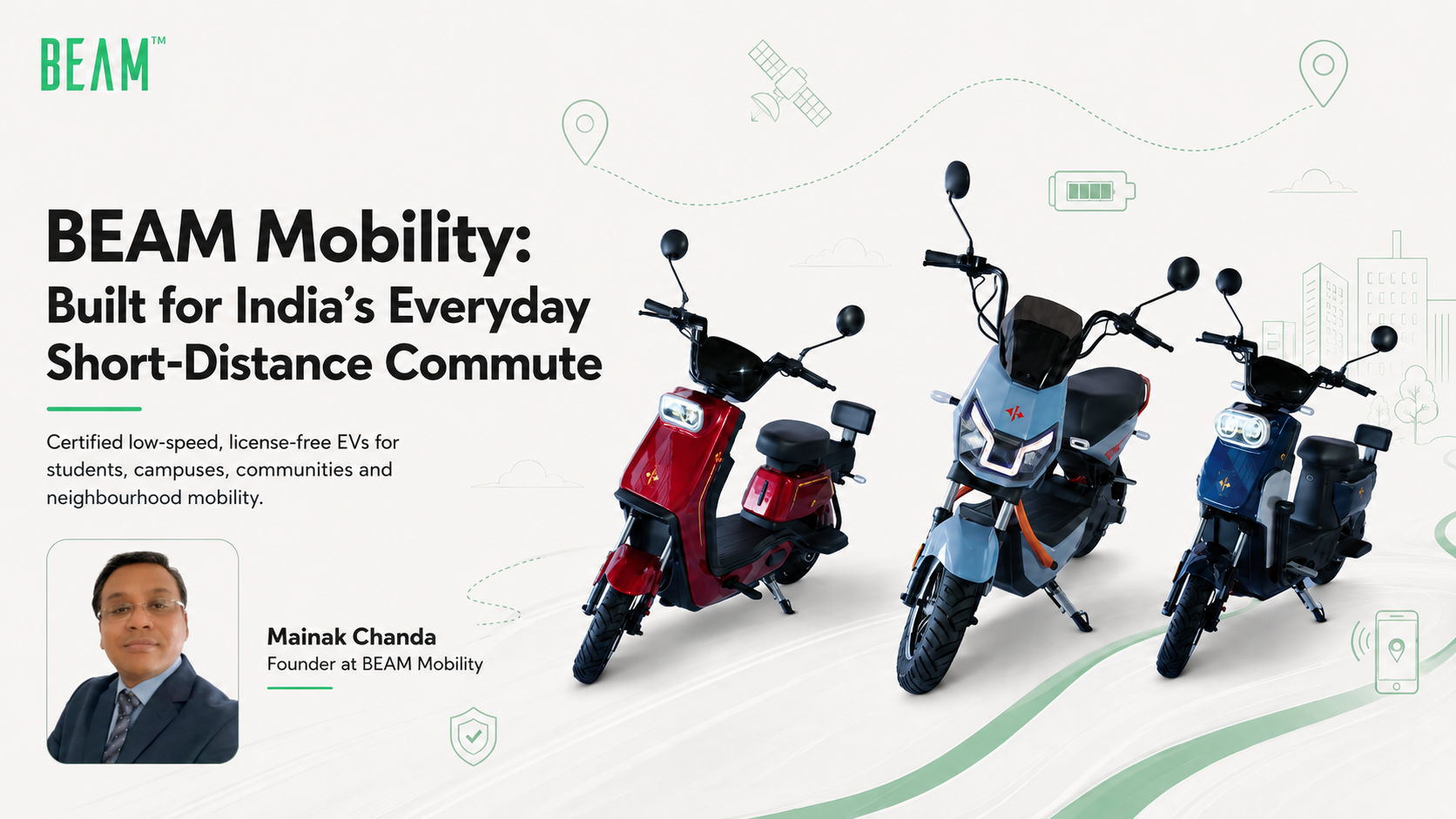
While most of India’s electric two-wheeler industry races toward higher speeds, longer ranges, and premium positioning, BEAM Mobility has deliberately chosen the opposite direction — and is building a serious business case around it.
- The Interview
- Q1. BEAM is positioning itself around certified low-speed, license-free electric mobility. What specific gap did you see in India’s urban commute market that made this category worth building for?
- Q2. Your scooters are built around a ~25 km/h top speed, ~70 km range, and non-registered / no-license convenience. How did you arrive at this product architecture, and what kind of user behaviour is it designed for?
- Q3. BEAM is also highlighting app-based features like vehicle ON/OFF, arm/disarm, theft alerts, battery state-of-charge, and vehicle tracking. In your view, how important is connected intelligence in making a low-speed EV feel more trustworthy and usable?
- Q4. A lot of EV companies talk about scale, but BEAM is visibly investing in dealership and showroom partnerships. Why is physical market presence still critical in an EV business — especially for first-time buyers?
- Q5. Low-speed electric scooters solve a very different problem than premium or highway-capable EVs. Do you see BEAM primarily as a consumer mobility brand, a neighbourhood commute solution, or part of a broader last-mile mobility system?
- Q6. From a policy perspective, what would help companies like BEAM scale faster in India: better local awareness, more charging confidence, urban mobility planning, dealer-level support, or clearer category communication for the broader electric two-wheeler segment?
- Conclusion: The Category Hiding in Plain Sight
BEAM designs and manufactures Certified Low-Speed Electric Vehicles — license-free, registration-free electric scooters built around a ~25 km/h top speed and ~70 km range. Its product line-up — the BL1.O, BL2.O, and BL3.O — targets a mobility pattern that India’s mainstream EV makers have largely overlooked: the 45–50% of daily Indian trips that fall within just 2–5 km.
The company’s focus segments read like a map of underserved India: women riders in rural and semi-urban areas, students aged 16 and above, campus and gated-community users, local shop owners, and senior citizens. Backed by software-coded speed controls, the BEAM Connect App, a 3-year/36,000 km warranty, and a dealership strategy centred on Tier-2, Tier-3, and taluka markets, BEAM is positioning low-speed mobility not as a compromise — but as a category.
All India EV reached out to BEAM Mobility to understand the thinking behind this contrarian product architecture, the market gaps it addresses, the role of connected intelligence in low-speed EVs, and what it will take for this category to scale across India. Here is the full conversation.
The Interview
Q1. BEAM is positioning itself around certified low-speed, license-free electric mobility. What specific gap did you see in India’s urban commute market that made this category worth building for?
BEAM Mobility: BEAM focuses on creating and serving specific mobility segments identified through our in-depth market research. These insights have helped us recognize significant gaps in the market, which are being addressed through our product line-up — BL1.O, BL2.O, and BL3.O.
1. Short-Distance Mobility
- Research Insight: 45–50% of daily trips in India are within 2–5 km, and average travel speeds are only 25–30 km/h.
- Market Gap: Most vehicles in the market are designed for high-speed commuting, making them expensive, complex, and unnecessary for short-distance travel.
- BEAM Solution: BL1.O / BL2.O — a simple, affordable, license-free electric vehicle designed specifically for short-distance neighbourhood mobility.
2. Rural & Semi-Urban Women Mobility
More EV News
- Research Insight: Women in rural and semi-urban areas often lack access to personal mobility due to vehicle weight, complexity, and safety concerns.
- Market Gap: Most two-wheelers are heavy, difficult to handle, and intimidating for first-time riders.
- BEAM Solution: BL2.O / BL3.O — a lightweight, easy-to-use electric mobility solution designed for safe and independent mobility for women.
3. Campus & Community Mobility
- Research Insight: Large campuses such as universities, industrial parks, hospitals, resorts, and gated communities require internal transportation.
- Market Gap: Existing options are either walking, bicycles, or expensive electric carts — leaving a gap for simple personal electric mobility.
- BEAM Solution: BL1.O / BL2.O — a compact, efficient electric vehicle designed for campus and closed-community mobility.
4. Student Mobility (16+ Years)
- Research Insight: Students aged 16+ manage multiple activities — school/college, coaching classes, sports, and extracurricular programs.
- Market Gap: Many students cannot use conventional scooters due to license requirements, cost, and complexity.
- BEAM Solution: BL1.O / BL2.O / BL3.O — safe, license-free electric mobility solutions enabling independent student commuting for short distances.
Based on these research insights and identified market gaps, BEAM has developed a dedicated product platform designed specifically for short-distance, low-speed mobility. Our products are Certified Low-Speed Electric Vehicles, engineered for simplicity, safety, and accessibility.
Key features include:
- Certified Low-Speed EV platform designed for safe and reliable short-distance mobility
- Software-coded speed controls to ensure regulated and safe vehicle operation
- BEAM Connect App for monitoring and controlling key vehicle functions
- Lightweight and easy-to-operate design, suitable for first-time riders
- Optimized for neighbourhood, rural, student, and campus transportation
- Warranty up to 3 years or 36,000 km
Q2. Your scooters are built around a ~25 km/h top speed, ~70 km range, and non-registered / no-license convenience. How did you arrive at this product architecture, and what kind of user behaviour is it designed for?
BEAM Mobility: BEAM’s Certified Low-Speed Scooters are designed around a very specific mobility behaviour pattern in India. The strategic thinking behind that product architecture is:
Built around the Indian short-distance mobility pattern. In most Indian towns, campuses, and communities, around 50% of daily trips are under 5 km, and average daily usage is 15–25 km. Trips are mostly home → market, home → school, inside campuses, inside gated communities, and short neighbourhood purchases.
A 70 km range covers 2–3 days of usage for most riders. This reduces range anxiety and charging frequency, which users appreciate.
The 25 km/h speed is a regulatory advantage. It is mandatory under Indian EV regulation [Clause No. 2 of GSR 291(E) dated 24.01.14, GSR 823(E) dated 6.11.23 & GSR 838(E) dated 14.11.23], which creates a huge user advantage — anyone in the family can ride, there is no paperwork or compliance, and purchase and use are immediate. This removes the biggest barrier to EV adoption.
Designed for users who cannot or prefer not to use motorcycles — women in semi-urban and rural areas, students (16+ age group), campus staff, gated-community residents, local shop owners, and senior citizens.
The lowest running cost per kilometre. BEAM’s certified low-speed architecture achieves this through a lower product price, smaller battery size, lower maintenance, a 3-year/36,000 km warranty, and a battery buy-back program.
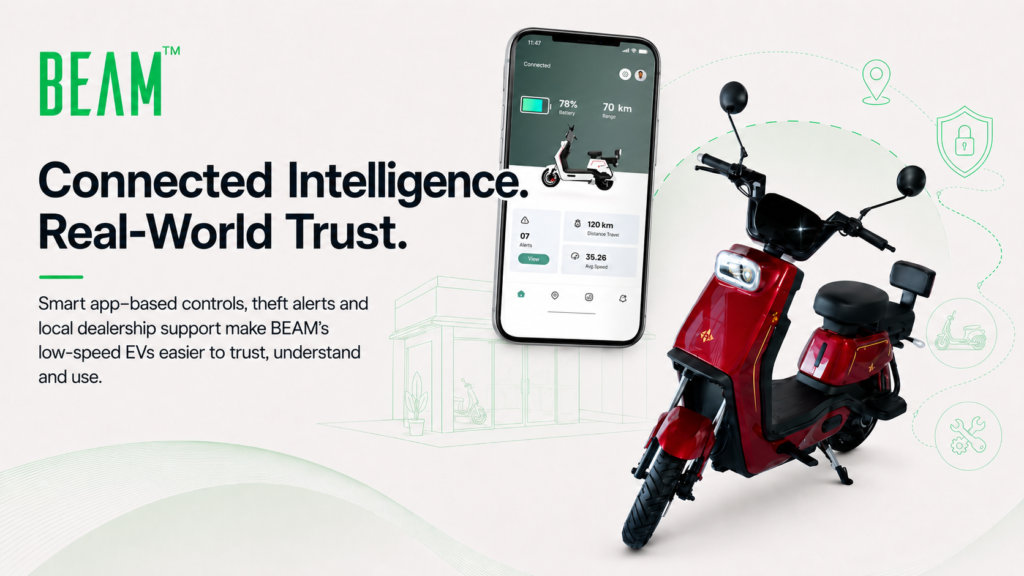
Q3. BEAM is also highlighting app-based features like vehicle ON/OFF, arm/disarm, theft alerts, battery state-of-charge, and vehicle tracking. In your view, how important is connected intelligence in making a low-speed EV feel more trustworthy and usable?
BEAM Mobility: At BEAM, we believe that a vehicle should not just provide mobility — it should also provide confidence and control to the user. Connected intelligence plays a very important role in building trust, safety, and usability, especially in the low-speed EV category, where many users are first-time electric vehicle owners.
Through the BEAM Connect App, users can access several smart features, including:
- Remote vehicle ON/OFF control
- Arm/Disarm functionality for enhanced security
- Theft alerts and vehicle tracking
- Real-time battery state-of-charge monitoring
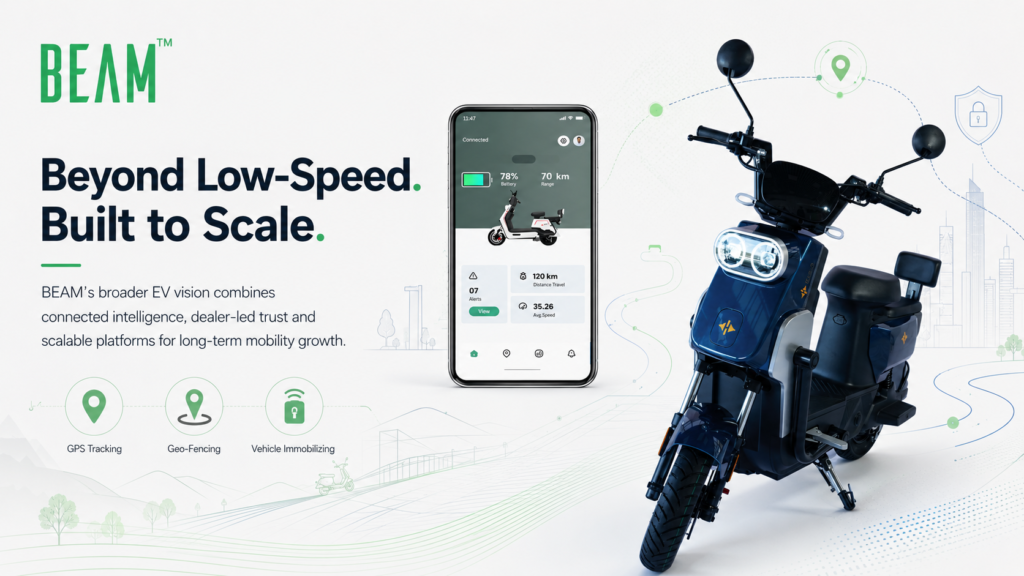
In addition, BEAM also offers the BEAM EYE App, an optional connected feature designed primarily for campus and closed-community mobility environments. Through this application, users and administrators can:
- Access GPS-based vehicle tracking
- Enable geo-fencing capabilities
- Track vehicle movement in real time
- Immobilize the vehicle in case of emergencies or unforeseen incidents
These connected features help users stay informed and connected with their vehicles at most times, improving both security and convenience. For segments such as students, women riders, and campus users, this connected intelligence significantly enhances trust and usability, as users can easily monitor vehicle status and location through their smartphones.
Additionally, software-coded speed control ensures that the vehicle operates within safe and regulated speed limits, which is particularly important for low-speed mobility environments such as neighbourhoods and campuses. Ultimately, connected technology transforms a simple electric vehicle into a smart mobility solution — safer, more reliable, and easier to use.
Beyond smart vehicle connectivity, the BEAM Connect App is also designed to enhance the overall ownership and service experience. Through the app, users can:
- Directly connect with BEAM technicians for guidance and technical assistance
- Access the BEAM Owner’s Manual for quick reference and product information
- View BEAM YouTube support videos that guide users through minor self-maintenance and troubleshooting
- Access online service support, enabling customers to receive assistance without always visiting a service centre
By combining connected vehicle intelligence with digital service support, BEAM aims to create a smart, transparent, and user-friendly EV ownership ecosystem.
(Insert pictures of BEAM Connect App — Android & iOS)
Q4. A lot of EV companies talk about scale, but BEAM is visibly investing in dealership and showroom partnerships. Why is physical market presence still critical in an EV business — especially for first-time buyers?
BEAM Mobility: At BEAM, we believe that dealerships and experience showrooms play a very important role in building customer confidence, because the decision to purchase a vehicle is deeply human and trust-driven. Physical market presence therefore remains critical in the EV industry, particularly since a large percentage of buyers are first-time electric vehicle users.
At the same time, we also recognize the growing influence of digital platforms, and we see both physical and digital channels as complementary to each other.
For many customers, especially in semi-urban and rural markets, purchasing an EV is not just a deal — it represents a shift to a completely new technology. Buyers often want to see the vehicle, understand how it works, experience the ride quality, and ask practical questions about charging, battery life, post-sales service, and warranty before making a decision.
Our showroom and dealership partners therefore play an important role in helping customers:
- Experience the vehicle physically through test rides
- Understand EV technology and vehicle operation
- Receive guidance on charging and maintenance
- Access reliable after-sales support and warranty services
This becomes even more important in segments such as students, women riders, and first-time vehicle owners, where trust, comfort, and local support significantly influence the purchase decision. In addition, dealerships help us build strong local service ecosystems, ensuring customers always have nearby support for maintenance and assistance.
It is also important to note that BEAM’s dealership expansion strategy is focused primarily on Tier-2 and Tier-3 cities, particularly semi-urban and taluka regions, where the need for simple and accessible electric mobility solutions is growing rapidly.
Q5. Low-speed electric scooters solve a very different problem than premium or highway-capable EVs. Do you see BEAM primarily as a consumer mobility brand, a neighbourhood commute solution, or part of a broader last-mile mobility system?
BEAM Mobility: At BEAM, in line with our vision and mission, we have developed a clear product and target market roadmap aimed at addressing key mobility gaps in the market. While our current focus is on low-speed electric mobility, our long-term strategy positions BEAM as a broader electric two-wheeler company, capable of addressing multiple mobility applications.
There are several reasons why BEAM intends to operate within the broader electric two-wheeler segment:
- Natural upgrade path for existing customers. Many users who begin with low-speed EVs eventually require higher speed and longer range as their mobility needs evolve. Introducing mid-speed or higher-speed BEAM vehicles will provide a natural upgrade path, allowing customers to remain within the BEAM ecosystem instead of shifting to other brands.
- Expanding market opportunity. The mid- and high-speed electric two-wheeler segments represent a significantly larger and faster-growing market compared to the low-speed category. Participating in this segment allows BEAM to address broader mobility demands.
- Strong fit with BEAM’s target markets. BEAM is strategically focused on Tier-2 and Tier-3 cities, semi-urban regions, and taluka towns. In these areas, customers often require a mix of low-speed and higher-speed mobility solutions, making product expansion a natural step in serving these markets effectively.
- Better dealer economics. Higher-speed electric vehicles typically offer better dealership economics, including higher ticket sizes and improved service revenue opportunities. This helps BEAM strengthen its dealership network and expand its physical market presence.
- Technology platform extension. BEAM has already built a strong technology foundation through the BEAM Connect App, advanced connected features, and evolving battery and charging technologies. These capabilities can be extended across future products while maintaining BEAM’s core philosophy of simplicity and accessibility.
- Stronger brand positioning. Expanding into higher-speed electric vehicles will position BEAM as a complete electric two-wheeler company, rather than being seen solely as a niche low-speed EV manufacturer.
Our goal is to build a complete electric two-wheeler ecosystem — starting with simple low-speed mobility and gradually expanding to address broader everyday transportation needs.
Q6. From a policy perspective, what would help companies like BEAM scale faster in India: better local awareness, more charging confidence, urban mobility planning, dealer-level support, or clearer category communication for the broader electric two-wheeler segment?
BEAM Mobility: At BEAM, we strongly believe in sustainable growth rather than pursuing fast growth. As mentioned earlier, we already have a clear product and target market roadmap, and our next-generation products are currently in the design pipeline, with design patents secured in India.
For long-term and responsible EV adoption, several ecosystem factors need to evolve together. The areas you touched on — local awareness, charging confidence, urban mobility planning, dealer-level support, and clearer category communication — are all extremely important for the growth of electric mobility in India.
In addition to these, a few other aspects can also significantly help BEAM scale sustainably:
- Clear policy continuity and a long-term EV roadmap, so manufacturers and other stakeholders can plan product development and supply chains with confidence
- Support for local manufacturing and component ecosystems — especially batteries, electronics, and charging components — to help reduce costs and improve supply stability
- Skill development and EV technician training programs to establish a strong service ecosystem across India
- Consumer education initiatives that clearly explain the benefits and practical use cases of different EV categories, including low-speed mobility solutions
However, if I had to prioritize two key areas, the first would be stronger dealer-level support, and the second would be platform commonization across EV products.
Dealer partners interact directly with customers every day and play a critical role in building trust and understanding around BEAM’s electric mobility. They help customers experience the vehicle through test rides, understand charging practices, clarify technology-related questions, and provide reliable after-sales service and warranty support. In many ways, our dealers are the face of BEAM in the market. Strengthening the dealer ecosystem through engagement and training programs, infrastructure support, and policy encouragement can significantly accelerate EV adoption — particularly in Tier-2, Tier-3, rural, and semi-urban markets, where personal interaction and local trust play a very important role in purchase decisions.
At the same time, platform commonization across EV products can play an important role in scaling our sustainable growth journey. By standardizing key components, technology platforms, and architecture across multiple vehicle models, manufacturers can achieve better cost efficiency, simplified maintenance, improved supply-chain stability, and faster product development cycles. This ultimately helps deliver more affordable and reliable EV solutions to customers.
While aspects such as awareness, charging confidence, and category communication are also important, companies like us are already actively working on many of these areas through product innovation, connected technology, and customer education initiatives. BEAM believes that a strong dealer ecosystem, combined with scalable product platforms and supportive policies and infrastructure, can play a transformative role in accelerating electric mobility adoption across India.
Conclusion: The Category Hiding in Plain Sight
BEAM Mobility’s bet is a counterintuitive one in an industry obsessed with top speeds and range figures — but the data behind it is hard to ignore. When nearly half of India’s daily trips are under 5 km and average urban speeds hover at 25–30 km/h, a 25 km/h license-free scooter is not a compromise; it is a precision fit.
Three takeaways stand out from this conversation:
The low-speed category is a demand story, not a product limitation. BEAM has built its architecture around how India actually moves — short trips, shared family usage, first-time riders — rather than how spec sheets compete.
Trust is the real infrastructure. From connected-app security features to a deliberately physical, Tier-2/Tier-3-focused dealership strategy, BEAM’s playbook recognizes that for first-time EV buyers, confidence matters as much as cost.
Low-speed is the entry point, not the destination. BEAM’s roadmap toward the broader electric two-wheeler segment — built on a natural customer upgrade path and platform commonization — signals that the company sees certified low-speed mobility as the foundation of a much larger ecosystem.
For India’s EV transition to be truly inclusive, it must reach the students, women riders, senior citizens, and small-town commuters that mainstream products were never designed for. BEAM Mobility is building for exactly that India — and the market gap it has identified may prove to be one of the most underestimated opportunities in Indian electric mobility.
This interview is part of All India EV’s ongoing coverage of India’s electric mobility ecosystem. For more industry conversations, data-driven reports, and EV market intelligence, visit allindiaev.com.