


So you’ve decided EV charging is where the money (and the mission) is. Good instinct: India has EVs multiplying faster than public charge points, and everyone from real estate developers to fuel retailers is trying to figure out which hardware partner to bet on. But here’s the thing nobody tells you upfront: picking a charger brand isn’t a hardware decision, it’s a portfolio decision.
You’re not buying one box. You’re buying into a roadmap, because the site you commission today (a housing society) is rarely the last site you’ll ever do. Tomorrow it’s a highway plaza, then a fleet depot, then maybe a bus terminal. If your charger vendor only makes one SKU, you’ll be juggling three vendors, three AMC contracts, three CMS dashboards, and three sets of spare parts within eighteen months. That’s the operational headache every new CPO (Charge Point Operator) discovers the hard way.
This is why RoadGrid’s portfolio is worth a proper look before you sign a PO with anyone. Noida based, founded in 2020, backed by Venture Catalysts and Z Nation Lab, with over installations already live across Madhya Pradesh, Rajasthan and Karnataka for names like IOCL, Amazon, BSES and NPCL, and a fresh partnership with VinFast’s V-Green arm for HPCL outlets, RoadGrid isn’t a garage startup pitching a prototype. It’s a company that has clearly thought about the full stack: two wheeler to four wheeler, wall mount to pedestal, AC to DC, and now, pushing into the high power end of the spectrum.
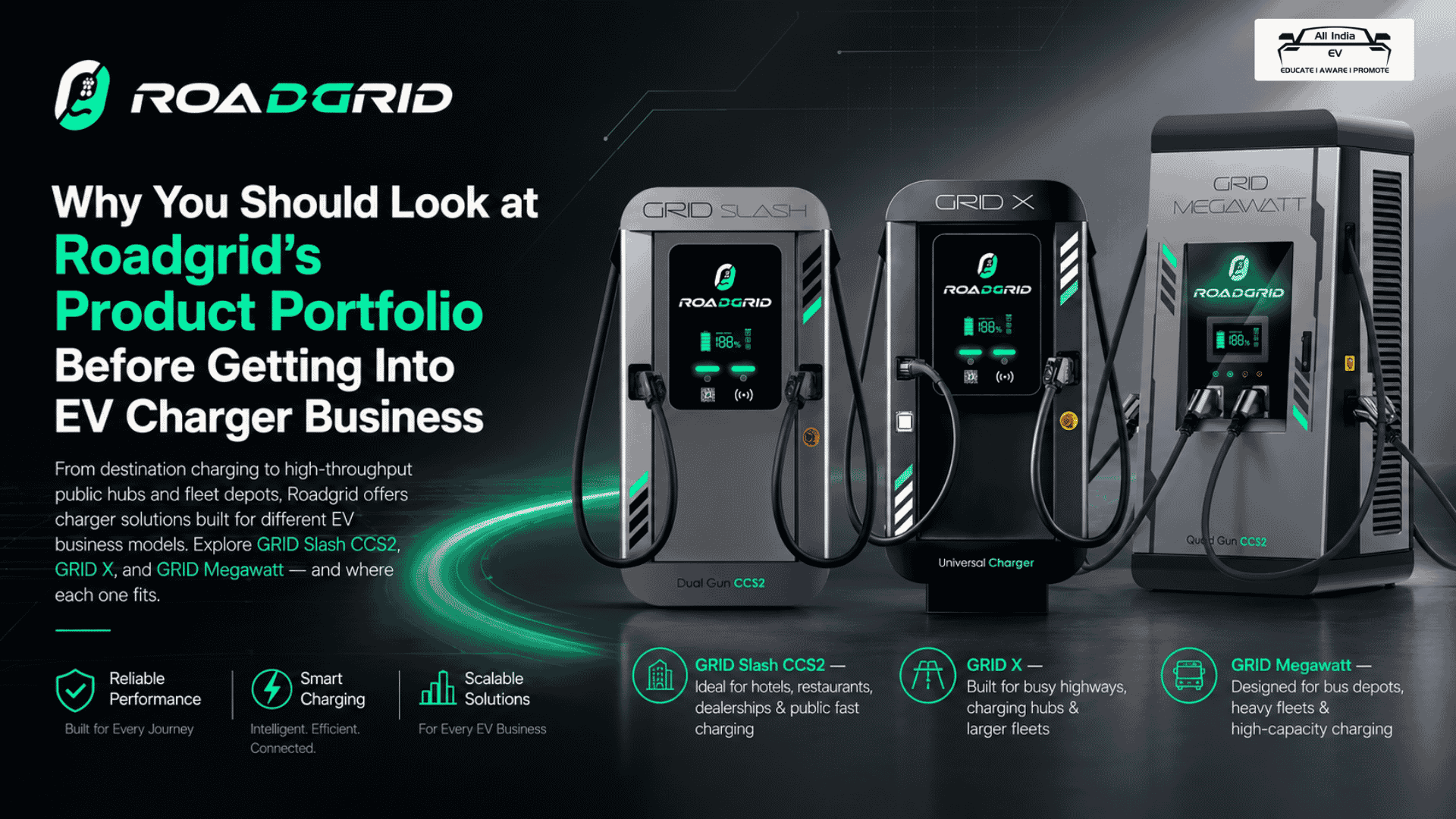
Let’s break down where three of their products, GRID Slash CCS2, GridX, and their Megawatt class charging line, actually fit into a real deployment plan.
1. GRID Slash CCS2: The Highway & Commercial Hub Workhorse
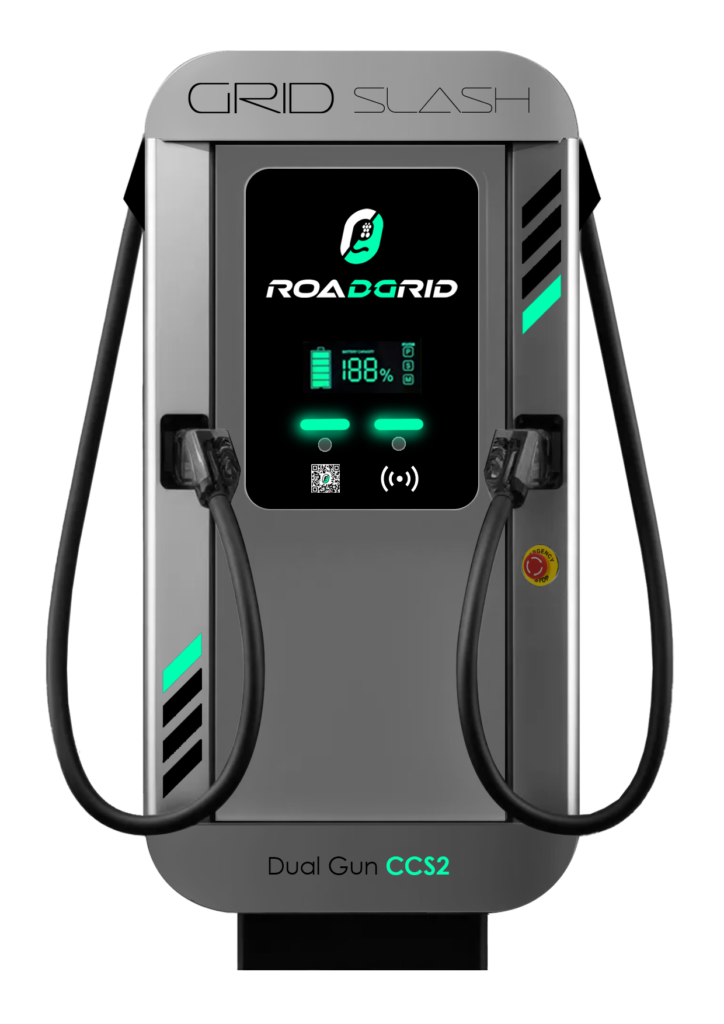
Think of this as RoadGrid’s flagship DC fast charger, the one built for locations where cars can’t afford to sit around.
The technical bit: It’s a 60kW DC fast charger with a dual CCS2 gun setup and smart load management between the two guns, OCPP 1.6J compliant, and tied into RoadGrid’s Smart CMS for remote monitoring, diagnostics, and OTA updates. It’s rated to push a passenger EV from 20 to 80% charge in roughly 25 to 35 minutes, and it’s been engineered, not just certified on paper, for Indian conditions: voltage surges, dust ingress, and the kind of heat that fries “imported spec” electronics within a monsoon or two.
More EV News

The casual bit: This is your bread and butter charger for anywhere someone is waiting: highway fuel stations, mall parking, commercial hubs, fleet depots. If your business plan involves a driver plugging in and grabbing chai while the car juices up, this is the box you want out front. The dual gun design also means you’re not paying for two separate installations to serve two cars, one unit, smart shared power, better unit economics per site. For a first time CPO, this is usually the anchor product you build your site portfolio around before diversifying.
There’s also a GRID Slash CCS2 HPC wall mounted variant in RoadGrid’s lineup for space constrained sites: same dual gun DC fast charging, but compact enough to bolt to a wall in a parking lot or fleet depot rather than needing pedestal floor space. Worth knowing about if your site is tight on real estate.
2. GridX: The Networked, Site Flexible Play
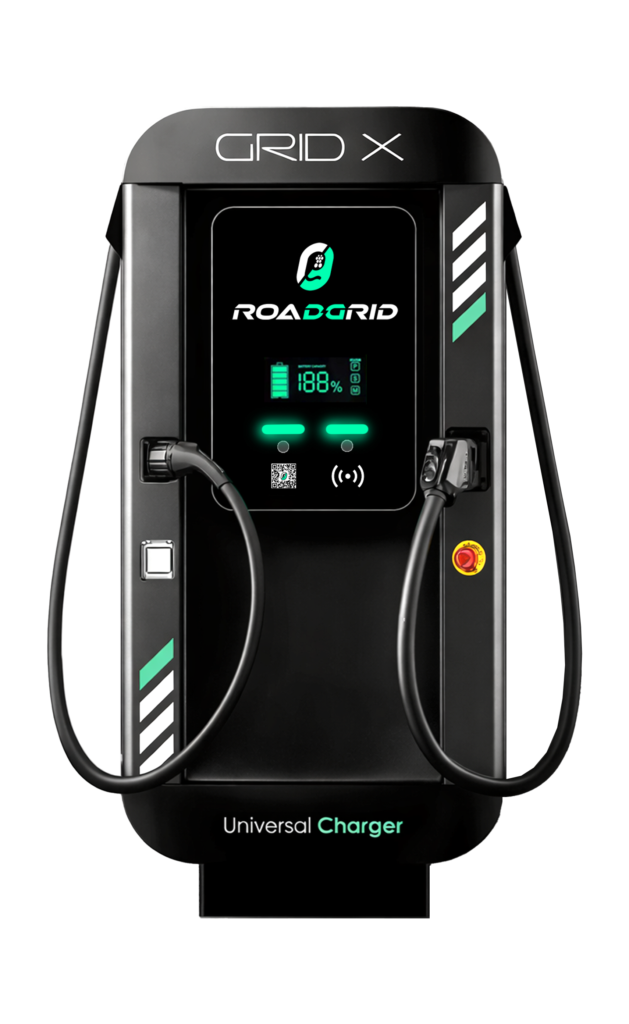
Here’s where it gets interesting from a business model standpoint rather than just a hardware one. If Slash CCS2 is about raw charging speed, GridX is positioned as the connective layer, a charger built to sit inside RoadGrid’s broader network logic rather than as a standalone box.
The technical bit: In practice, this is the kind of unit CPOs deploy when they’re thinking beyond a single site, where remote monitoring, session level data, dynamic load sharing across multiple connection points, and centralized fleet of chargers management matter as much as raw kW output. It slots into RoadGrid’s Smart CMS backend the same way the rest of the lineup does, which means whether you’re running five chargers or five hundred, they all show up on one dashboard.
The casual bit: This is really the product for the person who’s not thinking “I need one charger,” but “I need to build a network.” If your pitch to investors or your municipal partner involves phrases like “scalable charging infrastructure” or “multi site operations,” GridX is the SKU that backs up that promise operationally, because a network is only as good as your ability to monitor and manage it centrally, not drive to every site with a laptop when something goes down.
(Worth confirming exact power rating and connector configuration directly with the RoadGrid team at the time of quoting, like most fast scaling hardware companies, spec sheets evolve between funding rounds.)
3. The Megawatt Line: Where RoadGrid Is Betting on the Future
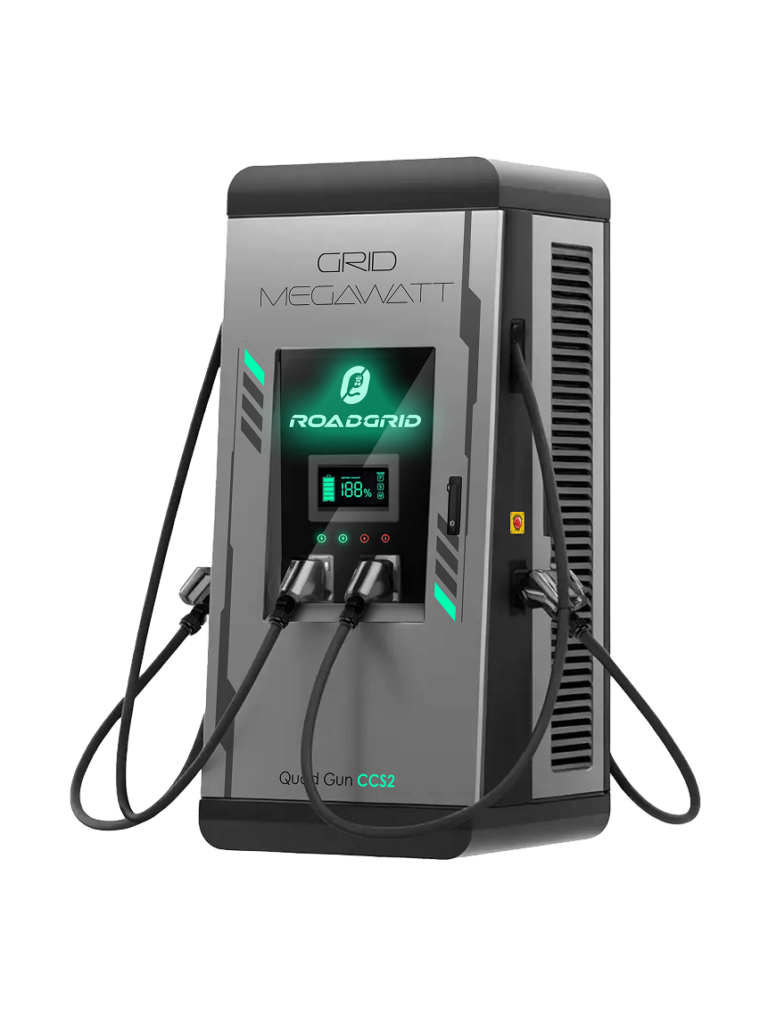
This is the one that should make you sit up if you’re thinking long term rather than just next quarter.
The technical bit: Megawatt Charging Systems (MCS) globally are the segment built for heavy commercial EVs, buses, trucks, and fleet vehicles with battery packs large enough that a 60kW or even 180kW charger would take hours, not minutes. India’s e-bus and e-truck rollout under schemes like PM E-DRIVE is accelerating, and the charging infrastructure gap for commercial EVs is arguably wider than for passenger cars, since depots need to turn buses around in a fraction of the time a diesel refuel takes, or the whole electrification math for fleet operators stops working.
The casual bit: Nobody’s making real money on megawatt charging in India today, the commercial EV fleet base is still building up. But that’s exactly the point. A vendor putting R&D into this segment now is signaling where the market goes in 2 to 3 years, and if you’re building a CPO business you want to grow with, not one you’ll outgrow, this is the product line to keep an eye on. Depot operators, logistics companies, and state transport undertakings evaluating e-bus charging infrastructure should specifically be asking RoadGrid about their roadmap here.
(As with GridX, treat exact power figures as “confirm before quoting,” MCS is a fast moving spec category everywhere in the world right now, not just in India.)
The Bigger Picture: Why “Portfolio Thinking” Beats “Single Charger” Thinking
Here’s the accountability first take, minus the sales gloss: most EV charger buying decisions in India today are still made site by site, almost reactively. Someone needs a charger for a society, they buy an AC wall box. Someone needs one for a highway plaza, they buy a DC fast charger, often from a different vendor, because nobody checked if the first one even made a DC product.
That approach works until it doesn’t, usually around the time you’re running five sites with three different CMS logins, three AMC renewal dates, and a spares inventory that makes no sense. RoadGrid’s pitch, a single manufacturer covering wall mount AC, dual gun DC fast, fleet depot units, and now pushing into megawatt class commercial charging, all sitting on one Smart CMS backend, is precisely the kind of portfolio depth that lets a CPO scale without re architecting their operations every time they add a new site type.
If you’re evaluating vendors for your first (or fifteenth) deployment, don’t just ask “what’s the price per unit.” Ask: does this vendor have a product for where my business will be in two years, not just where it is today? That’s the real test, and it’s the one RoadGrid’s expanding portfolio is clearly designed to pass.