


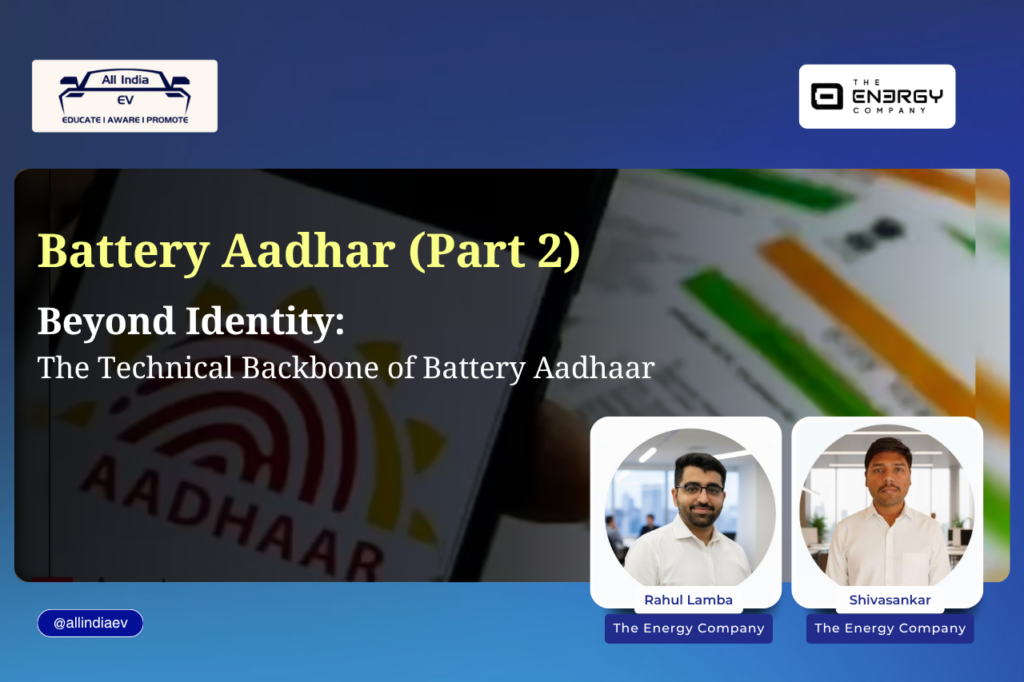
“Battery Aadhaar incorporates advanced analytics leveraging artificial intelligence and machine learning algorithms trained on the aggregated dataset from diverse battery populations. These models refine state-of-health (SoH) estimates and predict remaining useful life (RUL) with far greater accuracy than legacy SoH heuristics.”
This identifier is stored on distributed ledgers (blockchain) or other decentralized databases to guarantee authenticity and prevent forgery. Any attempt to alter or clone identity data triggers alerts, ensuring a trusted root of truth.
Building on the problem of battery black boxes and fragmented data ecosystems outlined earlier, Battery Aadhaar is engineered as a comprehensive software-defined platform that transforms every battery into an intelligent, connected asset over its entire lifecycle.
Digital Birth Certificate and Immutable Identity
At the core lies a tamper-proof, cryptographically secured unique identifier assigned to each battery at manufacturing.
This BatteryID encodes essential static metadata, chemistry type, rated capacity, manufacturing date, and serial number, creating a digital birth certificate akin to identity systems like Aadhaar.
Living Logboofi: Continuous Lifecycle Data Integration
More EV News

Unlike conventional Battery Management Systems (BMS) which only track instantaneous states such as voltage or temperature, Battery Aadhaar integrates and chains data streams from multiple sources in real-time:
- Onboard BMS telemetry: Captures granular electrochemical parameters during usage, including charge/discharge cycles, thermal conditions, and voltage irregularities.
- Service and maintenance records: Securely logged post repairs, calibrations, or battery swaps by authorized service centers.
- Fleet and swapping station usage: Operational data such as mileage, charging patterns, and environmental stressors in commercial deployments.
- User interactions: Data from peer-to-peer battery rentals, secondary sales, or leasing agreements.
All data points are cryptographically signed and chained sequentially, creating an auditable, comprehensive timeline free from tampering.
This living logbook mitigates the amnesia problem seen in isolated BMS units and bridges existing data silos with standardized APIs and interoperability protocols.
Battery Health and Prognostics Enhanced by AI
Battery Aadhaar incorporates advanced analytics leveraging artificial intelligence and machine learning algorithms trained on the aggregated dataset from diverse battery populations.
These models refine state-of-health (SoH) estimates and predict remaining useful life (RUL) with far greater accuracy than legacy SoH heuristics.
Contextual factors previously invisible to BMS alone, such as charging speed history, ambient temperature variations, and pattern irregularities, feed into predictive maintenance schedules, enabling preemptive interventions.
Fleet operators can thus drastically reduce downtime and optimize asset utilization.
Enabling Energy Market place and Finance Integration
Once battery health and history are verifiable in real time, the ecosystem can unlock transactional capabilities akin to digital finance systems:
- Batteries become bankable assets that can be collateralized or leased.
- Peer-to-peer energy trading platforms leverage verified battery capacity for supplying power dynamically to grids, households, or electric vehicles.
- Performance-based financing models such as battery-as-a-service gain trust through transparent usage and health histories.
Communication protocols are designed to integrate with India’s existing digital infrastructure, including UPI-like payment rails adapted for energy credits, and regulatory interfaces for compliance and auditing.
Open Standards and Security Frame work
Battery Aadhaar is designed using open, extension-friendly standards ensuring ecosystem participants—from manufacturers to recyclers— can plug in securely. Encryption, key management, and consent frameworks enforce user data privacy while supporting authorized third-party data sharing.
Decentralized consensus mechanisms guarantee system resilience and prevent single points of failure, making Battery Aadhaar a robust foundation for India’s energy transformation.
Electric mobility in India is accelerating at an extraordinary pace -yet until recently, the Northeast remained on the sidelines of this transition. The region’s breathtaking hills, rich biodiversity hubs, and vibrant tourism destinations were held back by long-standing infrastructure gaps, difficult terrains, and low early EV penetration.
A Plus Charge (Alternat EV Solutions Pvt. Ltd.), a Guwahati- based Charge Point Operator (CPO), is rewriting this narrative with a bold mission: to build the Northeast’s most trusted and widespread EV charging network.
Instead of relying only on theoretical market projections, the company leans heavily on direct market signals:
- Guidance from auto OEM partners based on real customer vehicle demand;
- Ground-level surveys to map mobility heat zones;
- Priority deployment along national highways ensuring a charger every 60 km;
- Presence in tourist corridors like Kaziranga and Shillong where access matters most; and nodes around workplaces, airports, malls, colleges, and residential hubs.
This approach reduces range anxiety and builds trust where it matters most -when someone is on the move and needs reliable support.
Technology is helping accelerate confidence. Every A Plus Charge station is cloud-connected through the APLUS App – enabling real-time station visibility, smart payments, remote diagnostics, and interoperability for all EVs. Smart load management and solar compatibility ensure grid efficiency while readying the network for a greener future. Through strong uptime commitments and responsive customer support, the brand is positioning itself as a dependable infrastructure partner.