
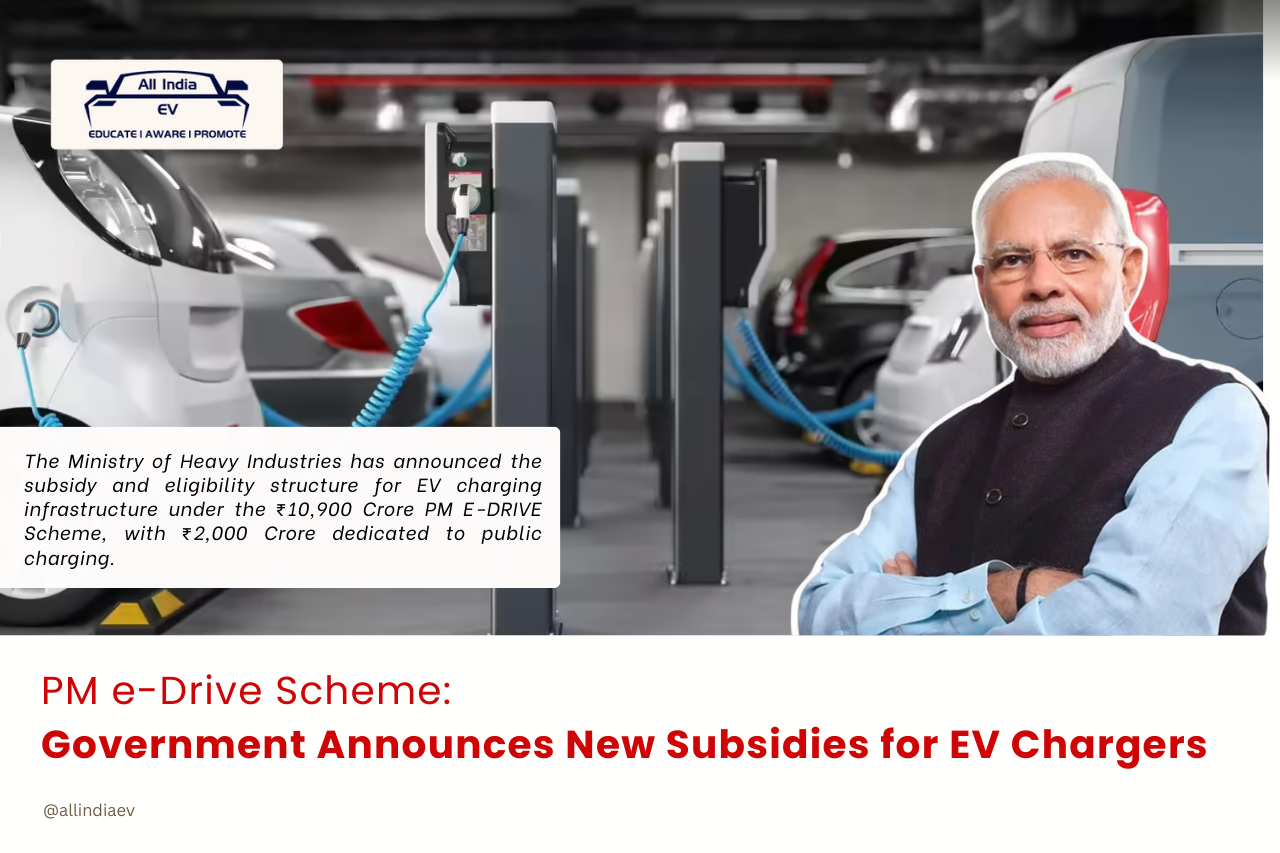

In a major push to accelerate India’s clean mobility transition, the Government of India has officially announced the eligibility norms and subsidy structure for setting up Electric Vehicle Public Charging Stations (EVPCS) under the ambitious PM E-DRIVE scheme.
The announcement outlines that Government ministries, Central Public Sector Enterprises (CPSEs), autonomous bodies, State/UT governments, and their PSUs will be eligible to participate. These bodies will also appoint nodal agencies responsible for demand aggregation and project execution across designated regions.
The PM E-DRIVE scheme carries a substantial financial outlay of ₹10,900 crore, with ₹2,000 crore earmarked exclusively for expanding public EV charging infrastructure. This includes charging stations, battery swapping stations, and battery charging facilities, aimed at strengthening India’s rapidly growing EV ecosystem.
A location-based subsidy model will be implemented, offering reimbursement for both upstream electrical infrastructure and EVSE (charging equipment). The subsidy distribution will vary across government-owned premises, public sector–managed spaces, and designated highway/urban locations as per official categories.
Subsidy Structure Table
| Category | Location Type | Subsidy Provided |
| A | Government-owned premises such as offices, residential complexes, hospitals, educational institutions, and CPSE establishments (open for unrestricted public access) | 100% subsidy on both upstream infrastructure and EVSE |
| B | Public sector–managed locations in cities and highways: railway stations, AAI airports, PSU fuel outlets, metro stations, bus depots, municipal parking areas, ports, toll plazas, NHAI/state-managed highway amenities | 80% subsidy for upstream infrastructure and 70% subsidy for EVSE |
| C | All other locations including city streets, shopping malls, market complexes, highway locations | 80% subsidy on upstream infrastructure |
| D | Battery Swapping Stations (BSS) and Battery Charging Stations (BCS) at any location | 80% subsidy on upstream infrastructure |
The government has confirmed that cost benchmarks for equipment and civil/electrical works will align with standards prescribed by the Bureau of Energy Efficiency (BEE) under the Ministry of Power.
Further clarity on city and highway selection, installation protocols, maintenance responsibility, and operational processes has been detailed in the Operational Guidelines for Deployment of EV Public Charging Stations, released by the Ministry of Heavy Industries on 26 September 2025.
The update was formally shared in the Rajya Sabha by Minister of State for Heavy Industries, Shri Bhupathiraju Srinivasa Varma, marking a significant policy milestone for India’s EV charging expansion.
More EV News
Author’s Comment:
The newly announced eligibility and subsidy framework under the PM E-DRIVE scheme marks a decisive step in building India’s EV charging backbone.
By standardising costs, widening eligibility, and offering location-based incentives, the government is clearly pushing for rapid, structured expansion of public charging stations.
The real test now lies in seamless execution—ensuring states, PSUs, and nodal agencies work in sync to translate this policy push into an accessible, nationwide charging network that can truly power India’s EV future.