
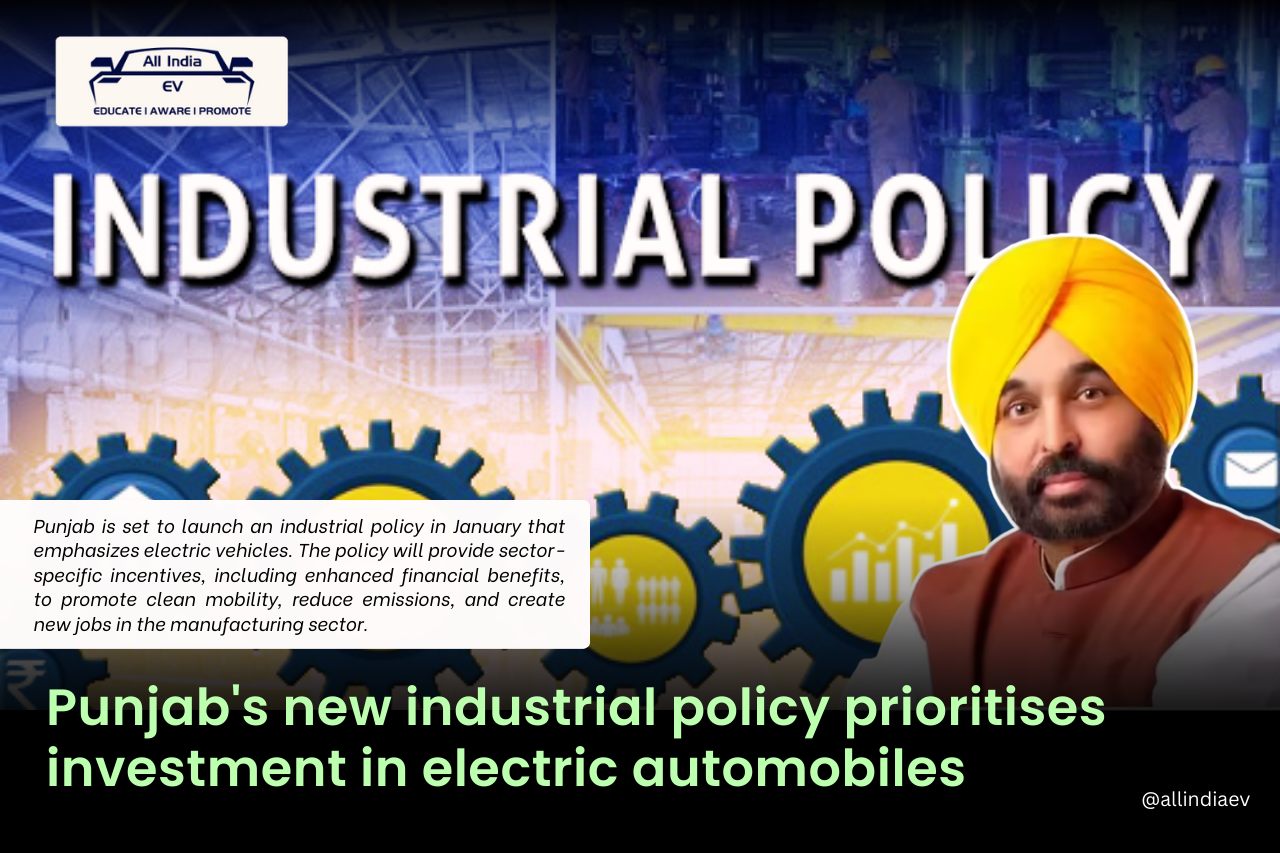

Punjab to Launch New Industrial Policy in January Focused on EVs, Offering Sector-Specific Incentives to Boost Clean Mobility and Manufacturing Jobs
Punjab is set to make electric vehicles (EVs) a cornerstone of its industrial growth strategy, as the state prepares to roll out a revamped industrial policy aimed at attracting fresh investments in clean and future-ready manufacturing sectors. The new policy, expected to be launched in January, is in the final stages of consultation and will offer enhanced, sector-specific incentives for EV manufacturing and allied industries.
According to senior state officials, electric mobility will receive preferential treatment over traditional manufacturing sectors, aligning with Punjab’s clean energy roadmap and broader environmental goals.
Higher Incentives for EV Manufacturing
Under the upcoming policy, EV manufacturers will be eligible for incentives that are up to 25% higher than those offered to other sectors. The state is also planning to introduce a sales-linked incentive (SLI) for EV manufacturers, modeled on the Centre’s Production Linked Incentive (PLI-Auto) scheme.
Punjab’s Minister for Industry and Commerce, Investment Promotion, Power and NRI Affairs, Sanjeev Arora, said the state-level SLI scheme would be designed to complement and be clubbed with the central PLI-Auto incentives, offering manufacturers a stronger financial push to set up or expand operations in the state.
“If we are offering 100% incentives to other sectors, the incentives to the EV sector will be 125%,” Arora said, highlighting the government’s intent to position Punjab as a competitive EV manufacturing destination.
Comprehensive Incentive Package
The new industrial policy will offer a bouquet of fiscal and non-fiscal incentives to EV manufacturers and component suppliers, including:
More EV News
- State GST exemptions
- Stamp duty waivers
- Electricity duty concessions
- Land-related benefits
- Fast-track approvals and clearances
These measures are aimed at reducing project costs, shortening execution timelines, and improving ease of doing business for EV players across the value chain, from vehicle assembly to components and sub-systems.
Focus on Clean Mobility and Job Creation
Punjab’s renewed focus on EVs is driven by dual objectives—emissions reduction and industrial employment generation. Electric vehicles, which produce zero tailpipe emissions, align with the state’s ambition to lower pollution levels while creating high-quality manufacturing jobs.
Officials believe Punjab’s strong road connectivity, proximity to northern markets, and availability of skilled manpower make it a cost-effective alternative to more saturated manufacturing hubs.
Discussions With EV and Auto Players
The Punjab government is already in talks with several industry players to explore potential investments under the new policy framework. These include SML Mahindra (formerly SML Isuzu), EV component maker Hero Cycles, and local commercial EV manufacturer EVAge.
While official confirmations from the companies are awaited, state officials indicated that active engagement with OEMs and component manufacturers is underway to build a robust EV ecosystem in Punjab.
Rising Competition Among States
Punjab’s push comes amid intensifying competition among Indian states to attract EV investments. States such as Maharashtra, Tamil Nadu, Karnataka, and Haryana have already rolled out aggressive EV policies to lure vehicle makers, battery manufacturers, and charging infrastructure companies.
Earlier this year, EV players including Ather Energy, Everta, and VinFast publicly praised state-level manufacturing incentives, highlighting the role of tax benefits, power subsidies, and land incentives in influencing investment decisions.
Benchmarking Against Other EV Policies
Several states have already set strong benchmarks:
- Karnataka’s EV Policy 2025–2030 offers capital subsidies of 20–25% on fixed asset investments for EV manufacturers, component suppliers, charging infrastructure providers, and battery manufacturers. The state currently hosts over 5,400 public charging stations and more than 250,000 EVs.
- Maharashtra’s EV Policy 2025–2030 identifies EVs as a “thrust sector”, offering 20% fiscal incentives for manufacturers setting up operations in the state.
- Tamil Nadu’s 2023 EV Policy allows manufacturers to choose between a 100% SGST waiver for 15 years, a turnover-linked subsidy, or a 10% capital subsidy for new manufacturing units above ₹50 crore. Battery manufacturing projects can receive up to 20% capital subsidy.
Punjab’s new policy is expected to match or exceed these offerings, particularly through its proposed sales-linked incentive model.
EV Adoption Continues to Rise
The surge in state-level incentives coincides with steady growth in EV adoption across India. More than two million electric vehicles were sold in 2025, up from approximately 1.9 million units in 2024, reflecting rising consumer acceptance and improving infrastructure.
However, industry experts caution that meeting long-term electrification targets will require sustained investment across the ecosystem, including manufacturing capacity expansion, R&D, and financing support.
Industry Perspective
EV financiers and industry stakeholders see 2025 as a promising year but stress the need for continued momentum. Kunal Mundra, founder and CEO of Astranova Mobility, said India remains broadly on track to achieve 30% EV adoption by 2030, but warned that progress must be uniform across the value chain.
“We can grow only as fast as our slowest ecosystem participants,” Mundra said, emphasizing the importance of scaling production capacity, especially for larger vehicles like electric buses, while strengthening value engineering and R&D to reduce overall ownership costs.
Looking Ahead
With its new industrial policy, Punjab is positioning itself as an emerging EV manufacturing hub in North India, leveraging policy incentives, infrastructure strengths, and a clean mobility vision. If successfully implemented, the policy could attract fresh investments, generate employment, and accelerate India’s broader transition to electric mobility.
Comment by Author:
Punjab’s decision to place electric vehicles at the core of its new industrial policy reflects a timely recognition that future industrial growth must align with clean mobility and sustainability goals. By offering higher, sales-linked incentives and fast-tracking approvals, the state is signaling serious intent to compete with established EV hubs.
The real test, however, will lie in swift execution and long-term policy stability, which are critical for investor confidence. If implemented effectively, Punjab’s EV-focused strategy could emerge as a strong North Indian counterweight in India’s rapidly evolving electric mobility landscape.