

Reliance’s Challenges Highlight Wider Constraints for Indian Firms Supporting PM Modi’s Net-Zero 2070 Goal Amid Fragile India-China Ties
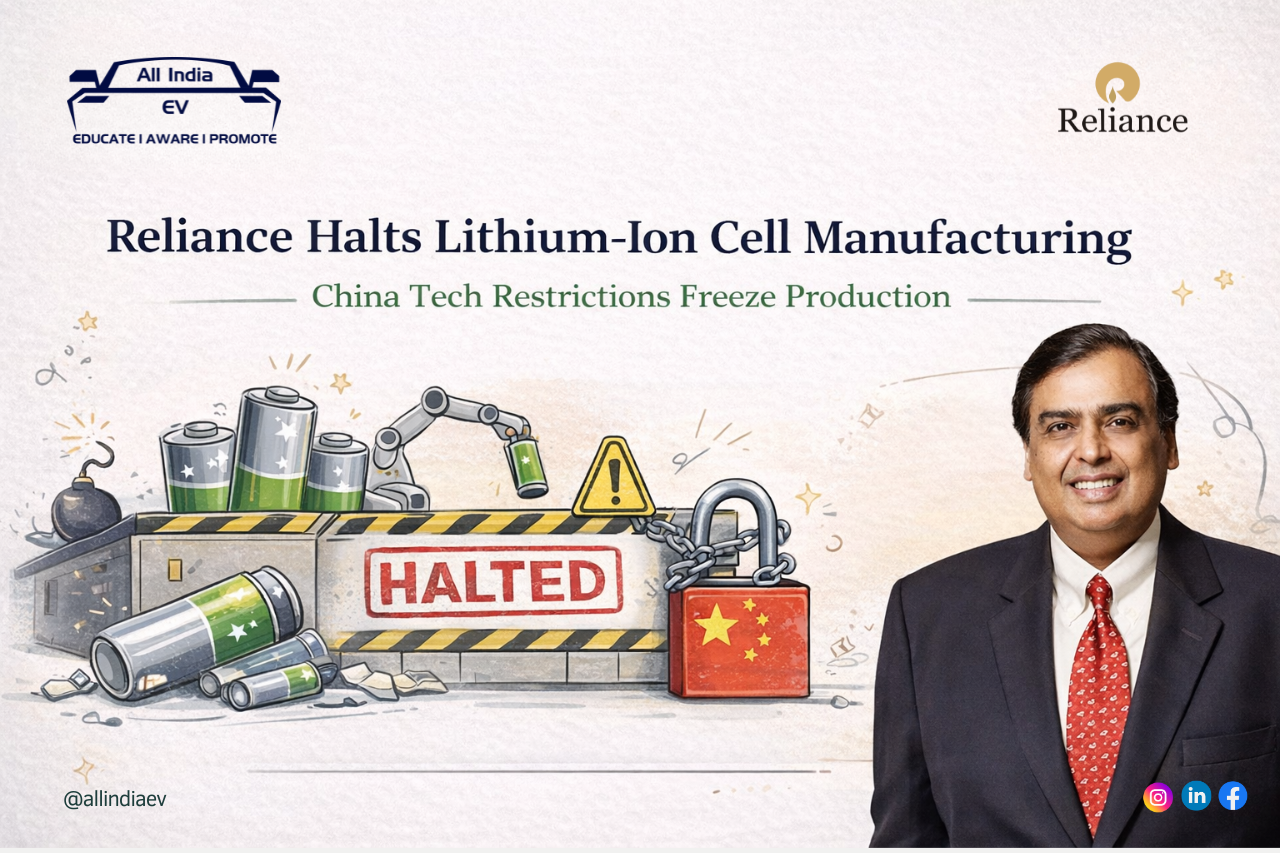
Reliance Industries has put on hold its plans to manufacture lithium-ion battery cells in India after being unable to secure technology licensing from a Chinese partner, according to a Bloomberg report citing people familiar with the matter. The development underscores the growing challenges faced by Indian conglomerates in building a self-reliant clean-energy supply chain amid tightening Chinese controls on the export of strategic technologies.
The Mukesh Ambani-led conglomerate had been aiming to begin lithium-ion cell manufacturing in 2025 and was in advanced discussions with Xiamen Hithium Energy Storage Technology to license lithium iron phosphate (LFP) battery cell technology. However, those talks stalled after the Chinese company withdrew from the proposed partnership, following Beijing’s stricter scrutiny of overseas technology transfers in clean-energy and advanced manufacturing sectors.
Shift in Focus to Energy Storage Systems
Following the setback, Reliance has redirected its near-term focus towards assembling battery energy storage systems (BESS) containerised energy storage units primarily to support its own renewable power projects. These systems are critical for balancing intermittent solar and wind generation and are increasingly seen as a near-term solution while domestic cell manufacturing capabilities remain constrained.
While the pause in cell manufacturing is not expected to have an immediate financial impact on Reliance given that the bulk of its revenues continue to come from oil refining, petrochemicals, and consumer-facing businesses it highlights execution risks tied to the company’s broader green energy ambitions.
A spokesperson for Reliance said there has been no change in the company’s overall strategy. “BESS manufacturing, battery pack manufacturing and cell manufacturing have always been part of our energy storage plans, and we are progressing well in their execution,” the spokesperson said, declining to comment on specific engagements with Xiamen Hithium. The Chinese company did not respond to requests for comment.
China’s Tech Curbs Complicate Localisation
China has in recent years stepped up oversight of clean-energy technology exports as it seeks to protect its strategic dominance in batteries, solar modules, and electric vehicle supply chains. These restrictions have complicated localisation efforts for overseas manufacturers, including Indian firms seeking to reduce dependence on imports.
More EV News

Reliance’s experience reflects a broader challenge confronting Indian companies expected to support Prime Minister Narendra Modi’s target of achieving net-zero carbon emissions by 2070. Fragile bilateral ties between New Delhi and Beijing have further added to the uncertainty surrounding technology partnerships.
In August last year, Ambani told shareholders that Reliance’s proposed battery gigafactory would begin operations in 2026. However, internal assessments reportedly concluded that proceeding without proven Chinese cell technology would significantly raise costs and execution risks particularly at a time when global battery markets are grappling with excess capacity and falling prices.
Alternative battery technologies sourced from Japan, Europe, and South Korea were also evaluated, but were found to be substantially more expensive for large-scale deployment in India, people familiar with the discussions said.
Industry-Wide Push and Limitations on Localisation
The challenges faced by Reliance are mirrored across India Inc. Groups such as Adani Group and JSW Group, both of which have outlined ambitious clean-energy expansion plans, are currently prioritising battery pack manufacturing and containerised storage assembly over full-scale cell production as they scout for viable technologies.
India has been pushing aggressively to build domestic battery manufacturing capacity to cut reliance on imports. In 2022, Reliance New Energy emerged as one of the winners under the government’s production-linked incentive (PLI) scheme for advanced chemistry cell manufacturing, which offers subsidies linked to project milestones.
However, earlier this year, Reliance New Energy was penalised for missing certain deadlines under the scheme, highlighting the limits of policy incentives at a time when cheaper Chinese batteries continue to flood global markets.
Storage Investments Gather Pace
With cell manufacturing facing constraints, investments in energy storage systems are accelerating. Adani Group announced plans in November to develop a multi-billion-dollar BESS project in western India with a proposed capacity of 1,126 megawatts. Meanwhile, JSW Group has begun operating a 30-megawatt BESS pilot project in Karnataka for captive industrial use.
India’s energy storage market is expected to expand rapidly in the coming decade. According to estimates by BloombergNEF, the country’s storage capacity could reach around 87 gigawatts by 2035 more than 300 times the capacity installed in 2024.
Company Reiterates Long-Term Commitment
In a statement, Reliance Industries said, “We would like to categorically affirm that there has been no change in our plans for creating a world-leading battery storage manufacturing ecosystem from cell to containerised ESS, and they are progressing well in line with our target timelines.”
The company added that further updates on its new energy initiatives and other businesses would be shared during its next quarterly earnings call, scheduled for January 16, 2026.
Despite near-term hurdles, industry observers say Reliance’s long-term clean-energy vision remains intact, even as geopolitical realities reshape the pace and pathways of India’s energy transition.