
All India EVAll India EVAll India EV
Notification
Font ResizerAa
  • Home
  • EV News
  • EV Launch
  • Market Insights
  • Investments & Funding
  • Guest Articles
  • EV Engineering
  • Contact
Reading: Reliance Pauses Lithium-Ion Cell Manufacturing Plans Amid China Tech Curbs: Report
Share
All India EVAll India EV
Font ResizerAa
  • Home
  • EV News
  • EV Launch
  • Market Insights
  • Guest Articles
  • EV Engineering
  • Contact
Search
  • Home
    • Home 1
    • Home 2
    • Home 3
    • Home 4
    • Home 5
  • Home
  • Categories
    • Electric
  • Categories
  • Shows
    • Rap
  • More Foxiz
    • Blog Index
    • Contact
  • Bookmarks
    • Customize Interests
    • My Bookmarks
  • More Foxiz
    • Blog Index
    • Sitemap
Have an existing account? Sign In
Follow US
Reliance Pauses Lithium-Ion
Home » Blog » Reliance Pauses Lithium-Ion Cell Manufacturing Plans Amid China Tech Curbs: Report
EV News

Reliance Pauses Lithium-Ion Cell Manufacturing Plans Amid China Tech Curbs: Report

Sunita
By
Sunita
Last updated: 13 January 2026
Share
6 Min Read
SHARE

Reliance’s Challenges Highlight Wider Constraints for Indian Firms Supporting PM Modi’s Net-Zero 2070 Goal Amid Fragile India-China Ties

Contents
  • Shift in Focus to Energy Storage Systems
  • China’s Tech Curbs Complicate Localisation
  • Industry-Wide Push and Limitations on Localisation
  • Storage Investments Gather Pace
  • Company Reiterates Long-Term Commitment

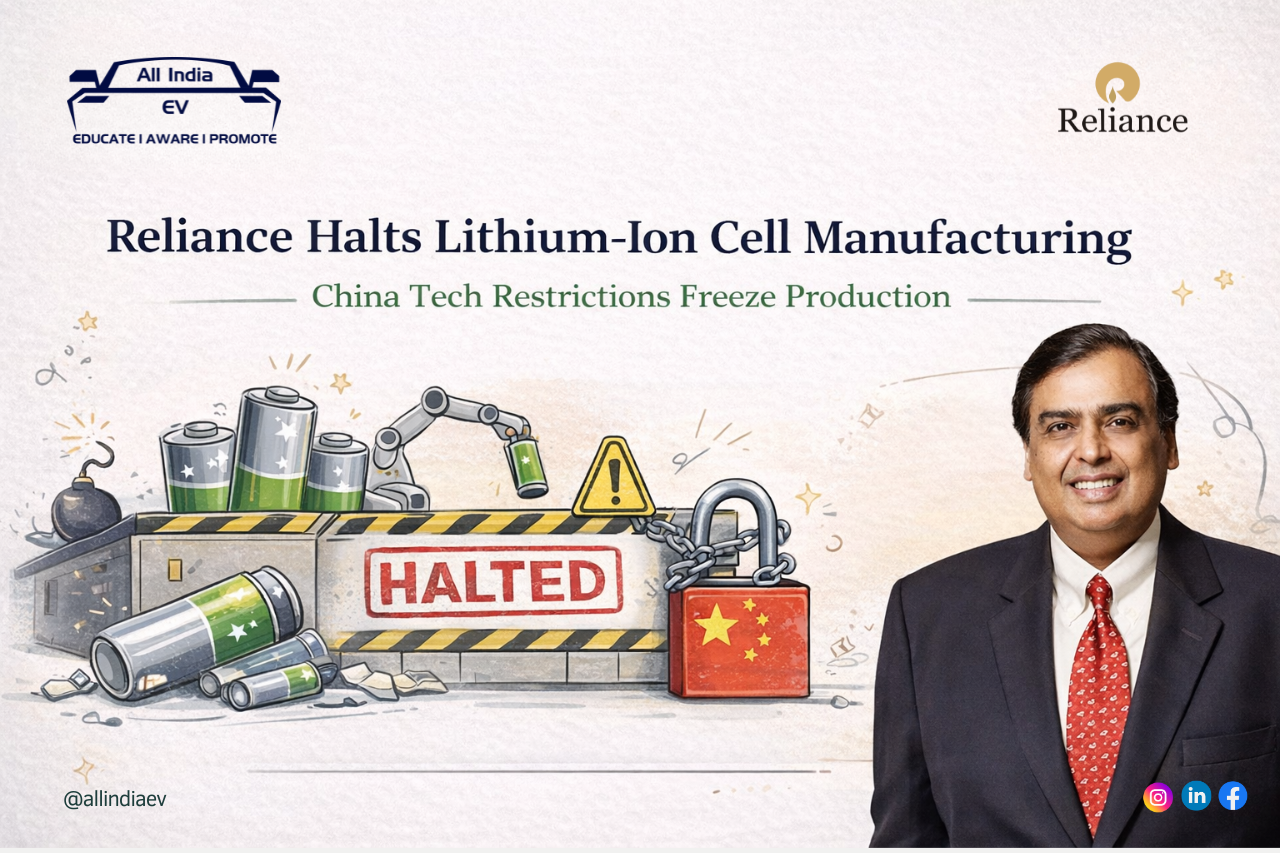
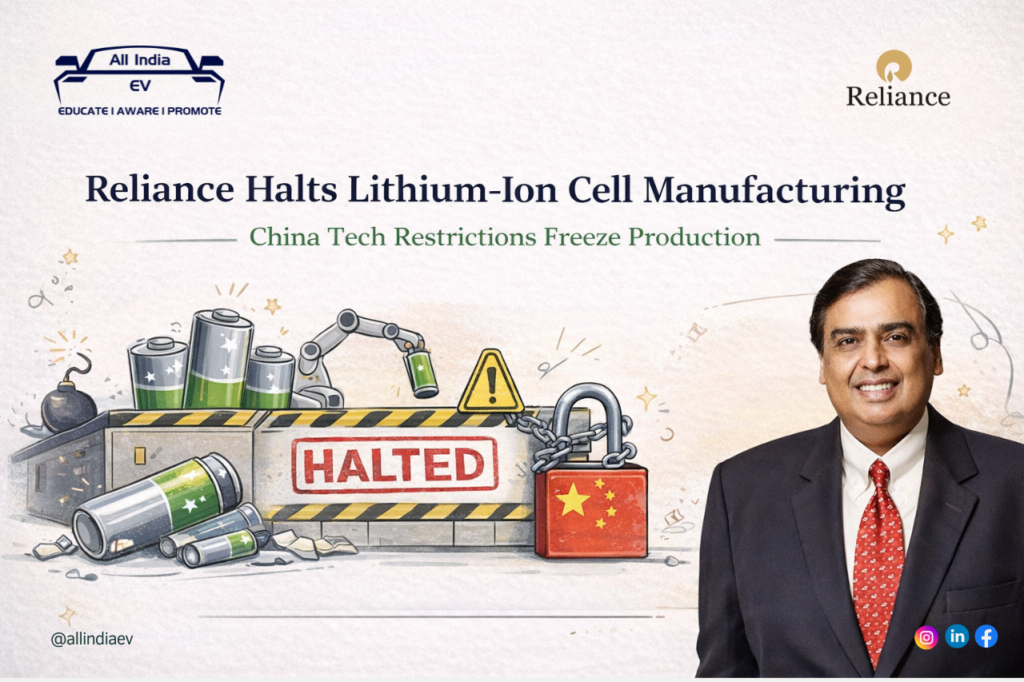
Reliance Industries has put on hold its plans to manufacture lithium-ion battery cells in India after being unable to secure technology licensing from a Chinese partner, according to a Bloomberg report citing people familiar with the matter. The development underscores the growing challenges faced by Indian conglomerates in building a self-reliant clean-energy supply chain amid tightening Chinese controls on the export of strategic technologies.

The Mukesh Ambani-led conglomerate had been aiming to begin lithium-ion cell manufacturing in 2025 and was in advanced discussions with Xiamen Hithium Energy Storage Technology to license lithium iron phosphate (LFP) battery cell technology. However, those talks stalled after the Chinese company withdrew from the proposed partnership, following Beijing’s stricter scrutiny of overseas technology transfers in clean-energy and advanced manufacturing sectors.


Shift in Focus to Energy Storage Systems

Following the setback, Reliance has redirected its near-term focus towards assembling battery energy storage systems (BESS) containerised energy storage units primarily to support its own renewable power projects. These systems are critical for balancing intermittent solar and wind generation and are increasingly seen as a near-term solution while domestic cell manufacturing capabilities remain constrained.

While the pause in cell manufacturing is not expected to have an immediate financial impact on Reliance given that the bulk of its revenues continue to come from oil refining, petrochemicals, and consumer-facing businesses it highlights execution risks tied to the company’s broader green energy ambitions.

A spokesperson for Reliance said there has been no change in the company’s overall strategy. “BESS manufacturing, battery pack manufacturing and cell manufacturing have always been part of our energy storage plans, and we are progressing well in their execution,” the spokesperson said, declining to comment on specific engagements with Xiamen Hithium. The Chinese company did not respond to requests for comment.


China’s Tech Curbs Complicate Localisation

China has in recent years stepped up oversight of clean-energy technology exports as it seeks to protect its strategic dominance in batteries, solar modules, and electric vehicle supply chains. These restrictions have complicated localisation efforts for overseas manufacturers, including Indian firms seeking to reduce dependence on imports.

More EV News

India Backs for EV Tariff Cuts to Boost US Trade Deal, Despite Opposition from Local Automakers
Tata Motors Hits 25,000 Public EV Charging Stations for SCVs, Targets 25,000 Next
Lectrix EV Unveils E2W at Price of INR 49,999 With Battery Subscription Model
EV push could raise import bill faster than it cuts crude oil dependence initially
4 EV Infrastructure Stocks Powering India’s Electric Mobility Growth

Reliance’s experience reflects a broader challenge confronting Indian companies expected to support Prime Minister Narendra Modi’s target of achieving net-zero carbon emissions by 2070. Fragile bilateral ties between New Delhi and Beijing have further added to the uncertainty surrounding technology partnerships.

In August last year, Ambani told shareholders that Reliance’s proposed battery gigafactory would begin operations in 2026. However, internal assessments reportedly concluded that proceeding without proven Chinese cell technology would significantly raise costs and execution risks particularly at a time when global battery markets are grappling with excess capacity and falling prices.

Alternative battery technologies sourced from Japan, Europe, and South Korea were also evaluated, but were found to be substantially more expensive for large-scale deployment in India, people familiar with the discussions said.


Industry-Wide Push and Limitations on Localisation

The challenges faced by Reliance are mirrored across India Inc. Groups such as Adani Group and JSW Group, both of which have outlined ambitious clean-energy expansion plans, are currently prioritising battery pack manufacturing and containerised storage assembly over full-scale cell production as they scout for viable technologies.

India has been pushing aggressively to build domestic battery manufacturing capacity to cut reliance on imports. In 2022, Reliance New Energy emerged as one of the winners under the government’s production-linked incentive (PLI) scheme for advanced chemistry cell manufacturing, which offers subsidies linked to project milestones.

However, earlier this year, Reliance New Energy was penalised for missing certain deadlines under the scheme, highlighting the limits of policy incentives at a time when cheaper Chinese batteries continue to flood global markets.


Storage Investments Gather Pace

With cell manufacturing facing constraints, investments in energy storage systems are accelerating. Adani Group announced plans in November to develop a multi-billion-dollar BESS project in western India with a proposed capacity of 1,126 megawatts. Meanwhile, JSW Group has begun operating a 30-megawatt BESS pilot project in Karnataka for captive industrial use.

India’s energy storage market is expected to expand rapidly in the coming decade. According to estimates by BloombergNEF, the country’s storage capacity could reach around 87 gigawatts by 2035 more than 300 times the capacity installed in 2024.


Company Reiterates Long-Term Commitment

In a statement, Reliance Industries said, “We would like to categorically affirm that there has been no change in our plans for creating a world-leading battery storage manufacturing ecosystem from cell to containerised ESS, and they are progressing well in line with our target timelines.”

The company added that further updates on its new energy initiatives and other businesses would be shared during its next quarterly earnings call, scheduled for January 16, 2026.

Despite near-term hurdles, industry observers say Reliance’s long-term clean-energy vision remains intact, even as geopolitical realities reshape the pace and pathways of India’s energy transition.
Join All India EV Community

Click here for more such EV Updates

Loading
India Sees Growing Opportunity in Battery Swapping for EVs
RunR Mobility launches its EV showroom in Vadodara, Gujarat
Jindal Steel & Power Advances Toward Net Zero with Addition of 10 Electric Buses and 27 SUVs at Angul Unit
Gensol EV Achieves ARAI Certification for Groundbreaking EV, Poised to Transform Urban Mobility in India
Atul Greentech: Jio’s Advanced IoT Technology

Sign Up For Daily Newsletter

Be keep up! Get the latest breaking news delivered straight to your inbox.
Loading
By signing up, you agree to our Terms of Use and acknowledge the data practices in our Privacy Policy. You may unsubscribe at any time.
Share This Article
Facebook Whatsapp Whatsapp LinkedIn Copy Link Print
Leave a Comment

Leave a Reply Cancel reply

Your email address will not be published. Required fields are marked *

Follow US
XFollow
InstagramFollow
YoutubeSubscribe
LinkedInFollow
EV push could raise import bill faster than it cuts crude oil dependence initially
15 May 2026
Musashi India signs LOI with Kinetic Green for 2W EV powertrain supply
15 May 2026
What: Eicher has completed a Kashmir-to-Kanyakumari (K2K) endurance run using its fully loaded Eicher Pro X EV commercial truck, positioning the campaign as a real-world validation of electric logistics capability in India. The company claims the vehicle became the first and fastest electric commercial vehicle to complete the route under loaded operating conditions. The Number: The Eicher Pro X EV covered over 4,000 km in six days across diverse terrain and temperature conditions ranging from approximately -2°C to 40°C, while setting four India Book of Records milestones during the journey. The Impact: The Eicher Pro X EV Kashmir Kanyakumari run directly addresses one of the biggest concerns in India’s electric commercial vehicle segment — operational reliability over long distances. The campaign also highlights the growing viability of public charging infrastructure for commercial EV deployment. The Core News VE Commercial Vehicles, through its Eicher Trucks and Buses division, has launched a proof-focused electric mobility campaign centred around the Eicher Pro X EV’s successful Kashmir-to-Kanyakumari expedition. The campaign, branded around the “#XpertHaiTohPossibleHai” initiative, is aimed at demonstrating practical commercial EV readiness instead of relying solely on specification-based marketing claims. The vehicle reportedly completed the Srinagar-to-Kanyakumari route while operating under fully loaded conditions, travelling through highways, plains, ghats, urban corridors, and varying climate zones. Eicher stated that the vehicle depended on public charging infrastructure accessed through the MyEicher App ecosystem during the expedition. The company used third-party validation through the India Book of Records to independently verify route compliance, charging stops, distance covered, and operational conditions. The campaign reflects a broader shift underway in India’s commercial EV industry, where manufacturers are increasingly focusing on operational economics, fleet confidence, uptime assurance, and infrastructure reliability rather than only announcing vehicle launches. Long-haul and mid-mile logistics remain one of the most difficult electrification segments due to concerns around charging availability, payload impact, range predictability, and route downtime. Eicher’s demonstration appears strategically designed to reduce these concerns for fleet operators evaluating electric truck adoption. Breaking Down the Update • The Eicher Pro X EV completed a Kashmir-to-Kanyakumari expedition under loaded commercial operating conditions • The journey covered more than 4,000 km in six days across multiple terrain conditions • Eicher claims the run established four India Book of Records milestones • Public charging infrastructure was used throughout the route via the MyEicher App ecosystem • The campaign focused on proving operational reliability instead of conventional promotional messaging • The route included highways, mountainous regions, urban corridors, and coastal stretches • The initiative targets commercial fleet operators evaluating electric logistics deployment • The campaign aligns with India’s broader decarbonisation and green logistics objectives How Eicher Pro X EV Kashmir Kanyakumari run will help Indian EV Market The Eicher Pro X EV Kashmir Kanyakumari run could become an important reference point for India’s electric commercial vehicle sector because it focuses on real operational validation instead of controlled test conditions. One of the largest barriers to electric truck adoption in India has been fleet operator hesitation around range reliability, charging access, payload capability, and uptime consistency during long-distance movement. By completing a loaded multi-state logistics route using public charging infrastructure, Eicher is attempting to demonstrate that electric commercial vehicles can gradually move beyond short urban delivery applications into more demanding logistics operations. This is particularly important for India’s mid-mile and intra-city freight segments, where electrification potential remains significant but operational confidence is still developing. The campaign also indirectly highlights improvements in India’s charging infrastructure ecosystem. Commercial EV adoption depends heavily on charger availability, route planning tools, energy management systems, and service support networks. Demonstration runs like this help validate ecosystem readiness for fleet operators who typically evaluate vehicles based on total operational efficiency rather than environmental positioning alone. If more OEMs begin showcasing real-world logistics deployment data instead of laboratory claims, the Indian commercial EV sector could move faster toward practical fleet electrification and wider private-sector adoption. Conclusion & Next Steps The Eicher Pro X EV Kashmir Kanyakumari run reflects a growing maturity in India’s electric commercial vehicle market, where operational proof is becoming more valuable than launch announcements alone. The next challenge will involve scaling charging reliability, lowering fleet transition costs, and ensuring consistent uptime performance under commercial deployment conditions. As electric logistics adoption expands, real-world validation exercises like this are likely to become increasingly important for fleet decision-making across India’s freight sector
Eicher sets new EV benchmark with K2K campaign
15 May 2026
All India EV: Edition 49
What all happened in April 2026?
Click Here
All India EV

Daily EV Industry updates for you…

Categories

  • EV News
  • EV Launch
  • Investments & Funding
  • Market Insights
  • Guest Articles
  • EV Engineering

Quick Links

  • Community
  • Content Services
  • Branding Services
  • My EV Charger
  • Substack

© Developed and Managed by “The Energy Log”

Welcome Back!

Sign in to your account

Username or Email Address
Password

Lost your password?

Not a member? Sign Up