

Government Unveils Policy, Financial and Regulatory Framework to Power Renewable Transition and Grid Stability
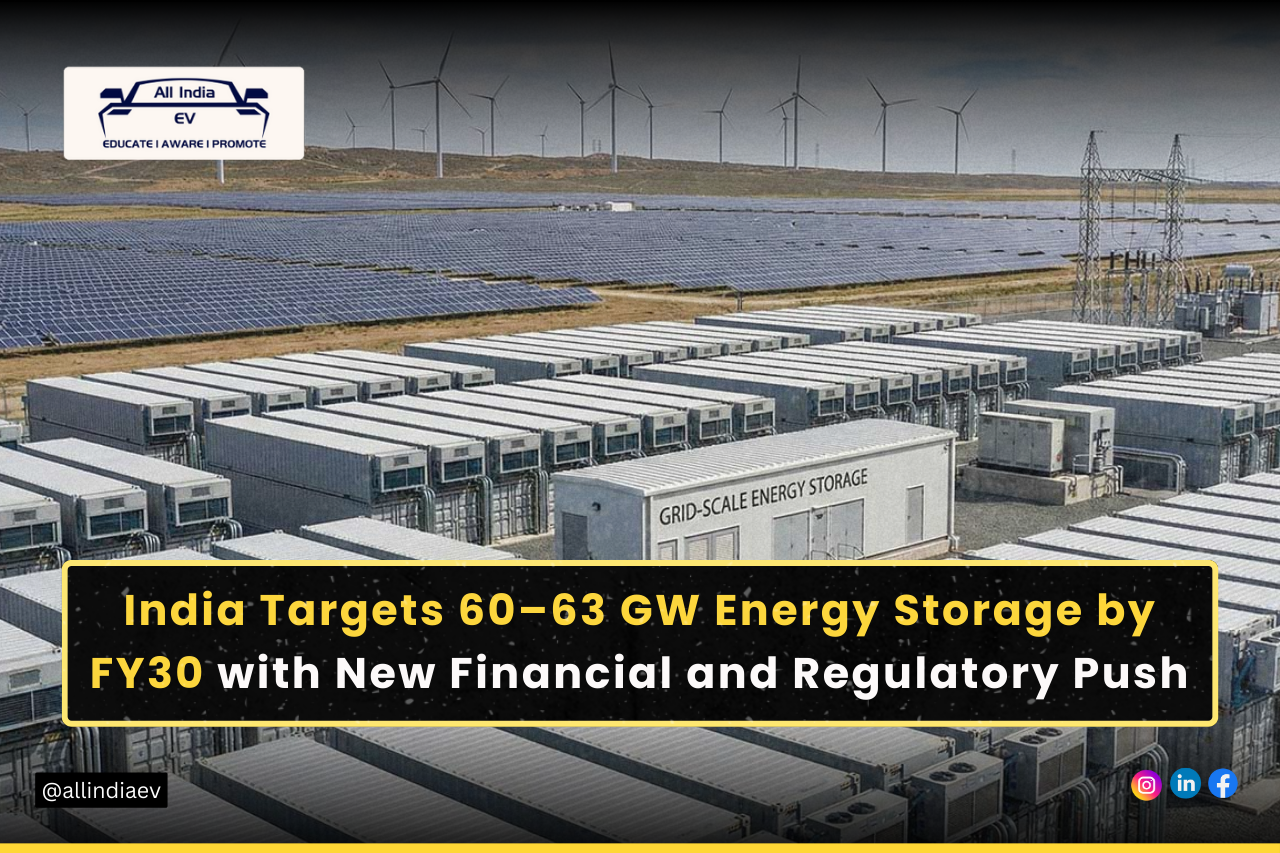
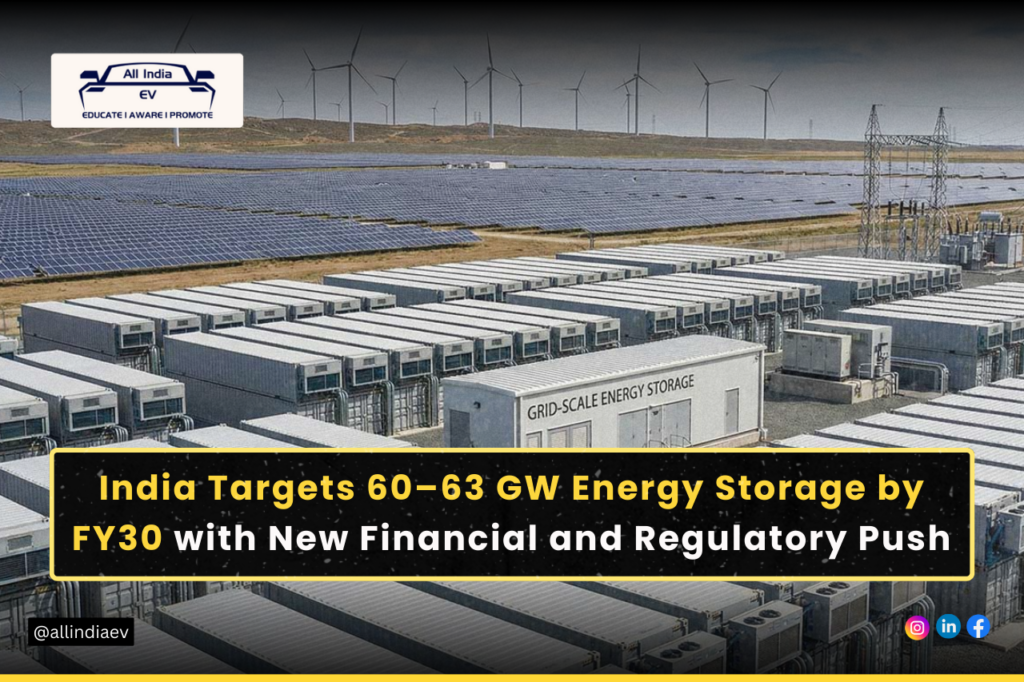
The Government of India has unveiled an ambitious multi-pronged policy, financial, and regulatory roadmap aimed at developing 60.63 gigawatts (GW) of energy storage capacity by financial year 2030, a critical milestone in supporting the nation’s clean energy and grid stability objectives.
According to the Central Electricity Authority (CEA) report titled Optimal Generation Mix 2030, India will require 60.63 GW of energy storage infrastructure by 2029-30 to accommodate the growing share of renewable energy in the power mix. This target includes approximately 18.98 GW from Pumped Storage Projects (PSP) and 41.65 GW from Battery Energy Storage Systems (BESS).
Energy storage has become a strategic priority for India’s energy transition drive, as intermittent renewable resources like solar and wind power require robust storage solutions to ensure grid reliability, peak-time flexibility, and uninterrupted power supply.
Comprehensive Policy and Regulatory Reforms
The Ministry of New and Renewable Energy (MNRE) has issued a set of guidelines to standardise the procurement and utilisation of BESS across generation, transmission, and distribution assets, including provisions for ancillary services. A national energy storage framework and tailored PSP guidelines have also been put in place to stimulate sector growth.
A key incentive announced under the roadmap is the 100 % waiver of Inter-State Transmission System (ISTS) charges for PSP projects awarded on or before June 30, 2028. A similar waiver has been extended to co-located BESS projects that meet the prescribed commissioning timelines and criteria, significantly reducing upfront project costs and encouraging faster deployment.
Financial Support Through Targeted Schemes
To boost investment in energy storage infrastructure, the government has implemented multiple Viability Gap Funding (VGF) schemes:
More EV News

- In March 2024, a ₹3,760 crore VGF program was approved to support the development of 13,220 MWh of large-scale BESS, offering ₹27 lakh per MWh in financial support.
- In June 2025, an additional VGF scheme worth ₹5,400 crore under the Power System Development Fund (PSDF) was sanctioned for 30 GWh of BESS capacity, providing ₹18 lakh per MWh.
- A further 10 GWh allocation has been designated under the National Programme on Advanced Chemistry Cell (ACC) Battery Storage to support grid-scale stationary storage.
These initiatives are aimed at lowering capital costs, improving project viability, and attracting greater private investment into the energy storage market.
Focus on R&D and Domestic Manufacturing
Recognising the importance of self-reliance, the government is placing strong emphasis on research and development as well as domestic manufacturing. Under the Renewable Energy Research and Technology Development Programme, research institutions and industry partners are receiving funding to advance cost-effective energy storage solutions.
Furthermore, the Department of Science and Technology (DST), through its Clean Energy Material Initiative (CEMI), is supporting multiple R&D projects focused on next-generation storage materials and devices. This effort is designed to nurture indigenous innovation and reduce dependency on imported technology.
Strategic Implications for India’s Energy Future
Experts say these coordinated initiatives not only lay the foundation for large-scale energy storage deployment, but also position India to become a global leader in clean energy technologies. By building a robust storage ecosystem, the country aims to enhance grid flexibility, attract investments, create jobs, and accelerate its journey toward net-zero emissions.