

Chinese EV major advances parallel strategies to improve range, charging speed, cost, and battery lifespan
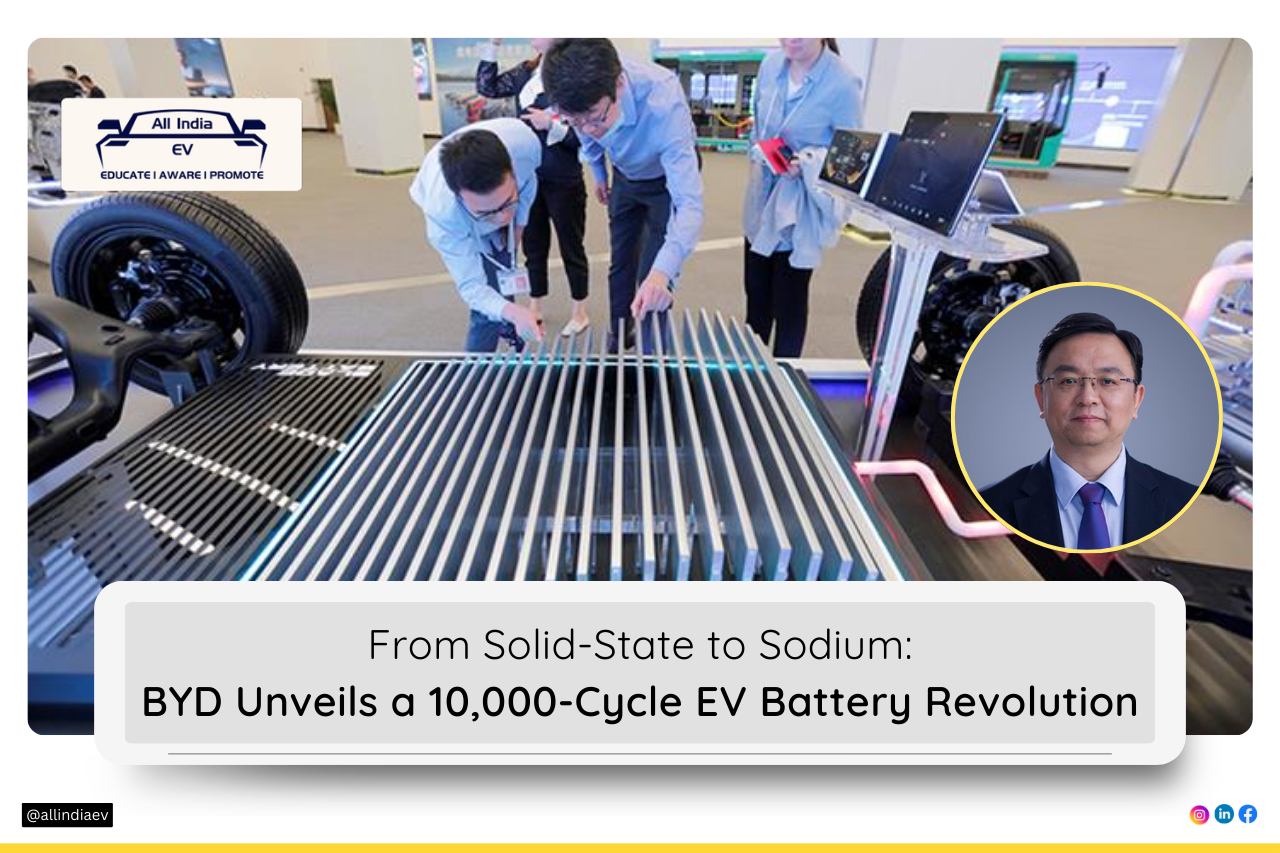
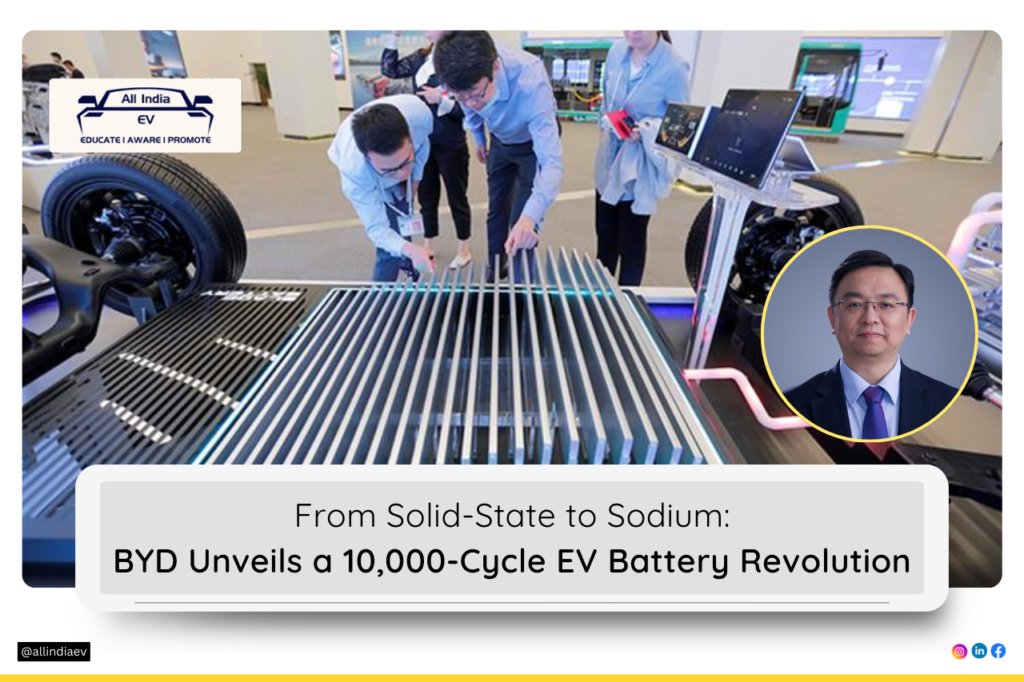
Chinese electric vehicle and battery powerhouse BYD has unveiled a major breakthrough in electric-vehicle battery technology, claiming its next-generation systems could handle up to 10,000 charge cycles a dramatic leap forward in durability, longevity and real-world value for EV owners and the broader energy storage market.
In a dual-track development strategy, BYD is simultaneously advancing two types of battery technologies: a third-generation sodium-ion platform designed for extreme longevity and cost-effectiveness and a solid-state battery program targeted at high energy density and fast-charging performance.
10,000 Cycles: What It Means for EV Owners
Most traditional EV batteries primarily lithium-ion based are designed to last between about 1,500 and 3,000 full charge cycles before degrading meaningfully. BYD’s latest sodium-ion technology, according to company data and industry sources, could endure as many as 10,000 cycles, potentially allowing vehicles to operate for decades under normal use, while significantly reducing lifetime ownership costs.
To put that into perspective: even with daily charging, a vehicle equipped with such a battery might theoretically retain usable capacity for more than 20 years, far beyond the typical lifespan of today’s EV batteries.
The sodium-ion chemistry also promises other practical advantages, such as the use of more abundant, lower-cost materials and enhanced safety characteristics compared with some lithium-ion chemistries.
More EV News
Parallel Progress in Solid-State Technology
Alongside the longevity-focused sodium-ion work, BYD is pushing forward with sulfide-based solid-state batteries, a technology long considered the next big step in EV energy storage. Solid-state designs replace the liquid electrolyte used in conventional batteries with a solid counterpart, which can boost energy density, safety and charge rates.
BYD reports measurable progress toward small-batch production of these solid-state cells by 2027, with future iterations expected to deliver higher energy densities and faster charging than today’s mainstream battery packs.
Industry analysts view the simultaneous pursuit of both paths sodium-ion for longevity and solid-state for energy density and performance as a strategic hedge that could position BYD ahead in the global EV battery race.
Future Impacts on EV Market and Beyond
While detailed specifications and mass-production timelines have not been fully disclosed, the implications of a 10,000-cycle battery are significant. Longer-lasting batteries could reduce the total cost of ownership for EV buyers and create new opportunities for second-life uses such as home energy storage or industrial backup systems.
BYD’s move also reinforces China’s broader leadership in EV and battery manufacturing, intensifying global competition with other major players like CATL and international automakers racing to commercialize advanced battery chemistries.
Experts caution that while lab results and early milestones are promising, mass commercialization, cost-effectiveness and real-world performance will determine how quickly these technologies reach mainstream vehicles. Nonetheless, BYD’s dual strategy signals a future where electric vehicles could be more durable, more affordable, and more capable than ever before.
Comment by Author:
BYD’s parallel push on sodium-ion longevity and solid-state performance reflects a pragmatic bet on two different market needs cost-stable, long-life batteries for mass adoption, and high-energy-density packs for premium EVs. If even one of these pathways scales commercially on time, it could materially shift EV total cost of ownership and accelerate second-life battery ecosystems. The real test, however, will be execution: manufacturing yields, safety validation, and pricing discipline will decide whether this breakthrough translates from lab promise to everyday roads.