

What: Vietnam-based EV maker VinFast is evaluating local battery assembly in India while preparing multiple EV launches this fiscal.
The Number: Battery packs account for ~30% of EV cost; current localisation stands at ~15%.
The Impact: Local battery assembly could significantly reduce costs and accelerate VinFast’s India localisation strategy.

The Core News
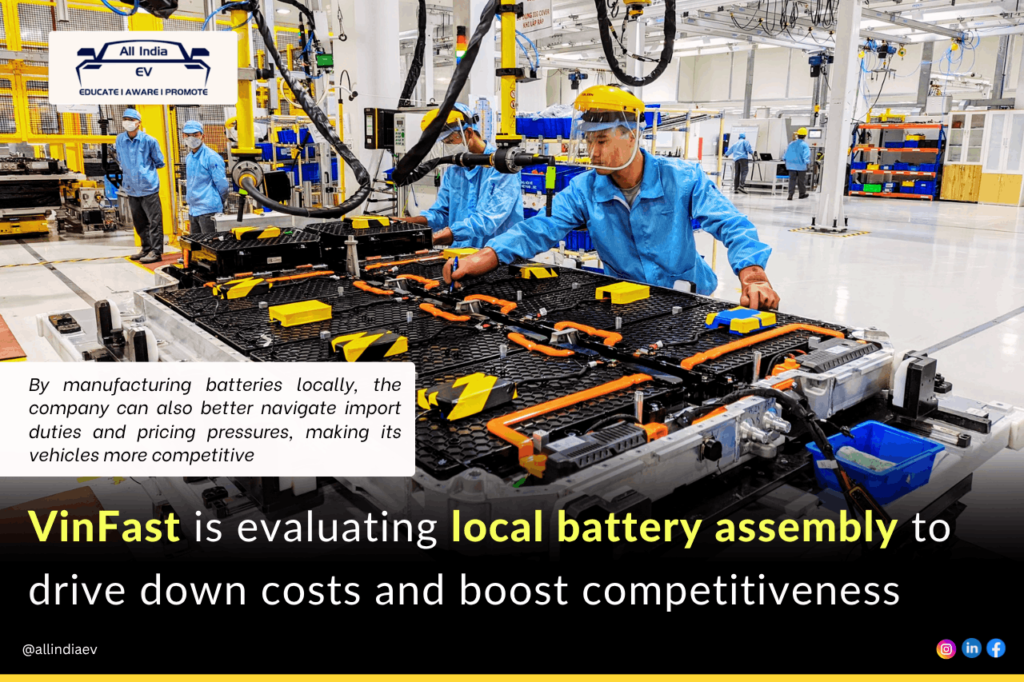
VinFast’s India push is entering a deeper execution phase, with the company actively exploring VinFast local battery assembly India as part of its localisation roadmap. The move is strategically aligned with reducing dependence on imports and improving cost competitiveness in a price-sensitive EV market.
Currently, the company imports battery packs from its Vietnam operations, but management has indicated that localisation of high-cost components is under active evaluation. With batteries contributing roughly one-third of EV costs, shifting to local assembly can materially impact pricing, margins, and supply chain resilience.
Alongside this, VinFast is scaling its product pipeline in India, including premium and mass-market EVs such as the VF MPV 7, while positioning the country as both a domestic market and an export hub. The strategy reflects a broader industry trend where global EV players are moving toward localisation to meet regulatory expectations and achieve long-term viability.
More EV News

Breaking Down the Update
• Battery localisation under evaluation; no confirmed timeline yet
• Current localisation level around 15%, expected to increase progressively
• Batteries contribute ~30–40% of EV cost, making them a priority
• New EV rollouts planned this fiscal across segments
• India being positioned as both a sales and export base
• Local supplier partnerships and sourcing expansion underway
How VinFast local battery assembly India will help Indian EV Market
The push toward VinFast local battery assembly India could play a meaningful role in strengthening the domestic EV ecosystem. Battery localisation is one of the most critical gaps in India’s EV value chain, and any incremental capacity, especially from global OEMs,adds depth to the supply network.
First, local assembly reduces cost pressures. Imported battery packs carry logistics, duties, and currency risks. By assembling batteries domestically, VinFast can potentially lower vehicle prices or improve margins, making EVs more competitive against ICE vehicles.
Second, it supports ecosystem development. Local battery assembly requires partnerships with cell suppliers, pack integrators, and component manufacturers. This can accelerate supplier base maturity and encourage technology transfer.
Third, it aligns with government localisation policies. India’s EV policies increasingly reward domestic value addition, and battery localisation directly contributes to meeting those thresholds.
Finally, it enhances supply chain resilience. With global battery supply chains under pressure, local assembly reduces dependency on imports and improves production stability.
Way Forward…
VinFast’s localisation intent signals a shift from market entry to long-term commitment, with VinFast local battery assembly India emerging as a critical lever for scale and cost optimisation. The key variables to watch will be execution timelines, supplier partnerships, and how quickly localisation translates into pricing advantage in an increasingly competitive EV market.
Read More: Catch up on All India EV’s related coverage on India’s evolving commercial EV subsidies and battery swapping policies at All India EV