


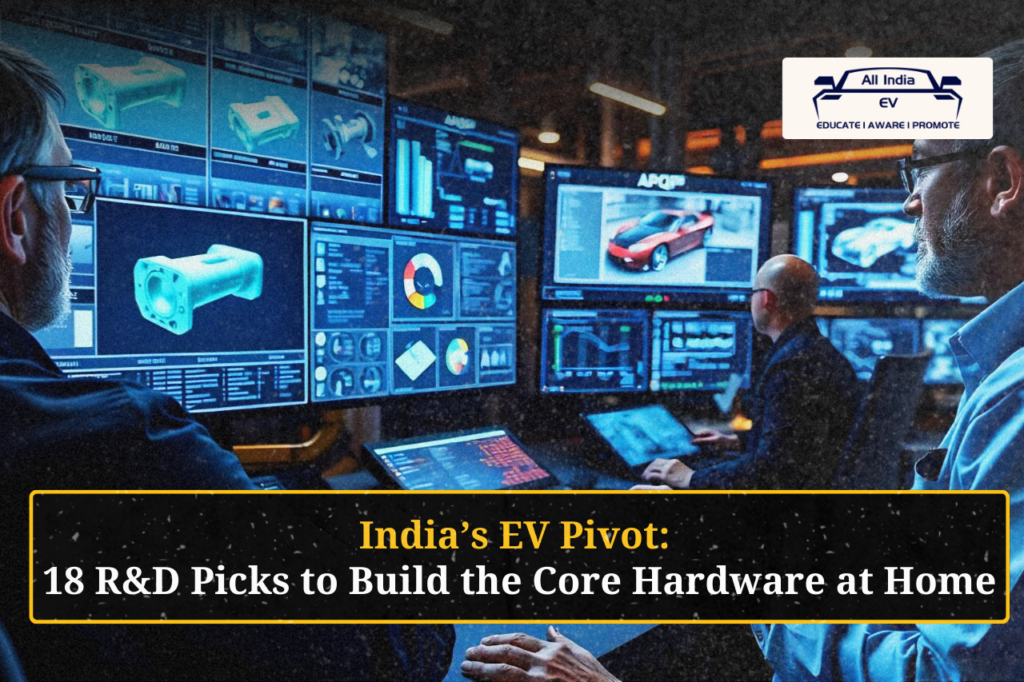
India has selected 18 research-and-development proposals aimed at domesticating high-value EV sub-systems—components that drive cost, performance, and reliability but are still largely imported (e.g., traction motors, inverters, power electronics, and smart charging gear).
The initiatives pair industry, academia, and government with an explicit push to move from prototypes to production, prioritizing “buildable” technologies over long-horizon research.
What’s being funded
The list stems from a joint MeitY–Ministry of Heavy Industries (MHI) call issued on October 21, 2024. Priority areas include:
- AC/DC charging and infrastructure,
- e-machines and drives,
- batteries and BMS,
- telematics,
- functional safety and cybersecurity, and
- prototyping/testing facilities.
Projects are expected at TRL 7+, meaning they should be near-commercial prototypes suitable for piloting within a typical vehicle model cycle.
According to officials familiar with the review, candidates include wireless charging solutions, traction powertrains, and associated control/power electronics—the exact areas where local content is thinnest and import exposure is highest. Final selections are being cleared jointly by MeitY and MHI.
Why this matters
This marks a deliberate shift from demand stimulation to supply-chain depth. Outside two- and three-wheelers, localisation in motors/controllers, high-power inverters, and advanced charging equipment often sits around ~30–40%. Those are the cost and IP hot zones—and the greatest geopolitical risk—so public R&D is being targeted there.
More EV News
Material concentration is a parallel concern. Rare-earth magnets and key motor inputs remain clustered in China, and recent curbs on magnet-related exports rattled Indian OEMs. Building domestic capability in motors and power electronics is the most direct hedge against such shocks.
How quickly could this hit production?
Because the program emphasizes TRL 7+, outputs should be pilot-ready within a couple of years, lining up with 2026–2028 refresh cycles—assuming partners move on tooling, validation, and qualification.
The consortium model assigns clear roles to OEMs/Tier-1s and labs, reducing the typical friction when moving from research to manufacturing.
IP and commercialization (for product teams)
IP and licensing terms are defined per project in the grant agreements. In comparable MeitY programs, domestic co-funding industry partners often receive non-exclusive, royalty-free rights to use project IP, but the definitive terms will be those in the sanctioned documents.
Align funding contributions with your exclusivity expectations.
Market context the program is reading
- Battery demand: India’s Li-ion usage was ~15 GWh in FY24 (EVs + consumer electronics) and is projected to rise to ~54 GWh by FY27 and ~127 GWh by FY30—a sharp ramp for BMS, thermal, safety, and pack electronics.
- R&D nodes: The MAHA-EV initiative under ANRF has designated e-nodes; institutes such as IIT-BHU are building national facilities for battery diagnostics and safety—useful proving grounds for the shortlisted work.
What to watch (for OEMs/Tier-1s/startups)
- Sanction letters and synopses: The first tranche will reveal leads, partners, and planned tech-transfer paths for FY26–FY28.
- Reference pilots: Especially in motors/inverters for buses/LCVs and in AC/DC fast charging, where cost and uptime are current chokepoints.
- Standards and validation: MHI’s role in harmonizing specs/testing will be pivotal to accelerating Tier-2 localisation and supplier qualification.
The takeaway
This is not another consumer-side subsidy. It’s a focused effort to build domestic strength in motors, power electronics, chargers, BMS, and the safety stack.
If execution stays tight, Indian suppliers could deliver credible, cost-competitive assemblies just as new model cycles hit—cutting forex exposure and giving OEMs a local route around supply disruptions.