
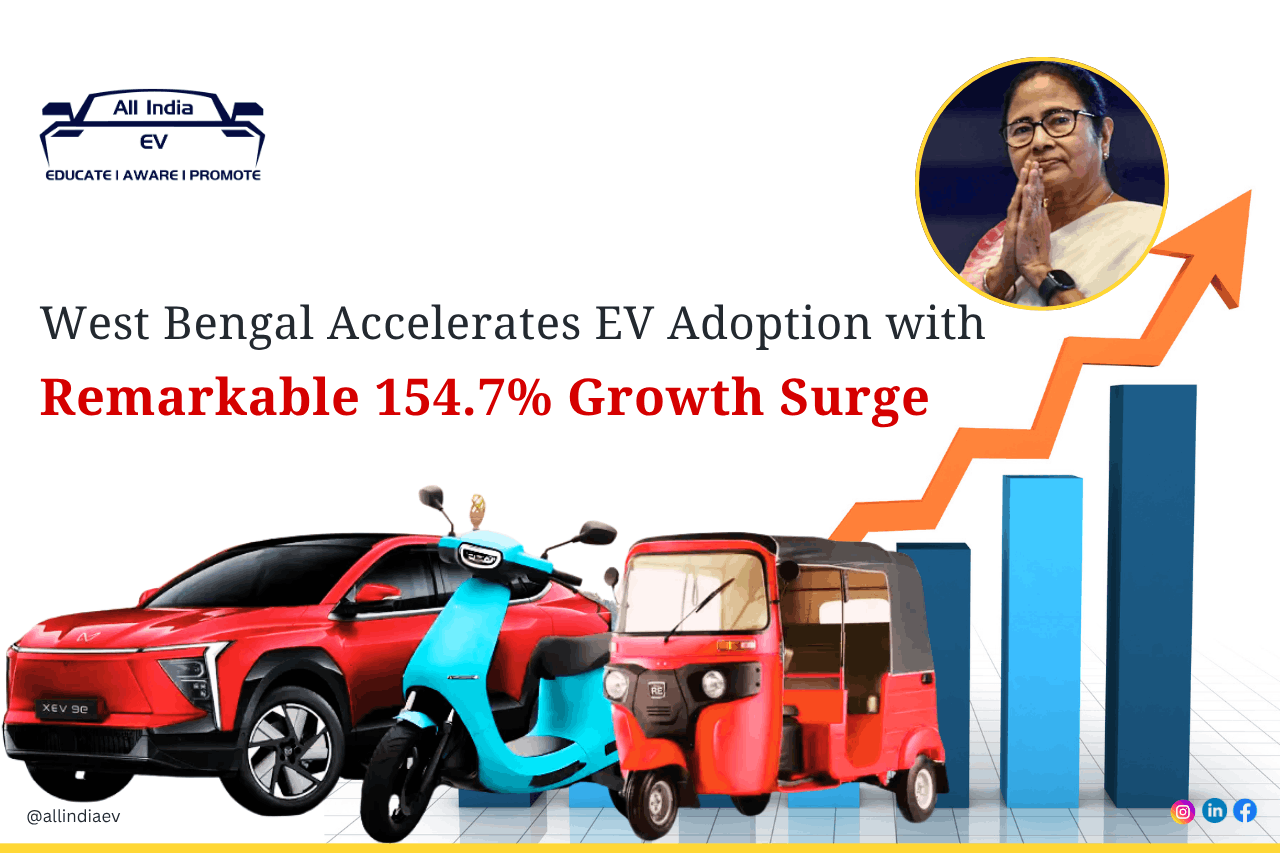

What: West Bengal has recorded a sharp surge in EV adoption, with registrations growing 154.7% over two years.
The Number:1,33,388 EV registrations in 2025–26, up from 52,327 in 2023–24.
The Impact: The state has crossed the national EV penetration average, indicating a strong regional acceleration in electrification.

The Core News
West Bengal EV adoption growth is emerging as one of the most significant state-level shifts in India’s electrification story. The state has recorded a 154.7% increase in EV registrations, pushing total volumes to over 1.3 lakh units and lifting EV penetration to 9.8%, above the national average of 8.2%.
This growth is not being led by high-end segments but by mass-market and shared mobility use cases. Electric three-wheelers, particularly e-rickshaws (locally called ‘totos’), dominate the ecosystem, accounting for nearly 67% of all EVs in the state. A large-scale government-led regularisation drive has also brought over a million previously unregistered vehicles into the formal system, accelerating official adoption metrics.
Beyond three-wheelers, the transition is gradually broadening. Electric two-wheelers have seen moderate growth, while electric car registrations have nearly doubled, indicating early traction in private ownership. However, the pace of adoption is beginning to outstrip infrastructure readiness, with charging availability flagged as a key constraint for sustained expansion.
More EV News

Breaking Down the Update
• EV registrations grew 154.7% between FY24 and FY26
• Total EV count reached 1.33 lakh units
• EV penetration in Bengal stands at 9.8% vs 8.2% national average
• E-rickshaws contribute ~67% of total EV volumes
• Electric two-wheelers grew ~15% year-on-year
• Electric car registrations increased nearly 90%
• Charging infrastructure remains limited relative to growth
How West Bengal EV adoption growth will help Indian EV Market
The rise of West Bengal EV adoption growth signals a structural shift in India’s EV expansion beyond traditional leading states like Maharashtra, Karnataka, and Delhi. What makes Bengal’s case particularly important is the dominance of bottom-up adoption, driven by affordability, utility, and shared mobility economics rather than premium vehicle demand.
This model strengthens the argument that India’s EV transition will be led by two- and three-wheelers, especially in dense urban and semi-urban markets. The scale of e-rickshaw electrification also highlights how informal transport ecosystems can be formalised and electrified simultaneously through targeted policy interventions.
Additionally, Bengal crossing the national EV penetration average indicates that regional policy execution and local demand conditions can outperform broader national trends. This decentralisation of EV growth reduces dependency on a few high-performing states and creates a more resilient national adoption curve.
However, the state also exposes a critical gap,charging infrastructure lagging behind vehicle growth. If replicated across other states without infrastructure alignment, this could slow India’s overall EV momentum. Addressing this gap will be essential for scaling similar adoption patterns nationwide.
Way Forward…
West Bengal EV adoption growth highlights how rapidly India’s EV transition can scale when low-cost segments, policy push, and local demand align. The next phase will depend on whether infrastructure deployment—especially charging and battery swapping, can keep pace with vehicle growth. Without that, the current momentum risks hitting a structural bottleneck even as demand continues to rise.
Read More: Catch up on All India EV’s related coverage on India’s evolving commercial EV subsidies and battery swapping policies at All India EV