
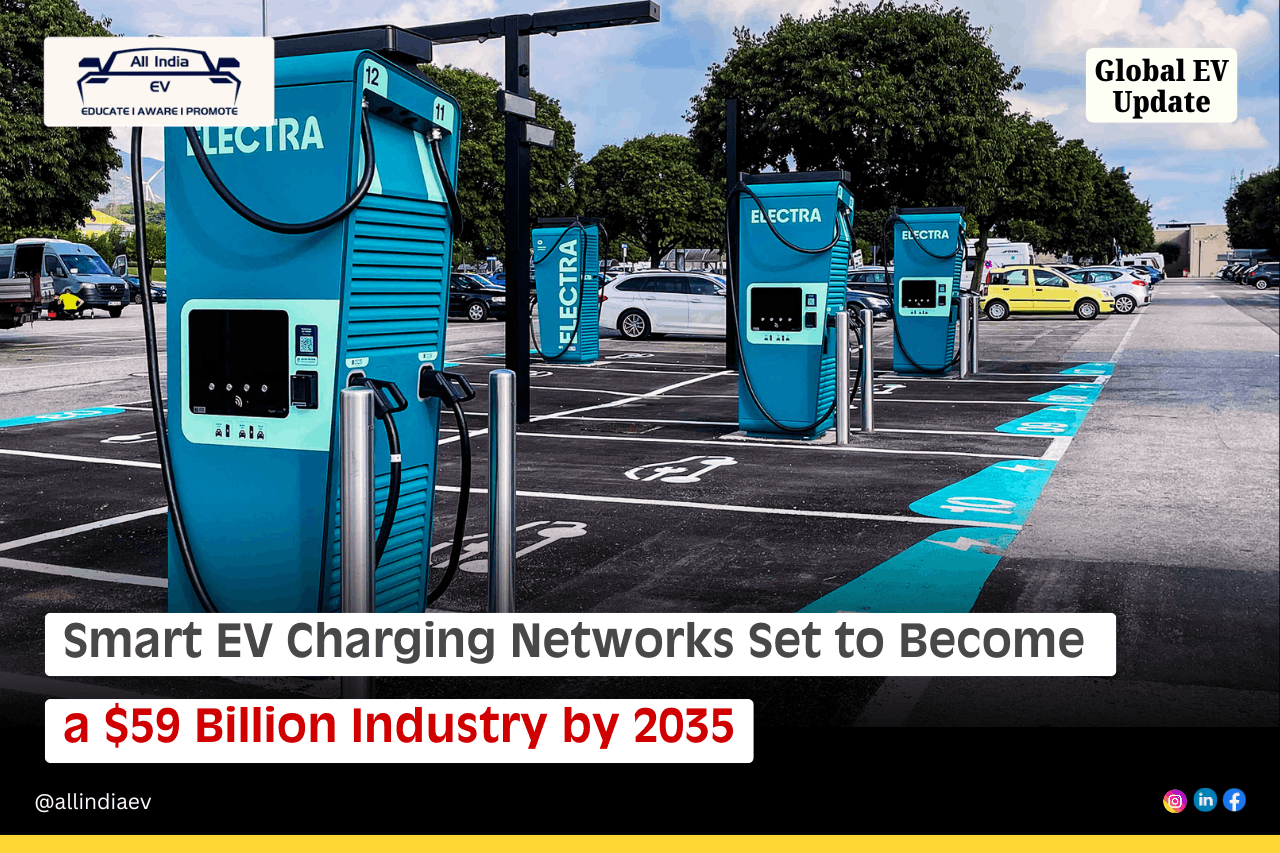

What: The global Smart EV Charging Networks Market is projected to expand from USD 10.16 billion in 2026 to nearly USD 59.27 billion by 2035, driven by rapid EV adoption, AI-enabled charging systems, and rising investment in connected charging infrastructure.
The Number: USD 59.27 billion projected market value by 2035 with a forecast CAGR of 21.65% between 2026 and 2035.
The Impact: The growth of the Smart EV Charging Networks Market signals a major shift from standalone chargers to software-managed energy ecosystems capable of balancing grid demand, enabling dynamic pricing, and supporting large-scale EV deployment globally.

The Core News
The Smart EV Charging Networks Market is entering a high-growth phase as governments, utilities, and automakers increasingly prioritize intelligent charging infrastructure over traditional hardware-led deployment. According to the latest market assessment, global market valuation is expected to rise sharply through 2035 as connected charging networks become central to EV scalability.
A major driver behind this expansion is the growing integration of artificial intelligence and cloud-based energy management into EV charging operations. Modern smart charging systems are now being designed to optimize electricity demand in real time, reduce grid stress during peak hours, and improve charger uptime through predictive diagnostics. Vehicle-to-grid (V2G) functionality and bidirectional charging are also emerging as key technologies shaping the next phase of charging infrastructure evolution.
Regionally, Asia Pacific currently dominates the market due to aggressive EV adoption policies, large-scale infrastructure investment, and strong manufacturing ecosystems. Europe, meanwhile, is expected to witness the fastest growth rate as regulators accelerate public charging expansion and push software-integrated charging networks. Companies including Tesla, ChargePoint, ABB, and Siemens are increasingly focusing on intelligent charging platforms rather than only charger deployment.
More EV News

Breaking Down the Update
• The market is expected to grow from USD 10.16 billion in 2026 to USD 59.27 billion by 2035
• Forecast CAGR stands at 21.65% during the 2026–2035 period
• DC fast charging currently holds the largest market share globally
• Level 2 charging infrastructure is projected to witness the fastest future growth
• AI-enabled charging management and predictive maintenance are becoming key differentiators
• Bidirectional charging and V2G integration are emerging as next-generation charging priorities
• Asia Pacific leads current deployment while Europe is expected to grow the fastest
• Commercial charging deployment remains dominant, though residential smart charging is accelerating
Conclusion & Next Steps
The long-term expansion of the Smart EV Charging Networks Market will depend on how effectively utilities, charging operators, and governments integrate software intelligence with large-scale charging deployment. While charger installation remains critical, future competitiveness will increasingly depend on grid balancing capability, AI-driven optimization, interoperability standards, and renewable energy integration. The next phase of the market will likely be defined not just by charger density, but by how intelligently those networks operate under rising EV demand
Read More: Catch up on All India EV’s related coverage on India’s evolving commercial EV subsidies and battery swapping policies at All India EV