
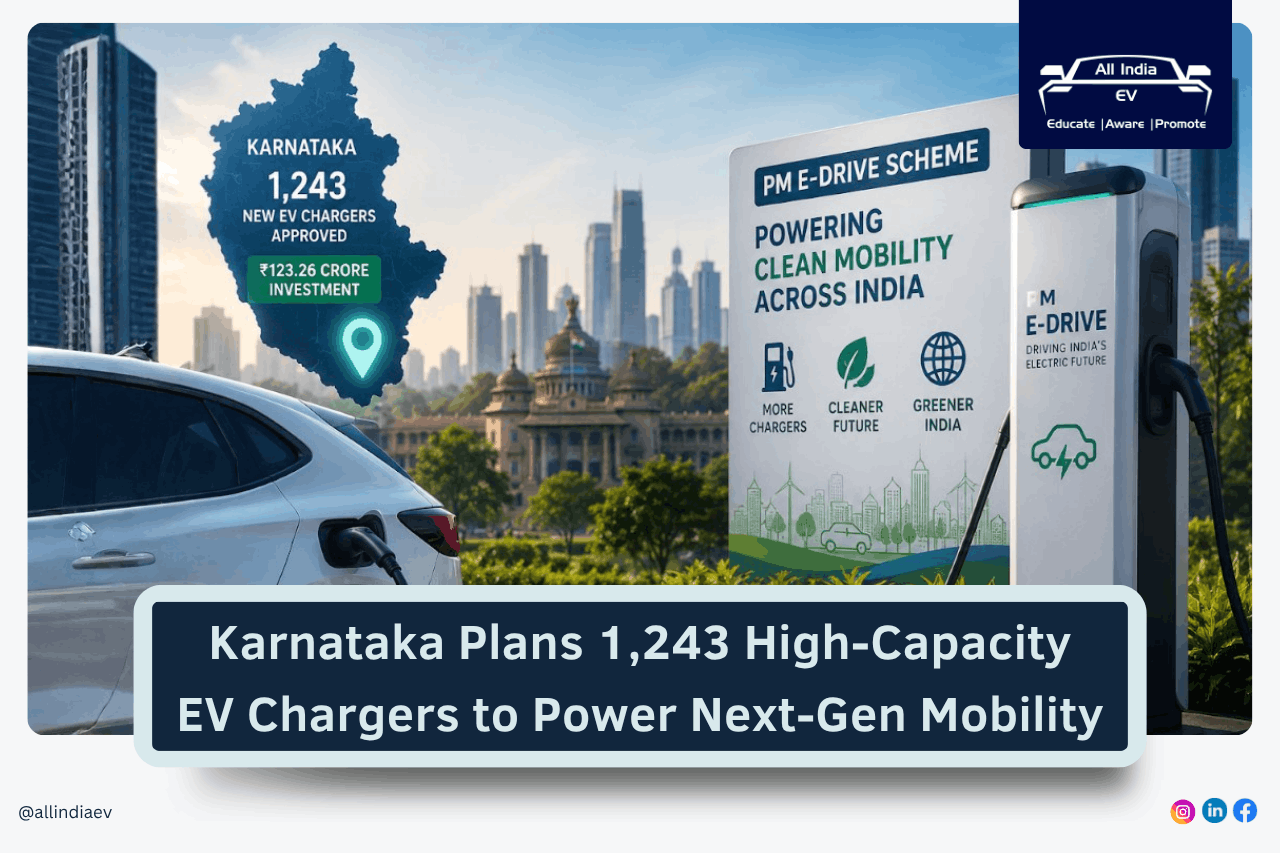

What: Karnataka has received approval to deploy 1,243 high-capacity EV chargers under the Centre’s PM E-DRIVE scheme, strengthening the state’s public charging infrastructure network and accelerating electric mobility deployment.
The Number: ₹123.26 crore has been allocated for Karnataka’s charging rollout as part of a larger ₹503.86 crore national approval covering 4,874 EV chargers across multiple states and public sector entities.
The Impact: The expansion could reduce one of the largest barriers to EV adoption , charging accessibility , especially for intercity mobility, commercial fleets, and high-utilisation electric vehicles in Karnataka.

The Core News
Karnataka will set up 1243 high capacity EV chargers as the state deepens its position in India’s fast-evolving electric mobility ecosystem. The approvals were announced during the National Conference on Enabling Nationwide EV Charging Infrastructure under the PM E-DRIVE scheme in Bengaluru, where the Ministry of Heavy Industries outlined a broader nationwide charging deployment strategy.
The approved infrastructure forms part of the Centre’s wider EV charging push that targets both state-led deployment and installations through oil marketing companies such as HPCL, IOCL, and BPCL. Karnataka alone accounts for over 25% of the newly sanctioned chargers under the current round, indicating the state’s strategic importance in India’s EV transition. The chargers are expected to support passenger EVs, electric buses, fleet operators, and commercial mobility corridors where charging uptime and fast turnaround are becoming critical operational requirements.
The announcement also aligns with the government’s parallel investments into battery manufacturing, rare earth magnet supply chains, and digital charging interoperability. Alongside the infrastructure rollout, the Ministry of Heavy Industries confirmed development of the Unified Bharat e-Charge platform, aimed at enabling charger discovery, payments, and network interoperability through a single interface. The charging expansion is therefore not only about physical infrastructure growth, but also about creating a connected EV ecosystem capable of supporting long-term electrification targets.
More EV News

Breaking Down the Update
• Karnataka will receive 1,243 new high-capacity EV chargers under PM E-DRIVE
• The state has been allocated ₹123.26 crore for the deployment
• Nationwide approvals cover 4,874 EV chargers with a total outlay of ₹503.86 crore
• Oil marketing companies including HPCL, IOCL, and BPCL will participate in installations
• The PM E-DRIVE scheme has an overall allocation of ₹10,900 crore
• ₹2,000 crore has been specifically earmarked for public charging infrastructure
• The Centre is also developing the Unified Bharat e-Charge platform for interoperable EV charging access
• Karnataka already hosts 721 chargers installed under the earlier FAME-II programme
How Karnataka high capacity EV chargers will help Indian EV Market
Karnataka high capacity EV chargers could play an important role in improving India’s EV adoption economics, especially in urban clusters and commercial transport operations. One of the biggest limitations in India’s EV ecosystem remains charging confidence — particularly for high-mileage users such as cab fleets, logistics operators, intercity buses, and commercial transport providers. Expanding fast and high-capacity charging infrastructure directly addresses this bottleneck.
Karnataka already functions as one of India’s largest technology and EV startup hubs, with Bengaluru emerging as a major centre for electric mobility pilots, battery innovation, and fleet electrification. A larger charging backbone can support higher EV density without creating grid congestion or long charging queues. This becomes particularly important as electric SUVs, buses, and premium EVs increasingly require high-output DC charging systems.
The rollout can also improve investment confidence for private charge point operators and OEMs planning large-scale deployments in southern India. Better charger availability generally improves vehicle utilisation rates, lowers operational downtime, and reduces range anxiety for consumers. Over time, Karnataka high capacity EV chargers may help strengthen regional EV corridors connecting industrial zones, logistics hubs, airports, and major highways, making electric mobility more commercially viable at scale.
Way Forward ..
Karnataka will set up 1243 high capacity EV chargers at a time when India is shifting from EV pilot adoption toward infrastructure-led scale-up. The success of the rollout will now depend on execution speed, grid readiness, uptime management, and interoperability between charging operators. If implemented efficiently, Karnataka could further consolidate its position as one of India’s leading EV infrastructure markets while setting a benchmark for large-scale public charging deployment nationwide
Read More: Catch up on All India EV’s related coverage on India’s evolving commercial EV subsidies and battery swapping policies at All India EV