

The Midweek Brief | All India EV “The 9AM Show”
Thursday, 13 August 2026 | 9:00 AM IST
Coverage window: Monday 10 – Wednesday 12 August 2026
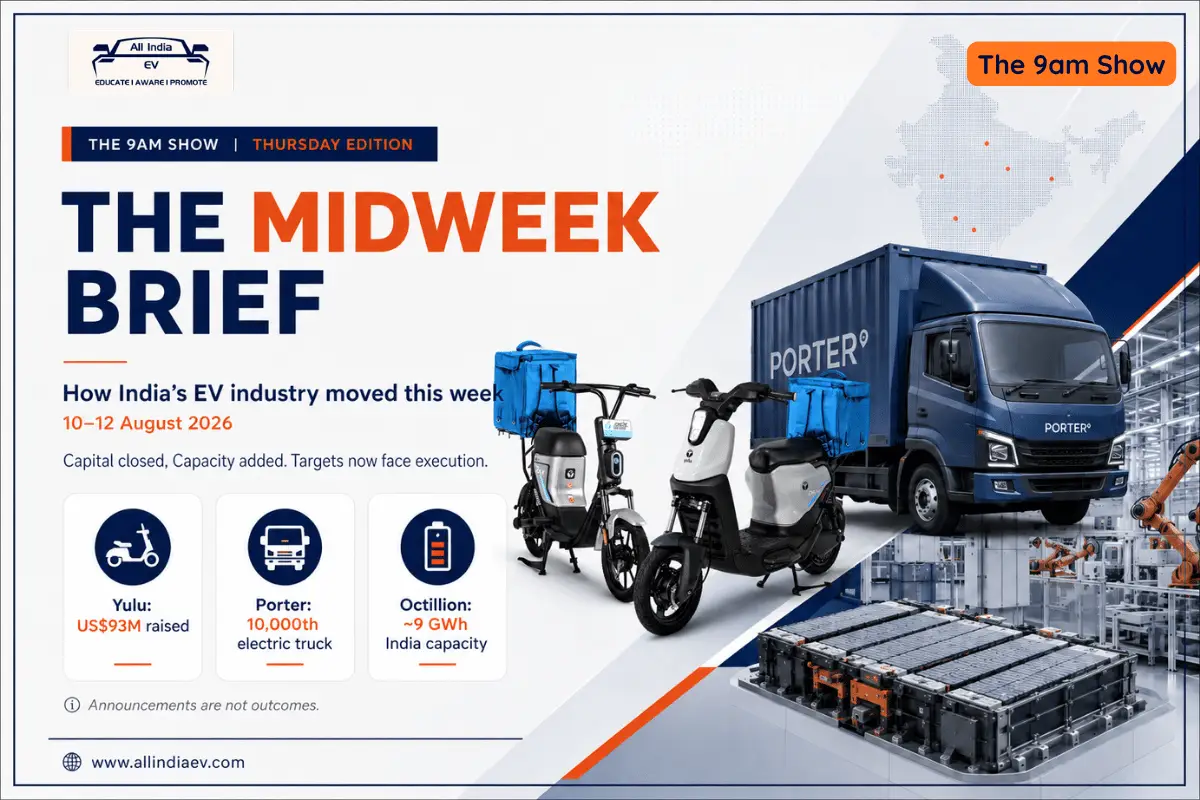
US$93 million is closed capital. Two lakh EVs are not. Yulu has 50,000 active vehicles today and says it will reach 2 lakh within two years.
The useful numbers this week came with very different levels of certainty.
Yulu closed a US$93 million funding package. Octillion says its third Indian battery plant is now operational. Porter flagged off its 10,000th electric truck in Delhi. These are events that have happened. Then come the larger numbers: Yulu’s 2 lakh active-EV target, Porter’s 3 lakh-EV ambition for 2030, and Octillion’s approximately 9 GWh of combined Indian battery capacity. Those are destinations, not outcomes.
The same distinction appears in capital. Ashok Leyland and Drivn signed an MoU to improve financing access for electric commercial vehicles. No financing corpus or disbursement number was disclosed. Volkswagen and JSW remain the subject of continuing JV reports, but there is still no announced definitive transaction.
India’s EV industry is moving from intent towards execution, but the scoreboard now has to be active vehicles, utilised capacity and disbursed capital, not the size of the target slide.
The Lead: Yulu Raises US$93 Million. Now Comes the Fleet Test.
Yulu said on Wednesday that it had raised US$93 million, roughly ₹887 crore, through a combination of equity and debt. The package comprises US$63 million of equity, led by GEF Capital Partners, and US$30 million of debt.
That distinction matters. This is not a US$93 million equity round. Nearly one-third is debt.
Yulu currently operates 50,000 active electric two-wheelers and plans to increase that to 2 lakh within two years. It also intends to expand from 12 cities to 20 over the next 12 months using company-run and franchise models.
The structural story is bigger than the headline fundraising number.
India’s last-mile EV market has spent years proving that electric two-wheelers can reduce operating costs for high-utilisation delivery use cases. Yulu’s next test is whether those economics can support asset expansion at much greater scale without requiring equity to subsidise daily operations.
There is some evidence to work with. CEO Amit Gupta said Yulu has been operationally profitable since April 2025. For FY25, however, the company reported ₹237 crore in revenue and a ₹126 crore loss, although the loss narrowed 12%. Yulu now says it wants to become PAT-positive on a monthly basis in the next calendar year.
Operational profitability and PAT profitability are not the same milestone.
The company is also targeting annualised revenue of ₹1,200–1,500 crore before an eventual public listing. Again, that is a target, not reported revenue.
What deserves credit is the specificity. We have a current fleet, a future fleet, a city count, an equity/debt split and a profitability milestone. Those can all be checked later.
What we do not know
The disclosed material does not tell us the pricing, tenure or lenders behind the US$30 million debt component; the capital expenditure required to move from 50,000 to 2 lakh active vehicles; how much of that fleet will sit under company ownership versus franchise structures; or the utilisation and contribution economics of the additional vehicles.
Those are the numbers that will determine whether this round creates scale or simply finances it.
Four Lenses
Demand
Porter puts an operational number behind electric urban freight [11 August]. Porter flagged off its 10,000th electric truck in Delhi, while more than 50,000 EVs are active on Porter’s network on a monthly basis. The company has also stated an ambition to expand its EV logistics fleet to 3 lakh vehicles by 2030.
Porter is asset-light and works with driver-partners, so the 3 lakh figure should be read as a network ambition, not a 3 lakh-vehicle purchase order.
Kia gets a measurable corporate-fleet datapoint [11 August]. Kia India says more than 1,100 Carens Clavis EVs have been deployed in corporate fleets since the model’s July 2025 launch.
The fresh transaction this week is smaller: a 100-unit agreement with Refex Mobility, with the first batch handed over on Tuesday.
The 1,100 figure is cumulative. The 100-unit Refex deal is the incremental development.
Supply
Octillion opens its third Indian battery plant [11 August]. Octillion Power Systems announced that its new 13,000+ sq m Halol facility in Gujarat is operational.
The company says that at full capacity it can produce more than 48,000 battery systems and 3 GWh annually. Combined with its other two Indian facilities, Octillion expects Indian capacity to exceed 1.5 lakh battery systems and approximately 9 GWh a year.
That 9 GWh is nameplate capacity, not reported annual production.
The next useful number is plant utilisation.
Capital
Ashok Leyland and Drivn sign an EV-finance MoU [10 August]. Ashok Leyland confirmed an MoU under which Drivn will offer financing, leasing and fleet-ownership solutions to buyers of its electric commercial vehicles.
This addresses a real bottleneck in commercial EV adoption: upfront capital.
But the announcement contains no disclosed lending pool, interest rate, sanctioned volume or disbursement figure.
It is an enabling agreement today. Its importance depends on financed vehicles later.
The Volkswagen-JSW story remains a negotiation [10 August]. Automotive World reported that Volkswagen was nearing a JSW joint venture connected to its India EV push.
The important qualifier is “reported”.
Talks between the two groups were already being reported before this week’s coverage window. Subsequent reports have discussed structures including a new JV and possible JSW majority economic interest.
No definitive transaction has been announced by either side.
Jupiter Electric Mobility adds a ₹400 crore stationary-storage project [10 August]. Jupiter Wagons’ subsidiary JEM emerged as successful bidder for two WBSEDCL standalone BESS projects totalling 100 MW/400 MWh, to operate under a 15-year build-own-operate model.
The reported project value is approximately ₹400 crore.
The company says this takes its BESS order book to around 500 MWh, valued above ₹500 crore, while its ₹1,000 crore FY27 BESS order-book figure remains a target.
This is stationary storage rather than EV demand, but it is relevant as an EV-linked company builds a second battery revenue pool.
Policy
No qualifying new EV policy action landed inside this three-day window from the submitted set.
The Maharashtra platform-EV mandate story was published before the window and described a proposal under consideration, not an approved mandate.
The ethanol-versus-EV item published on 10 August is an opinion column arguing for a policy direction, not a government notification or decision.
Treating either as a new policy action would manufacture momentum that did not occur.
The Contrarian Read
Porter’s 3 lakh EV target is not an order book
The easy headline is that Porter wants 3 lakh EVs by 2030.
The more useful story is its 50,000-plus monthly active EV base and the 10,000th electric truck deployed in Delhi.
Porter operates an asset-light marketplace. Scaling its EV count therefore depends not only on Porter wanting more electric vehicles, but on driver-partners being able to finance them, OEMs supplying vehicles suited to freight duty cycles, and the vehicles earning enough trips per day to justify the asset.
That makes 3 lakh a demand signal, not committed procurement.
The distinction matters to OEMs and financiers.
A fleet operator saying “we intend to have 3 lakh EVs on our network” is not equivalent to an OEM holding an order for 3 lakh vehicles.
Porter’s achievement is real.
So is the distance between the operational base and the 2030 ambition.
The Desk View
Three developments fit together.
Yulu has raised capital to multiply deployed assets. Porter is showing that commercial EV demand can exist at tens of thousands of active vehicles. Ashok Leyland is trying to build financing around the commercial vehicle itself.
Meanwhile, Octillion is adding battery-system manufacturing capacity.
That points to a change in where the industry’s constraint sits.
India no longer needs only more EV announcements or another proof that an electric vehicle can be manufactured.
In high-utilisation segments, the harder problem is increasingly financial and operational: who finances the asset, how many revenue-generating trips it completes, whether the operator can keep it active, and whether factories convert nameplate capacity into actual output.
The next winners will not be identified by the largest capacity slide or fleet target.
They will be visible in utilisation, cash flow and repeat deployment.
India’s next EV phase is not a race to announce more electric assets, but a race to make electric assets earn.
What We’re Watching
- Yulu: whether active fleet moves materially above the current 50,000 base, and whether its next accounts support the company’s operational-profitability claim and path towards monthly PAT positivity.
- Octillion Halol: actual output and utilisation against the stated 3 GWh annual nameplate capacity, plus disclosed customer programmes tied to the new plant.
- Porter: monthly active EVs against the 3 lakh by 2030 ambition, rather than treating the target itself as deployment.
- Ashok Leyland-Drivn: the first disclosed sanctioned or disbursed EV-finance volumes, and whether a financing corpus or commercial terms are eventually published.
- Volkswagen-JSW: a signed MoU or definitive agreement, including ownership, capital commitment and which Indian assets actually enter any proposed JV. Until then, it remains a reported negotiation.
Sources include company disclosures, Reuters, ETAuto, Autocar Professional, Business Standard and submitted industry reports. Company targets are identified as such; the Volkswagen-JSW transaction remains reported and unconfirmed.