

The 9AM Show | EV Stock Wednesday
- The Top 10
- 1. Ola Electric Mobility
- 2. Tunwal E-Motors
- 3. Wardwizard Innovations & Mobility
- 4. Mercury EV-Tech
- 5. Servotech Renewable Power System
- 6. RattanIndia Enterprises
- 7. Supertech EV
- 8. Victory Electric Vehicles International
- 9. Gensol Engineering
- 10. Urja Global
- Why track these stocks
- 1. They provide concentrated exposure to smaller EV segments
- 2. Some are operating where EV penetration is already structurally high
- 3. Smaller companies can reveal where the next layer of EV value is forming
- 4. Small listed companies can become acquisition, consolidation or capital-raising stories
- 5. They are excellent indicators of whether EV industry growth is translating into business quality
- The biggest mistake: confusing price with valuation
- What we would watch before touching any EV penny stock
- Vehicle companies
- Charger companies
- Battery companies
- Fleet companies
- All companies
India’s EV story on the stock market is usually discussed through large names: Tata Motors, TVS Motor, Bajaj Auto, Mahindra & Mahindra, Exide Industries or Amara Raja.
But underneath these large companies sits a much smaller and considerably more volatile universe of listed companies whose businesses are directly tied to electric vehicles, electric two-wheelers, e-rickshaws, batteries and charging infrastructure.
Some trade at ₹80. Some at ₹30. A few below ₹10.
And that deserves attention.
Not because a ₹10 stock is automatically “cheap”. Share price tells us almost nothing about valuation by itself. But these companies offer something the large diversified auto stocks sometimes cannot: much more concentrated exposure to individual parts of India’s emerging EV ecosystem.
For this edition of EV Stock Wednesday, All India EV screened listed EV-linked companies trading below ₹100 per share and ranked ten names primarily on the strength and directness of their EV exposure.
Important classification note: There is no official SEBI definition saying that a stock below ₹100 is a “penny stock”. We are using the term broadly for this editorial screen. This is an industry-analysis list, not a stock recommendation.
Stock prices used below are based on the market close/latest available price on August 18, 2026.
The Top 10
| Rank | Company | Share Price* | EV Business | EV Exposure |
|---|---|---|---|---|
| 1 | Ola Electric Mobility | ₹38.61 | Electric 2W, cells, batteries | Very High |
| 2 | Tunwal E-Motors | ₹26.10 | Electric 2W | Very High |
| 3 | Wardwizard Innovations & Mobility | ₹6.28 | Electric 2W & 3W | Very High |
| 4 | Mercury EV-Tech | ₹35.13 | EVs + EV components | Very High |
| 5 | Servotech Renewable Power System | ₹82.19 | EV chargers & charging infra | High |
| 6 | RattanIndia Enterprises | ₹30.67 | Revolt Motors | High |
| 7 | Supertech EV | ₹36.20 | Electric 2W & 3W | Very High |
| 8 | Victory Electric Vehicles International | ₹16.65 | Electric 2W & 3W | Very High |
| 9 | Gensol Engineering | ₹18.32 | EV leasing + clean energy | High, but exceptional risk |
| 10 | Urja Global | ₹9.41 | EVs + renewable energy | Limited / requires deeper verification |
*Approximate prices as of August 18, 2026.
1. Ola Electric Mobility
Price: ₹38.61
Ola is the odd one out in this list. It trades below ₹100, but it is certainly not a traditional penny-stock-sized company.
It remains one of India’s most visible pure-play listed EV companies, with operations spanning electric two-wheelers, vehicle manufacturing, battery technology and increasingly cell manufacturing.
The stock closed at ₹38.61 on August 18, compared with ₹39.22 in the previous session.
The operating story, however, has become more complicated.
Ola sold around 1.64 lakh electric two-wheelers in FY26, significantly below roughly 3.44 lakh in FY25, as TVS, Bajaj, Ather and Hero expanded aggressively.
At the same time, Ola is deepening vertical integration. In May 2026, the company approved around ₹2,000 crore of investment into its EV and cell-technology businesses, with the investment expected to run through May 2027.
2. Tunwal E-Motors
Price: ₹26.10
Tunwal deserves considerably more attention than it normally receives.
Unlike diversified auto companies, electric two-wheelers are its core operating business.
Its share price stood at ₹26.10 on August 18, against a 52-week range of ₹25.15-₹49.80.
More importantly, the company’s FY26 financials showed genuine operating growth.
Tunwal reported ₹276.84 crore revenue from operations in FY26, up 55% from ₹178.59 crore in FY25, while PAT reached ₹12.73 crore.
That makes Tunwal one of the more interesting names on this list because there is an actual question to investigate:
Can a relatively small electric two-wheeler manufacturer build a profitable niche while India’s largest OEMs fight for scale?
3. Wardwizard Innovations & Mobility
Price: ₹6.28
Wardwizard owns the Joy e-bike electric two-wheeler brand and operates in electric mobility alongside other businesses.
The company describes EV manufacturing as a core part of its operations.
Its stock closed around ₹6.28 on August 18, with a market capitalisation of roughly ₹190 crore.
That puts it much closer to the conventional penny-stock category than Ola.
But here’s where price can fool investors.
A ₹6 stock isn’t automatically cheap.
Wardwizard’s valuation metrics need to be examined against its earnings, revenue trajectory and operating cash generation before making any judgement about valuation.
4. Mercury EV-Tech
Price: ₹35.13
Mercury EV-Tech is one of the more unusual EV companies in the listed universe.
It describes itself as an end-to-end EV manufacturer, with capabilities spanning batteries, chassis and motor controllers, alongside complete vehicles. Its portfolio covers scooters, three-wheelers and four-wheelers.
The stock closed around ₹35.13 on August 18, giving the company a market capitalisation of roughly ₹676 crore.
This is precisely where investors need to separate the EV story from the valuation story.
Mercury’s reported P/E is well into triple digits on some market screens.
Low share price ≠ low valuation.
That distinction will keep appearing throughout this tracker.
5. Servotech Renewable Power System
Price: ₹82.19
Servotech brings something different to this list.
Instead of manufacturing vehicles, the company participates in EV charging infrastructure.
It develops AC/DC chargers while also operating in solar and clean-energy equipment.
The stock closed at approximately ₹82.19 on August 18, with a market cap of around ₹1,856 crore. Its 52-week range was ₹57.51-₹143.
That makes Servotech one of the larger businesses in this screen and potentially one of the clearest listed proxies for India’s EV charging hardware buildout.
6. RattanIndia Enterprises
Price: ₹30.67
RattanIndia is not a pure EV company.
But it owns Revolt Motors, giving shareholders indirect exposure to India’s electric motorcycle market.
Revolt launched its RVX electric motorcycle in July 2026 at an introductory price of ₹1.24 lakh.
RattanIndia Enterprises closed at approximately ₹30.67 on August 18, with a market capitalisation of roughly ₹4,239 crore.
The key distinction here is important:
Investing in RattanIndia is not the same as investing directly in Revolt.
The listed parent also contains other businesses, including e-commerce and drones.
7. Supertech EV
Price: ~₹36.20
Now we move into the genuinely tiny end of the listed EV market.
Supertech EV manufactures electric scooters, e-rickshaws and L5 electric vehicles.
Its stock closed around ₹36.20, while its market capitalisation was only around ₹45 crore on August 18.
That small size creates both sides of the penny-stock equation:
potential operating leverage if the company scales, and very high business/liquidity risk if it doesn’t.
This is exactly the kind of stock where vehicle registrations, dealer productivity and audited revenue deserve more attention than announcements.
8. Victory Electric Vehicles International
Price: ₹16.65
Victory Electric Vehicles operates primarily in commercial electric mobility.
Its product portfolio includes:
- L3 e-rickshaws
- cargo/loaders
- L5 electric three-wheelers
- electric scooters
The stock closed at approximately ₹16.65 on August 18, versus a 52-week high of ₹34.45 and low of ₹13.70.
Its market capitalisation sits around only ₹40 crore, making it one of the smallest publicly traded EV manufacturers in India.
9. Gensol Engineering
Price: ₹18.32
Gensol belongs on an EV-industry list because its business historically included EV leasing alongside renewable-energy operations.
But it belongs in a completely different risk category.
The stock stood at approximately ₹18.32 on August 18, with a market capitalisation around ₹70 crore.
More importantly, SEBI issued an interim order in the matter of Gensol Engineering Limited on April 15, 2025.
Therefore, Gensol should not be treated as simply another beaten-down EV stock.
For this tracker:
EV relevance: Yes. Normal penny-stock risk: No. Exceptional governance/regulatory risk: Yes.
That distinction matters.
10. Urja Global
Price: ₹9.41
Urja Global rounds out the list.
The company has historically positioned itself across renewable energy, batteries and electric mobility, but its present EV exposure is less straightforward than companies such as Tunwal, Supertech or Victory.
Its stock closed around ₹9.41 on August 18, with a market capitalisation of roughly ₹495 crore.
For All India EV, this should therefore sit in the:
“EV exposure requiring deeper revenue verification”
bucket rather than alongside pure-play EV manufacturers.
This is another important lesson from penny-stock screening.
A company mentioning EVs doesn’t automatically make it an EV company.
Why track these stocks
The answer is not simply because their prices can multiply faster.
That is precisely the wrong way to read this segment.
There are several more useful reasons, and the ten names above illustrate all of them.
1. They provide concentrated exposure to smaller EV segments
Buying Tata Motors does not mean buying only its EV business. The same applies to TVS Motor, Bajaj Auto or Mahindra.
Companies such as Tunwal, Supertech EV and Victory EV, however, operate much closer to a pure electric-mobility thesis. That means changes in EV demand, dealer expansion, vehicle registrations or product acceptance can have a more visible impact on their underlying businesses.
2. Some are operating where EV penetration is already structurally high
Small electric three-wheelers, commercial last-mile vehicles and electric scooters are very different markets from passenger electric cars.
Companies such as Victory EV, Supertech EV, Mercury EV-Tech and Wardwizard give investors exposure to these smaller vehicle categories. Supertech, for example, currently markets electric scooters, L3 e-rickshaws and L5 passenger/cargo vehicles. Victory’s portfolio similarly includes e-rickshaws, e-loaders, L5 autos and electric scooters. These aren’t necessarily glamorous segments, but they sit close to the commercial-use economics where electrification can make considerable operational sense.
3. Smaller companies can reveal where the next layer of EV value is forming
The EV transition isn’t only about who sells the most scooters. There are investable businesses emerging around EV charging, commercial electric mobility, batteries, motors and controllers, fleet leasing, EV components and last-mile mobility.
Servotech is a good example. It is not an EV manufacturer. Its EV exposure comes through charging equipment and charging infrastructure, alongside solar and other clean-energy businesses. In April 2026, Servotech secured orders covering 375 units of 60 kW chargers and 48 units of 120 kW chargers from OMCs and PSUs. Charging demand can grow even when market share shifts between Tata, Mahindra, Ola, TVS, Bajaj or Ather. The charger doesn’t particularly care which logo is on the vehicle.
RattanIndia offers a variant of this same logic. Its EV exposure runs indirectly through Revolt Motors, sitting inside a larger diversified parent, which is a reminder that concentrated exposure and indirect exposure are not the same thing and need to be tracked differently.
So a low-priced EV stock screen can sometimes surface parts of the ecosystem that disappear when investors focus only on vehicle OEMs.
4. Small listed companies can become acquisition, consolidation or capital-raising stories
India’s EV industry still contains hundreds of relatively small manufacturers. Not all of them will survive independently.
As the industry consolidates, listed companies with manufacturing plants, dealer networks, homologated vehicles, technologies or distribution assets could become interesting strategic assets. That doesn’t guarantee shareholder returns. But it makes this universe worth tracking, particularly for investors trying to understand where consolidation could happen.
5. They are excellent indicators of whether EV industry growth is translating into business quality
This might actually be the most useful reason.
India can sell more EVs every year while an individual EV company still destroys shareholder value.
Tracking smaller listed EV companies allows us to compare:
EV registrations → revenue → margins → cash flow → debt → shareholder value.
If registrations rise but revenue doesn’t, something is wrong. If revenue rises 50% but receivables rise 150%, something deserves investigation. If a company repeatedly announces orders without corresponding revenue or cash generation, that deserves investigation too.
Ola illustrates this at the larger end of the scale. It is becoming a test of whether vertical integration, localisation and battery-cell manufacturing can restore margins after losing vehicle market share. Gensol illustrates the opposite lesson: EV relevance on paper does not override exceptional governance and regulatory risk underneath it.
Penny EV stocks therefore aren’t just investment candidates.
They can be industry health indicators.
The biggest mistake: confusing price with valuation
Consider these two hypothetical stocks:
Company A Share price: ₹500 Shares outstanding: 1 crore Market cap: ₹500 crore
Company B Share price: ₹10 Shares outstanding: 100 crore Market cap: ₹1,000 crore
Company B has the cheaper-looking share.
But the market is valuing the company at twice as much.
That is why ₹6, ₹10 or ₹30 should never be the investment thesis.
Investors should instead examine:
Market Capitalisation Revenue Revenue Growth EBITDA PAT Cash Flow Debt Promoter Holding Share Pledging Receivables Vehicle Registrations Order Execution
The share price comes much later.
What we would watch before touching any EV penny stock
For EV companies specifically, traditional financial analysis isn’t enough.
A better checklist is:
Vehicle companies
Compare Vahan registrations with reported vehicle revenue.
Charger companies
Compare orders announced with chargers actually supplied and revenue recognised.
Battery companies
Track capacity commissioned, capacity utilisation and actual customer contracts.
Fleet companies
Track fleet size, utilisation, financing costs and receivables.
All companies
Track operating cash flow, not just PAT.
And perhaps most importantly:
Count what is operational, not what has been announced.
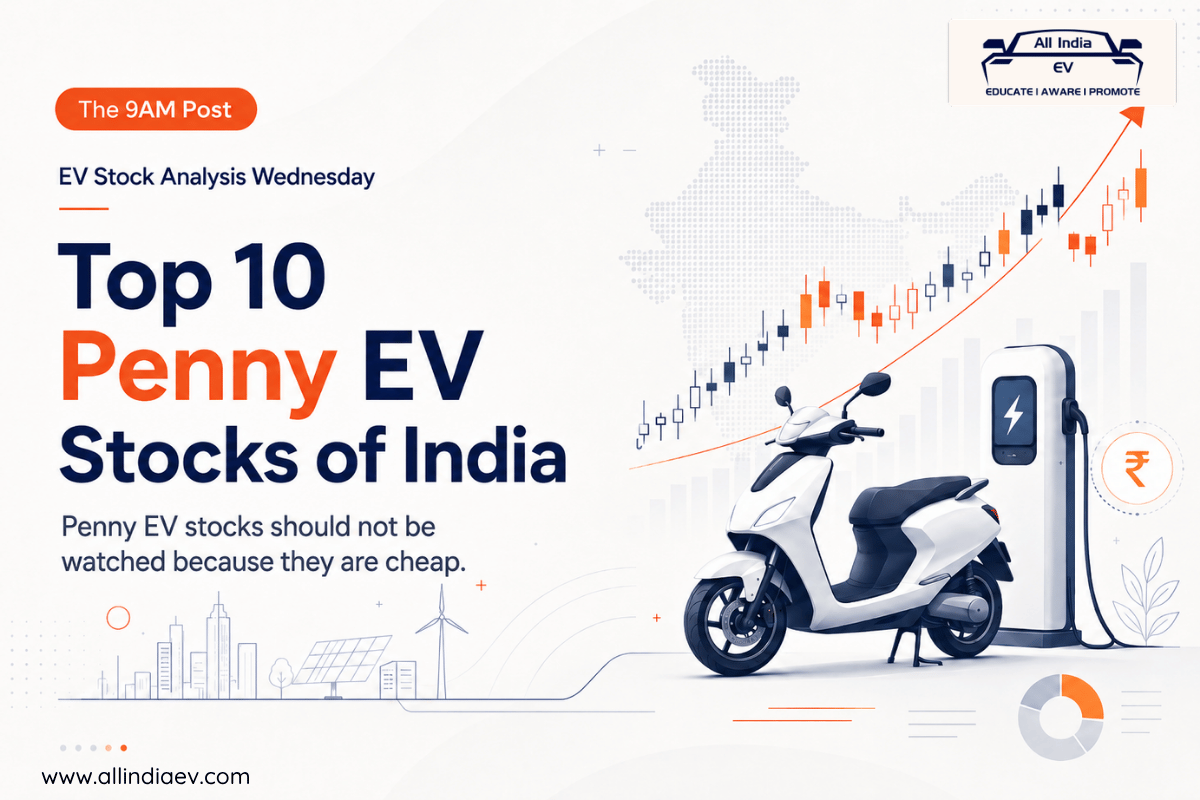
Penny EV stocks should not be watched because they are cheap.
They should be watched because they sit at the experimental edge of India’s EV industry, where small companies are trying to turn a fast-growing market into sustainable businesses.
The real question isn’t:
“Which ₹10 EV stock can become ₹100?”
The better question is:
“Which ₹10 EV company can build a ₹1,000 crore-quality business?”
That is the question The 9AM Show: EV Stock Wednesday will keep tracking.
Disclaimer: This analysis is for informational and industry-research purposes only and does not constitute investment advice, a recommendation to buy or sell securities, or a representation of future returns. Penny and micro-cap stocks can carry significant liquidity, governance, business and price-volatility risks.