

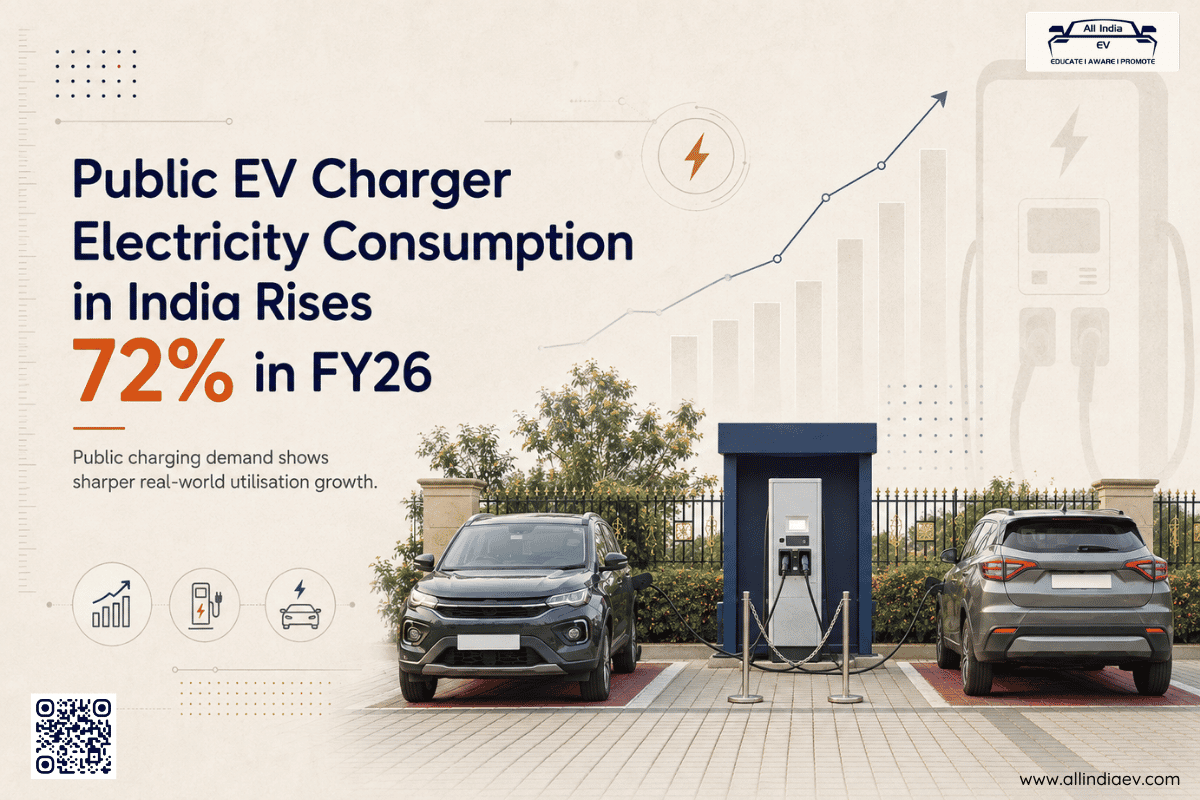
Electricity consumption at India’s public EV charging stations increased by more than 72% during FY2025-26, providing one of the clearest indicators yet that charging infrastructure is seeing greater real-world utilisation.
Data compiled by the Central Electricity Authority (CEA) shows electricity consumed at public charging stations increased from 848 million units in FY25 to 1,460 million units in FY26.
The number is particularly significant because charger installations alone do not tell us how much infrastructure is actually being used.
Energy consumption does.
Heavy-Duty EVs Account for 74% of Charging Demand
More than 74% of electricity consumed through public charging stations in FY26 came from heavy-duty charging, including electric buses, trucks, high-capacity passenger vehicles and commercial fleets.
Light and medium personal and commercial EVs accounted for the remaining 26%.
That represents a shift from FY25, when heavy-duty vehicles accounted for approximately 70% of public charging electricity consumption.
The data suggests that India’s public charging demand is increasingly being driven by vehicles with high daily utilisation rather than private electric cars alone.
This distinction matters for charging companies.
A private EV may visit a public charger occasionally because much of its energy can come from home or workplace charging.
An electric bus, truck or commercial fleet vehicle can require substantially more energy and may return to high-power charging infrastructure every day.
That creates a much stronger utilisation profile for charging operators.
Maharashtra and Delhi Lead Public Charging Consumption
The CEA data also shows significant concentration in a few states.
Maharashtra consumed nearly 378 MU, equivalent to around 26% of reported national public charging electricity consumption.
Delhi followed with approximately 359 MU, while Karnataka recorded 213 MU and Telangana around 111 MU.
These four markets therefore account for a substantial share of reported public charging demand.
For charging companies, this data can become increasingly useful when deciding where to expand networks, deploy higher-powered chargers or target commercial fleet customers.
India Has More Than 52,000 Public Charging Stations
As of July 2026, government data reported 52,718 public charging stations across India, including 16,561 stations equipped with fast chargers for electric cars.
But the latest consumption numbers highlight why charger count should not be the industry’s only KPI.
Two charging networks with the same number of chargers can have completely different economics if one delivers significantly more electricity.
Metrics such as energy sold per charger, utilisation rate, sessions per day and uptime will increasingly matter as India’s charging market matures.
There is also an important limitation in the latest CEA dataset.
The consumption figures do not include complete data from several northeastern states, Himachal Pradesh, Uttarakhand and some Union Territories because relevant information was not submitted by their distribution companies. The reported 1,460 MU figure therefore does not represent every public charger operating in India.
Still, the direction is clear.
India’s public charging conversation is gradually moving from “How many chargers have been installed?” to “How much are those chargers actually being used?”
And a 72% rise in electricity consumption suggests that utilisation is beginning to catch up with infrastructure expansion.