

The 9AM Show | All India EV Editorial Tracking the Indian EV charging market: 7–13 September 2026
- CHARGEZONE Makes the Week’s Biggest Statement
- Commercial Vehicles Are Becoming the Next Charging Battleground
- States Are Starting to Build at Scale
- New Chargers Are Being Built, But Utilisation Is Becoming the Better Metric
- Two-Wheelers Generate Sessions. Cars Consume the Energy.
- Charging Networks Are Also Becoming Software Networks
- And Then Kerala Showed the Grid Problem
- The Week in Numbers
For years, the conversation around India’s electric vehicle charging infrastructure has revolved around a single, deceptively simple question: how many chargers are being installed?
Last week’s developments suggest that the market is finally moving past that question, and toward a more consequential set of them: Who will actually use these chargers? How much energy will they consume? Where should infrastructure be located? Who will finance it? And can the grid support the demand?
From CHARGEZONE’s billion-dollar energy contracts to new charging programmes for electric trucks, ports, government premises and highways, India’s charging ecosystem is beginning to look less like a race to install hardware and more like a structured, demand-driven, commercially sophisticated industry. Here is what changed.
CHARGEZONE Makes the Week’s Biggest Statement
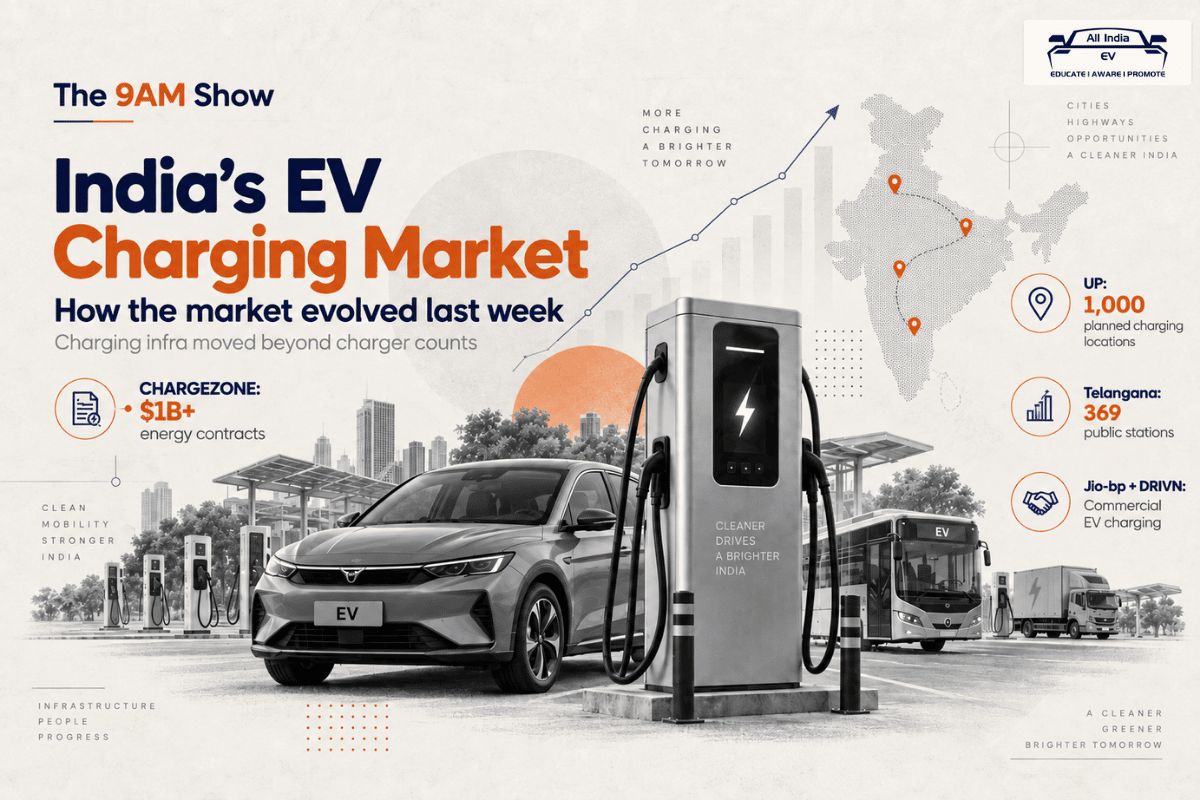
The single largest announcement of the week came from CHARGEZONE, which said it has secured more than $1 billion in long-term EV charging-energy contracts, concentrated around electric buses, trucks and commercial fleets.
The infrastructure plan attached to that demand is substantial:
- 1,000 new supercharging stations
- 180 MW of additional charging capacity
- 300 MW targeted total capacity
- $25 million in debt financing already secured, with a further $100 million planned but not yet raised
That distinction is important: the $1 billion figure represents contracted charging-energy demand, not capital invested into CHARGEZONE. It should not be mistaken for a funding round.
But strategically, it may matter more than one. The announcement signals a shift toward a model where infrastructure is built against known fleet demand, rather than chargers being installed speculatively and left to wait for utilisation to catch up. That single change in sequencing could meaningfully alter the underlying economics of charging infrastructure in India.
Commercial Vehicles Are Becoming the Next Charging Battleground
A clear pattern ran through last week’s news: India’s charging market is pivoting toward trucks, buses and commercial fleets.
Jio-bp signed an MoU with DRIVN to explore charging solutions for commercial EVs, particularly electric buses and trucks, built around a model that bundles vehicle leasing, charging access, preferential tariffs and dedicated infrastructure.
Separately, JNPA signed an agreement with CESL to develop public charging and battery-swapping infrastructure at five parking locations within the port ecosystem, designed to support multiple vehicle categories including tractor-trailers and buses.
This matters because freight hubs operate on fundamentally different economics than conventional public, passenger-EV charging points. Ports, logistics parks and industrial clusters offer a combination that urban charging rarely can:
- Concentrated demand
- Predictable vehicle movement
- Known dwell times
- High daily utilisation
- Large energy requirements
For commercial EV charging, that combination can produce far stronger infrastructure economics. The next major charging opportunity in India, in other words, may not be another car-charging point on a city street. It may be the truck depot, port, logistics hub or freight corridor.
States Are Starting to Build at Scale
Government-led charging deployment was also unusually active last week.
Uttar Pradesh outlined plans for EV charging infrastructure across approximately 1,000 locations, spanning highways, expressways and major cities. The scale is notable, but the industry should distinguish between the stages of that pipeline: locations identified → tenders → contracts awarded → chargers installed → operational stations. At this point, the 1,000 figure should be read as an expansion plan, not 1,000 chargers already under construction.
Telangana’s charging procurement entered an important stage, with TGREDCO working on 369 public charging stations, comprising 200 stations under the Hyderabad-region programme and 169 stations across 116 locations under a separate procurement. With long-term CPO participation built into the plans, Telangana is emerging as one of the more interesting state-level opportunities for charging operators.
In Bihar, the state Transport Department and IOCL agreed to establish fast chargers at 10 government premises in Patna, pointing to another viable deployment model: government-owned land + energy company/CPO + publicly accessible charging.
New Chargers Are Being Built, But Utilisation Is Becoming the Better Metric
Hyundai and Statiq inaugurated new 120 kW DC fast-charging infrastructure in Delhi last week. Hyundai says its broader fast-charging network now spans 185 stations across 105 cities, with a target of 600 stations by 2030.
But a different announcement may say more about where the market is actually heading. Tata Power and TATA.ev released utilisation data from their 10 Mega Charger hubs, reporting:
- 70,000+ charging sessions
- 85,000+ charging hours
- 25 chargers and 56 charging guns
- 2.7 MW combined capacity
This is precisely the kind of data the charging industry needs more of. The number of installed chargers tells us about supply. It says nothing about whether people are actually using it. Going forward, metrics such as sessions per charger, energy sold per day, peak utilisation, charger uptime and revenue per location are likely to matter far more to investors, CPOs and energy companies than simple charger counts.
Two-Wheelers Generate Sessions. Cars Consume the Energy.
Charging data released by Bolt.Earth offered a useful, and easily missed, distinction.
Electric two-wheelers accounted for roughly 78% of charging sessions, but electric four-wheelers accounted for around 67% of the energy dispensed.
That gap is strategically significant. A charger network can show extremely high session volumes driven by smaller vehicles while still drawing most of its electricity demand from passenger cars or commercial vehicles. Measuring the market purely by the number of charging events, in other words, risks painting the wrong picture entirely. India’s charging industry increasingly needs to think in terms of sessions + kWh consumed + vehicle category + dwell time + power requirement, not sessions alone.
Charging Networks Are Also Becoming Software Networks
ChargeIndia launched a unified charging platform last week, connecting multiple CPO networks under a single interface. The platform claims to cover 40+ charging networks, more than 1,200 cities, and approximately 25,000 charging locations/points across the ecosystem.
This addresses a problem that is distinct from infrastructure scarcity. India doesn’t only have a charger-availability gap. It also has an interoperability problem. Drivers routinely need different apps, accounts and wallets depending on which operator’s charger they encounter. The future charging experience will therefore hinge on two developments advancing in parallel: more physical chargers, and better digital interoperability between the networks that operate them.
And Then Kerala Showed the Grid Problem
Perhaps the most revealing development of the week wasn’t a charging expansion at all.
Facing electricity-demand pressure, KSEB internally asked users to shift EV charging away from peak evening periods. The message is significant: installing chargers is only one half of the infrastructure equation. The electricity grid sitting behind those chargers has to be able to support rising demand too.
That constraint becomes increasingly important as India starts deploying multi-megawatt truck charging hubs, large bus depots, highway superchargers and hundreds of chargers concentrated within single cities. Over time, charging infrastructure development will need to fold in BESS, renewable energy, smart charging, energy management, demand response and grid upgrades, rather than simply wiring another DC charger into the existing distribution network.
The Week in Numbers
| Metric | Figure |
|---|---|
| CHARGEZONE charging-energy contracts | $1B+ |
| Planned CHARGEZONE supercharging stations | 1,000 |
| Planned additional CHARGEZONE capacity | 180 MW |
| Debt financing already secured by CHARGEZONE | $25M |
| Charging expansion planned across Uttar Pradesh | 1,000 locations |
| Telangana charging procurement | 369 stations |
| Planned JNPA–CESL port charging/swapping sites | 5 locations |
| Sessions recorded across Tata Power/TATA.ev Mega Charger hubs | 70,000+ |
| New Hyundai–Statiq Delhi fast-charging infrastructure | 120 kW |
What This Means
Taken together, last week’s developments suggest that India’s EV charging market is entering a second phase.
The first phase was about building chargers. The second phase appears to be about building economically viable energy infrastructure around real vehicle demand. The emerging model looks increasingly like a stack of interdependent layers:
Anchor fleet demand → predictable vehicle movement → strategically located chargers → financing → software interoperability → grid management → energy storage.
Passenger-car charging will remain important, but some of the most interesting infrastructure opportunities are now emerging around electric buses, trucks, ports, logistics hubs, industrial corridors and fleet depots.
That shift also changes the question the industry should be asking. Not:
How many EV chargers does India have?
But rather:
Where is the energy demand, who controls that demand, and which charging networks can convert it into sustainable utilisation?
That is where India’s EV charging market appears to be heading.
The 9AM Show, All India EV. Tracking the developments shaping India’s electric mobility industry before the working day begins.