

All India EV – The 9am Show: Tuesday, 6 October 2026
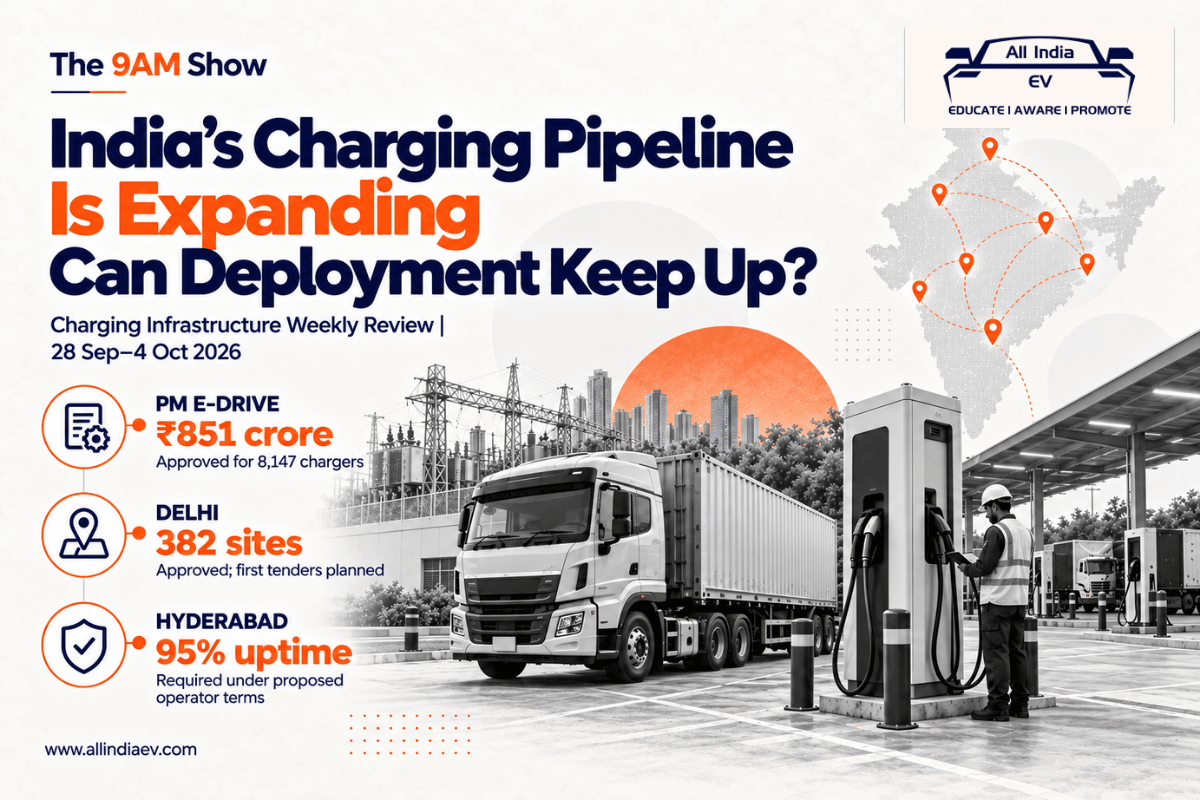
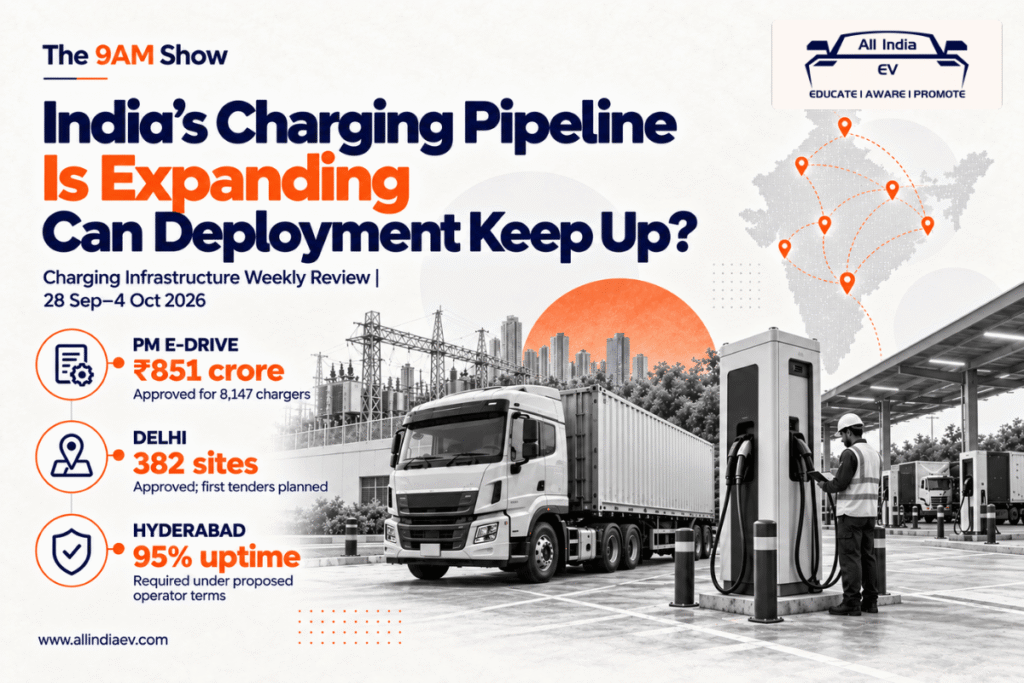
- ₹851 crore approved for 8,147 chargers: the national pipeline takes shape
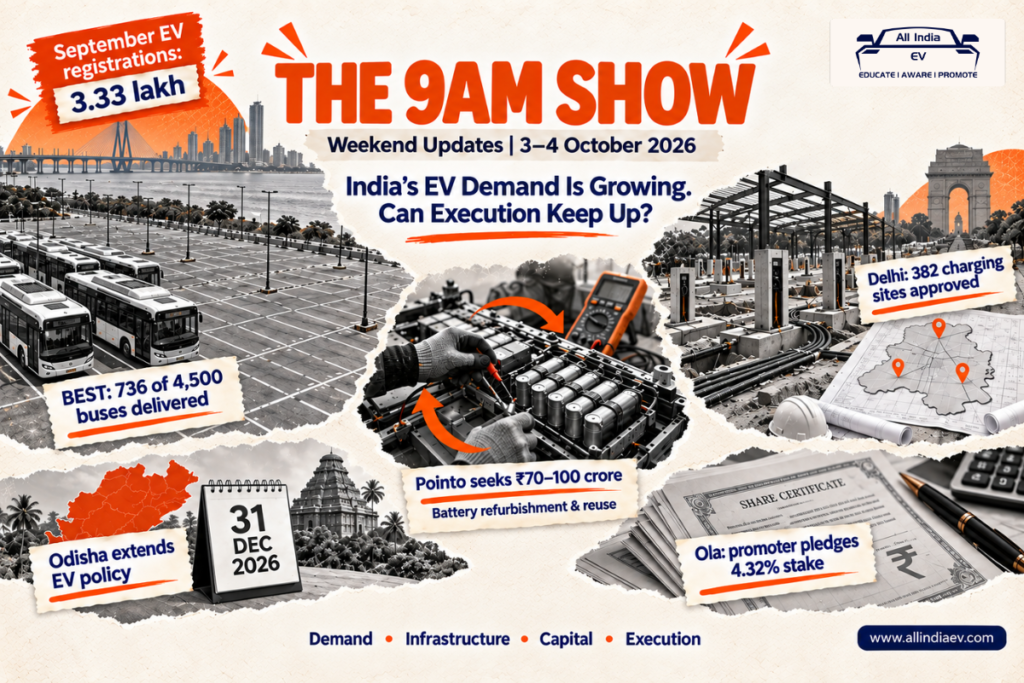
- Delhi: 382 approved sites, with the first tender tranche approaching
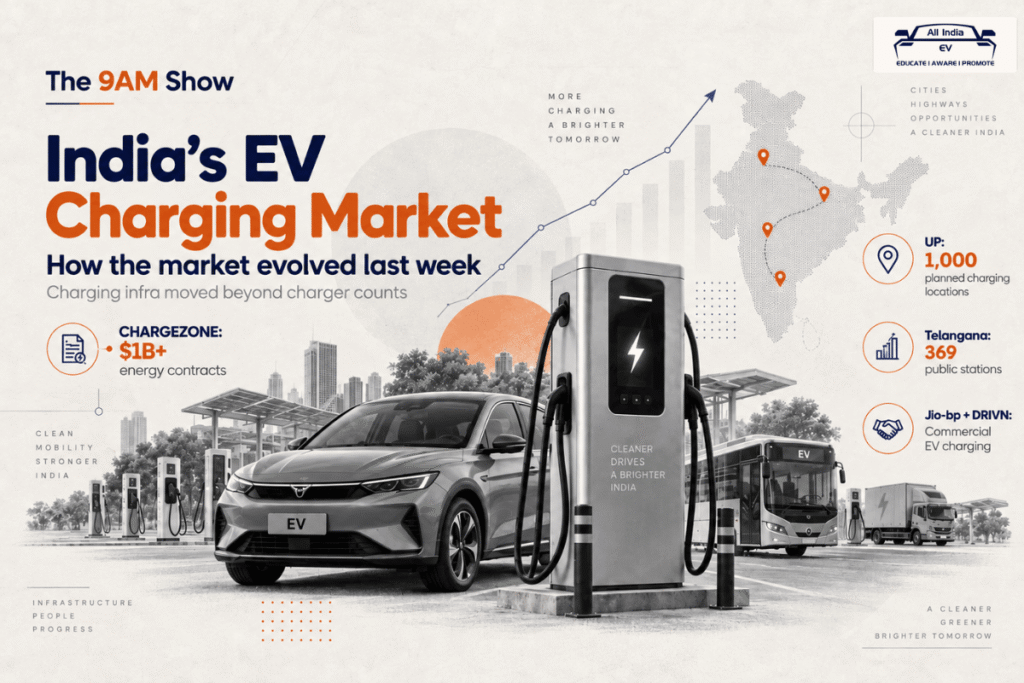
- Uttar Pradesh: 99 MoUs signed, another 1,500 locations targeted
- Hyderabad: public charging comes with an uptime obligation
- Ghaziabad: the first station opens under a 20-location plan
- Rewari: heavy-duty swapping expands the freight infrastructure conversation
- Jammu and Kashmir: a longer-term charging network target
Good morning, and welcome to All India EV’s The 9AM Show.
Last week’s charging infrastructure developments brought three questions into focus: how quickly approved projects will become operational, who will maintain public charging networks, and whether infrastructure is reaching the places where drivers need it.
From central funding approvals and Delhi’s upcoming tenders to Hyderabad’s uptime requirements and heavy-duty battery swapping in Haryana, here is what matters—and our reading of what comes next.
₹851 crore approved for 8,147 chargers: the national pipeline takes shape
An October 1 PIB update said ₹851 crore had been approved for deploying 8,147 chargers through three oil marketing companies and ten states, as of September 28. PM E-DRIVE has earmarked ₹2,000 crore for public charging infrastructure nationwide. These are cumulative approvals, rather than 8,147 chargers installed last week.
Our reading: this creates a substantial deployment pipeline for charger manufacturers, installation contractors and operators. The next meaningful milestones are procurement, power connections, commissioning and usage.
For the industry, the question now is how much of this approved pipeline becomes accessible, working infrastructure—and how quickly.
Delhi: 382 approved sites, with the first tender tranche approaching
Delhi’s power minister said on Sunday that the Ministry of Heavy Industries had approved 382 of the 456 identified charging sites. The government plans to tender the first tranche of approximately 160–180 high-readiness locations. Sites have been reassessed for different vehicle segments, with KPMG onboarded as the project management unit.
Our reading: readiness-based deployment is worth watching. A location suitable for a passenger car may serve an electric three-wheeler or commercial fleet poorly.
The tender details should reveal how Delhi balances vehicle demand, available power, accessibility and operating economics. The approved-site count is the starting point; commissioning will establish the outcome.
Uttar Pradesh: 99 MoUs signed, another 1,500 locations targeted
An October 1 report on Uttar Pradesh’s review meeting said 99 MoUs had been signed against 238 identified charging sites. Officials were also directed to identify 1,500 locations for a second phase. The larger figure represents a site-identification target.
Our reading: district-level execution will determine the value of this expansion.
A charging location needs more than available land. It needs suitable electricity infrastructure, practical access and enough demand to support continued operation. Tracking the conversion from identified sites to agreements, and then to commissioning, will give a clearer picture of progress.
Hyderabad: public charging comes with an uptime obligation
Reporting on September 28 highlighted TGREDCO’s plan to bring private operators into the operation, maintenance, upgrading and commercial management of 200 public charging stations in Hyderabad for an initial ten-year period.
The reported conditions include a minimum monthly uptime of 95%, a ₹500-per-charger-per-day penalty for excess downtime, customer support obligations and integration with the TGEV application. The notified consumer tariff was ₹13 per kWh, excluding applicable taxes, subject to future revision by TGREDCO.
Our reading: this is one of the week’s most consequential operational stories.
Maintenance, payment failures and customer support directly affect whether drivers can rely on a network. The next test is enforcement: how uptime is measured, how failures are resolved, and whether those service obligations translate into dependable charging.
Ghaziabad: the first station opens under a 20-location plan
Statiq, GLIDA and Ghaziabad Nagar Nigam inaugurated the first public charging station under a planned network of 20 locations. The first phase envisages 100 charging points, with the civic body providing land and private partners developing and operating the facilities.
Our reading: municipal partnerships can help operators secure accessible urban sites.
This is an opening milestone within a larger rollout. The remaining locations, their commissioning schedules and their usage will determine how much convenience the network adds for residents and commuters.
Rewari: heavy-duty swapping expands the freight infrastructure conversation
EIM’s heavy-duty battery swapping-cum-charging station in Rewari, Haryana, was reported during the week. The facility serves the NH48 freight corridor, bringing commercial transport into the infrastructure discussion.
Our reading: electric freight requires infrastructure designed around truck schedules and route economics.
For fleet operators, turnaround time, battery availability and dependable service can matter as much as the advertised capacity. Swapping infrastructure will need to prove that it can support repeated, predictable operations along a corridor.
Jammu and Kashmir: a longer-term charging network target
An October 1 report on Jammu and Kashmir’s EV Policy 2026–32 described a target of 900 charging sites, including 140 fast-charging hubs, by 2032. These are policy targets for future deployment.
Our reading: regional coverage requires careful planning around travel patterns, seasonal demand and electricity availability.
The implementation programme will be worth following for its site choices, procurement timelines and approach to maintaining service across the network.
Hyderabad: ThunderPlus adds destination charging
An October 1 report covered ThunderPlus’s launch of a 120 kW fast-charging station at Prasads IMAX in Hyderabad.
Our reading: destination charging can make charging easier to fit into a driver’s day.
Its value depends on how well charger capacity, parking access and pricing match the time visitors spend at the venue. Utilisation and successful charging sessions will show whether the location works commercially and practically.
Bengaluru: residential charging remains an unresolved access problem
A September 29 report, drawing on an August survey of 15 BDA apartment complexes covering around 5,000 flats, found only one complex with an operational community charging facility. The findings apply to the surveyed properties.
Our reading: residential charging deserves a place alongside public network expansion.
For apartment residents, parking arrangements, electrical capacity, approvals and billing can determine whether everyday charging is convenient. Public fast charging adds flexibility, while dependable residential access can make EV ownership much easier.
The All India EV view
Taken together, these developments suggest that India’s charging market has work to do across several stages at once: building the approved pipeline, commissioning usable sites, maintaining existing assets and extending access to homes and freight routes.
For the coming weeks, we will be watching three measures:
- Deployment: how many approved or contracted sites begin serving vehicles?
- Reliability: how consistently can users complete a charging session?
- Usage: are locations attracting enough demand to sustain their operation?
Last week supplied encouraging funding, planning and opening milestones. The next chapter will be written through working chargers, dependable service and repeat users.
That’s Tuesday’s charging infrastructure review on All India EV’s The 9AM Show.
Which deserves the most attention now: commissioning speed, charger uptime or residential charging access?