

By Sambit Patnaik, Founder at RapidE Power
- 1. The Livelihood Revolution: Beyond the Hype of EV Adoption
- 2. The Economics of Time: The Battery is the Bottleneck, Not the Motor
- 3. The Policy Paradox: Regulation Lags While Markets Scale
- 4. Ground Truths: Lessons from Building RapidE Power
- 5. The Road Ahead: Constructing India’s Decentralized Energy Grid
1. The Livelihood Revolution: Beyond the Hype of EV Adoption
India’s electric mobility story is no longer a speculative forecast or an ambition reserved for glossy policy documents. In the segments that matter most for daily livelihoods, the transition has already arrived.
In FY2025–26, India recorded approximately 1.40 million electric two-wheeler retail sales, marking a solid year-on-year growth of around 22%. Electric models now account for roughly 6.5% of total two-wheeler sales nationwide. Even more dramatic is the transformation of the commercial three-wheeler sector, where electric models represent around 61% of all new vehicle registrations. When electrification crosses the halfway mark in a mass-transit and commercial freight segment, it ceases to be an alternative technology; it becomes the established economic baseline of India’s everyday transport and urban logistics ecosystem.
Yet, as the market matures beyond early adopters and policy-driven pilot projects, the fundamental conversation in clean mobility has shifted. The primary question for this next phase is no longer whether riders and drivers will accept electric vehicles, but rather: How do these vehicles get their energy, and who carries the financial cost and operational risk of the battery?
As commercial fleets, quick-commerce delivery operators, and gig workers drive millions of daily kilometres, the bottleneck in scaling clean transportation has migrated from vehicle assembly lines to energy distribution networks.
THE EV LIVELIHOOD PARADIGM SHIFT
- Phase 1: Vehicle Adoption. Focused on vehicle viability, initial subsidies, early adopters, and overcoming high upfront sticker prices.
- Phase 2: Energy & Asset Logistics. Focuses on rapid energy replenishment, unbundling battery cost from the chassis, and shifting battery degradation risk to specialized infrastructure operators.
2. The Economics of Time: The Battery is the Bottleneck, Not the Motor
To understand why energy delivery is the true battleground, one must look at the daily unit economics of commercial drivers. For a quick-commerce delivery rider carrying groceries, a parcel delivery executive, or an e-rickshaw driver navigating crowded urban corridors, time is directly convertible into income. A vehicle parked at a charging dock is a vehicle that is not earning.
Re-fuelling Method Comparison for Commercial Fleets
| Re-fuelling Method | Typical Turnaround Time | Impact on Commercial Operations |
|---|---|---|
| Slow AC Charging | 4–6 Hours | High downtime penalty; locks vehicles overnight or requires mid-shift idle hours. |
| Fast DC Charging | 30–45 Minutes | Imposes 45-min downtime per shift; induces high thermal stress & rapid cell degradation. |
| Battery Swapping | 1–2 Minutes | Zero downtime penalty; maximizes daily rider revenue and keeps fleet turnaround near 100%. |
While fast charging has made impressive strides for passenger cars, it remains fundamentally unsuited for high-utilization commercial two- and three-wheelers due to three critical friction points:
- Charging Time vs. Turnaround: Fast charging requires 30 to 45 minutes to restore charge. For a rider completing 30 to 35 or more delivery runs a day, saving 45 minutes per shift represents additional income that directly dictates monthly household economics.
- Cell Degradation under Frequent Fast Charging: Pushing high-DC currents into compact two-wheeler batteries elevates internal thermal stress, accelerating chemical degradation and shortening overall pack lifespan.
- Grid Infrastructure Stress: Concentrating high-power DC fast chargers in high-density commercial hubs puts immense local load on urban distribution transformers.
Beyond the downtime penalty lies the daunting barrier of upfront capital outlay. The lithium-ion battery pack accounts for roughly 40% to 50% of an electric vehicle’s total bill of materials (BOM). When a driver buys a traditional EV with a fixed battery, they are pre-paying for 3–5 years of fuel upfront while taking on the balance-sheet depreciation of a chemical asset subject to temperature wear.
Through any Battery-as-a-Service (BaaS) service such as that of RapidE Power’s, the energy pack is unbundled from the vehicle chassis. By purchasing the vehicle without the battery, the upfront sticker price drops by 40% to 45%. This shifts the buying decision entirely for a first-time rider/driver or a small fleet operator who cannot afford to lock up scarce capital in a depreciating asset. Crucially, BaaS transfers battery degradation risk, performance warranties, and end-of-life recycling logistics away from the individual worker and onto specialized energy infrastructure operators.
3. The Policy Paradox: Regulation Lags While Markets Scale
Despite the evident commercial logic of battery swapping, operators continue to navigate an uncertain policy environment. The regulatory landscape exhibits a stark contrast between draft frameworks and ground execution.
In April 2022, NITI Aayog released a progressive draft Battery Swapping Policy. Its foundational principles were well-directed: it mandated that any public swapping station receive subsidies only if it served at least one vehicle category and supported at least two EV original equipment manufacturers (OEMs). The goal was clear: prevent the rise of walled gardens, encourage interoperable battery architectures, and protect consumers from locked-in proprietary ecosystems.
However, as of late 2026, this national policy remains formally unnotified. Yet, the Indian mobility market has not waited for bureaucratic alignment. Battery swapping across major metros operates at a commercial scale without a notified national policy framework. While standards organizations like the Bureau of Indian Standards (BIS) have made progress by publishing safety and performance testing guidelines (such as the IS 17896 series), several structural policy friction points persist:
- The GST Inversion Paradox: Electric vehicles sold with fixed batteries attract a concessional 5% Goods and Services Tax (GST). However, standalone batteries purchased for swap networks or sold as Battery-as-a-Service operations attract an 18% GST rate (HSN 8507). Swapping services themselves are treated as a supply of service (SAC 998714), also taxed at 18%. This 13% tax differential penalizes the exact asset-light, low-upfront-cost model best suited for low-income gig workers.
- Subsidy Parity under PM E-DRIVE: National demand incentive programs, such as the PM E-DRIVE scheme, have historically structured demand subsidies around registered vehicles with fixed battery capacity. Devising equitable mechanisms to channel demand incentives directly to swappable battery assets or BaaS providers remains an ongoing administrative challenge.
- Asset Classification and Bankability: Financial institutions require clear legal classifications for swappable batteries as independent collateral assets. Without standardized asset registry frameworks, cross-collateralization, equipment insurance, and secondary market valuation remain complex, raising the cost of capital for swap operators.
4. Ground Truths: Lessons from Building RapidE Power
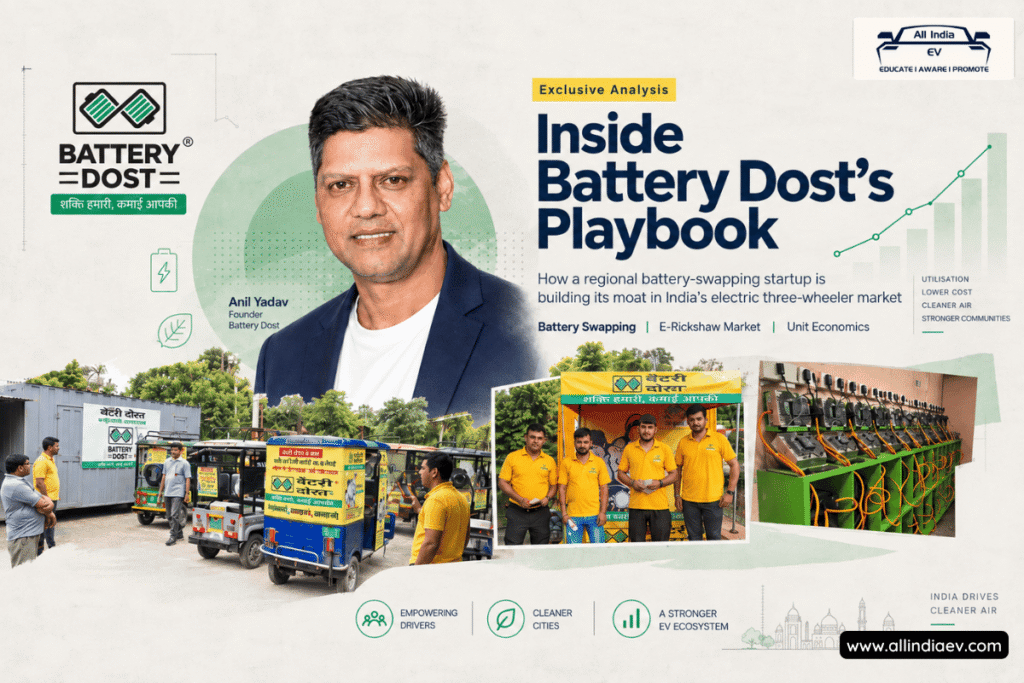
At RapidE Power, we have spent years addressing a foundational challenge: How do you bring charged batteries directly into the rider’s active workflow without building hyper-expensive, land-heavy networks of fixed automated swap cabinets?
Instead of forcing delivery workers to divert from their routes to visit distant, static charging hubs, our asset-light model integrates battery logistics directly into the delivery ecosystem. Operating across diverse urban terrains, including Hyderabad, Bengaluru, Nagpur, and Bhubaneswar, we have gathered practical operational insights from managing thousands of swaps on real streets:
FOUR STRATEGIC LESSONS FROM GROUND OPERATIONS
- Density Beats Coverage. A swap network is only as good as the nearest charged battery. Saturated micro-clusters outperform broad, thin city coverage.
- Logistics is the Real Product. Cell chemistry matters, but uptime, turnaround speed, and rider trust are what retain commercial customers.
- Asset-Light is a Survival Strategy. Capital-heavy station rollouts are hard to justify while policy is unsettled. Flexible models let operators scale with demand.
- Standardisation is the Multiplier. Every incompatible pack form factor fragments the market and raises costs. Interoperability is a commercial necessity.
Deep-Dive into Operational Execution
- Density Beats Coverage: Spreading 100 swapping points thinly across an entire tier-1 metro yields poor utilization and high rider frustration. Conversely, concentrating those same 100 swap touchpoints within a dense 5-square-kilometer commercial or logistics corridor ensures that no rider ever travels more than two minutes out of their way. High asset utilization within a tight micro-cluster delivers superior unit economics compared to broad geographic coverage.
- Logistics is the Real Product: While battery chemistry, cycle life, and thermal management are important technical prerequisites, the customer ultimately evaluates the service on logistics execution. Fleet managers and gig workers do not measure swap operators by the sophistication of their cloud dashboards; they measure them by turnaround speed, predictable battery inventory, software uptime, and operational reliability during peak delivery windows. Energy is a commodity; logistics excellence, customer support, and driver trust form the defensible business model.
- Asset-Light as a Survival Strategy: Deploying heavy, fully-automated static swap cabinets requires substantial real estate leases, high grid-sanctioned load costs, and lengthy municipal permitting processes. In an industry marked by evolving battery chemistry and unsettled regulatory frameworks, heavy capital expenditure in fixed infrastructure carries significant structural risk. An asset-light distribution approach allows operators to dynamically adjust capacity alongside real-time delivery demand patterns.
5. The Road Ahead: Constructing India’s Decentralized Energy Grid
The next phase of India’s electric mobility movement will be defined by the convergence of energy, software, and financial infrastructure. Battery swapping is evolving beyond simple hardware replacements into a data-driven, distributed energy storage ecosystem.
- Telematics and Predictive Analytics: Advanced Battery Management Systems (BMS) equipped with IoT cellular modules provide real-time telemetry on cell health, thermal gradients, internal impedance, and state-of-charge (SoC). Machine learning algorithms analyze historical riding behaviors and delivery heatmaps to dynamically position fully charged packs at high-demand nodes before order volumes peak.
- Grid Balancing and Solar Integration: Distributed networks of swappable battery packs function as aggregated Battery Energy Storage Systems (BESS). During off-peak or solar-abundance hours (09:00 to 16:00), swap hubs can absorb cheap renewable power. During peak grid demand, connected battery banks can feed energy back or modulate charge rates, helping discoms balance local transformer loads.
- Second-Life Cascade Economics: When a swappable battery pack degrades to 70–80% of its initial capacity, rendering it less suitable for high-acceleration transport, it retains significant utility. Standardized pack designs allow seamless transition into secondary, stationary energy storage applications, such as telecom tower backup power or rural micro-grids. This cascade framework extends asset monetization across a 10-to-12-year lifecycle, directly improving unit economics for primary swap operations.
India’s transition to electric mobility is no longer constrained by motor efficiency or vehicle design. It is anchored in the speed, accessibility, and financial accessibility of energy replenishment. By unbundling energy from hardware, rationalizing tax structures, and prioritizing fleet-integrated, interoperable logistics, battery swapping can convert the battery from a costly bottleneck into a core engine of India’s commercial EV adoption.
I can turn this into a doc, or run a fact-check on the figures before it goes on All India EV. Claims worth verifying include the 1.40M FY26 e2W sales, the 61% e3W share, the 40–45% price drop, and the “13% GST differential.”