

EV Charging Infrastructure Special | Tuesday, 27 October 2026
- 1. What is Unified Bharat e-Charge?
- 2. Why does India need it?
- 3. How does UBC work?
- Step 1: The driver searches for a charger
- Step 2: The app requests information from participating networks
- Step 3: The driver selects and starts a session
- Step 4: Charging and payment information is exchanged
- A simple example
- 4. Is UBC an app like BHIM?
- 5. How can UBC help EV users?
- Easier charger discovery
- Better information before reaching a station
- Simpler payments
- More confidence on longer journeys
- 6. How can UBC help the EV charging market?
- For charge point operators: greater visibility
- For vehicle manufacturers and app providers: wider access
- For smaller CPOs: access to a wider ecosystem
- For the industry: better information exchange
- 7. Can a private CPO join UBC?
- 8. How can a private CPO start the onboarding process?
- Step 1: Check your existing charging network and CMS
- Step 2: Contact a UBC integration provider
- Step 3: Prepare your charger and business information
- Step 4: Integrate and test
- Step 5: Confirm commercial terms and go live
- 9. What UBC will need to succeed
- Accurate live status
- Clear tariffs
- Reliable charging equipment
- Clear responsibility
- Fair access for smaller operators
- All India EV’s perspective
Imagine driving an electric car from Delhi to Jaipur.
You find a charging station on your route. But when you reach it, you discover that the charger belongs to a network whose app you have never used. You download the app, register, check the tariff and figure out how to pay.
At the next stop, you may have to repeat the process with another operator.
This fragmented experience is one of the problems Unified Bharat e-Charge, or UBC, aims to address.
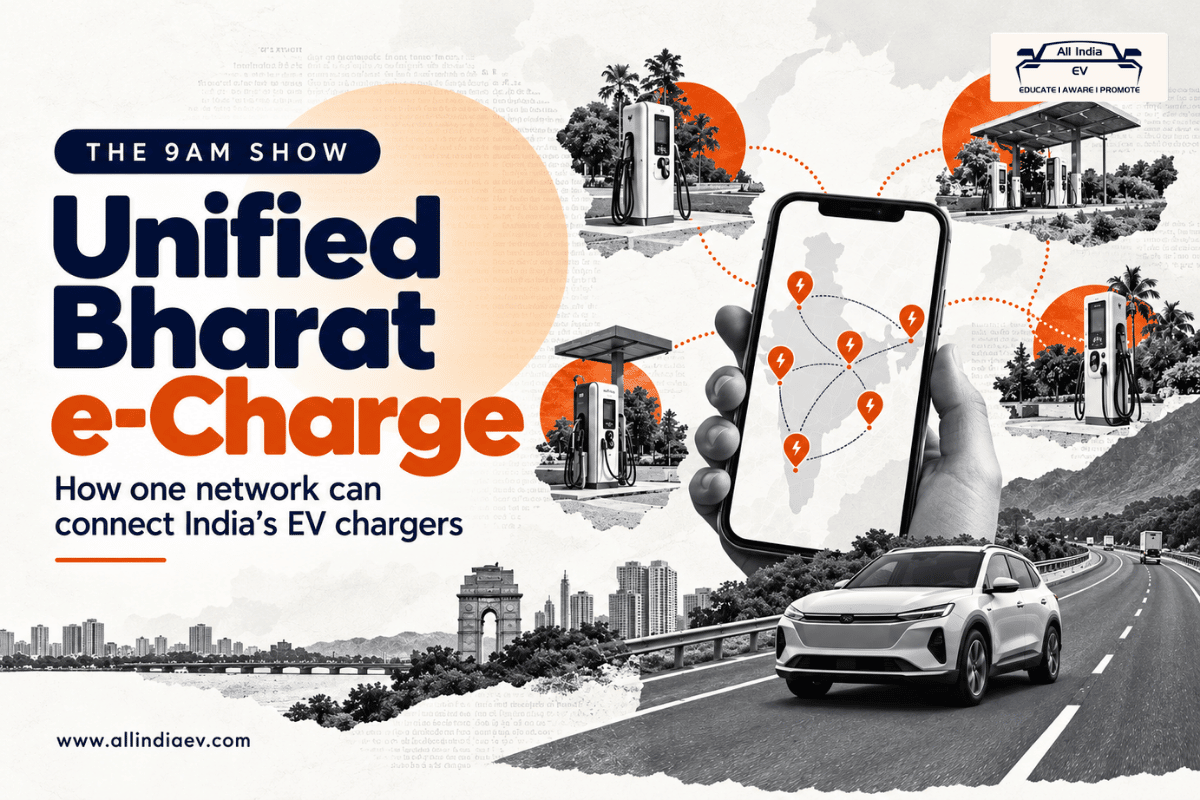
The idea is to connect participating charging networks and compatible customer-facing apps through a common digital framework—making it easier for EV users to discover, access and pay for charging across operators.
But what exactly is UBC? How does it work? And how can a private charge point operator become part of it?
Let’s break it down.
1. What is Unified Bharat e-Charge?
Unified Bharat e-Charge is an interoperability initiative for India’s EV charging ecosystem.
It is intended to help different charging operators, digital platforms and payment services communicate with one another through an open network.
The initiative involves the Ministry of Heavy Industries, BHEL and NPCI. Technology providers working on UBC describe it as an open framework through which EV users can discover participating chargers, view information such as availability and pricing, and complete charging-related transactions through compatible applications. Energetica India Magazine
Think of the objective this way:
An EV user should be able to access charging services from different participating operators through a compatible app, without needing a separate relationship with every charging network.
UBC does not itself manufacture chargers, build stations or supply electricity. Its role is to make the digital side of charging more connected.
2. Why does India need it?
India’s charging ecosystem includes many participants:
- Charge point operators, or CPOs.
- Charger manufacturers.
- Charger management system providers.
- Vehicle manufacturers.
- Charging discovery applications.
- Payment providers.
- Site owners and electricity distribution companies.
That diversity supports competition and innovation. But it can also make the charging experience complicated for the customer.
A driver may need to find out:
- Which network operates the charger?
- Does the charger work with my vehicle?
- Is it available?
- What is the tariff?
- Which app or payment method is required?
- What happens if the session fails?
A shared interoperability framework can help participating platforms exchange this information in a more consistent way.
The Ministry of Heavy Industries’ PM E-DRIVE charging guidelines also identify the need to share information such as charger location, availability, pricing and digital payment options with Unified Bharat e-Charge. That requirement applies within the relevant scheme framework; it should not automatically be read as a blanket mandate on every private charger in India.
3. How does UBC work?
At a simplified level, UBC connects the app used by the EV driver with the system managed by the charging operator.
Step 1: The driver searches for a charger
An EV user opens an application that supports UBC and looks for a charging station near their location or along a route.
Depending on the app and the information supplied by the operator, the user may be able to see details such as:
- Station location.
- Connector type and charging capacity.
- Availability.
- Applicable tariff.
- Payment options.
Step 2: The app requests information from participating networks
The customer-facing app communicates with participating providers through the network.
The operator’s system supplies information about its chargers, pricing and availability. UBC is built around Beckn, an open network protocol designed to help different digital platforms exchange information. Kazam
Step 3: The driver selects and starts a session
The driver selects a compatible charger and follows the process available in the app. Depending on the implementation, this could include scanning a QR code, confirming the tariff and starting a charging session.
Step 4: Charging and payment information is exchanged
The operator’s system communicates session information, while the participating application supports the relevant transaction and payment flow.
The exact experience—including booking, session initiation, payment and refunds—can vary by app, operator and the features they have enabled.
A simple example
A driver uses a compatible app to find a charger operated by CPO A.
The driver sees its location and tariff, selects the charger and follows the app’s instructions to charge. On another journey, the same app could help the driver access a participating charger operated by CPO B.
The value comes from connecting the services behind the scenes.
4. Is UBC an app like BHIM?
UBC is the interoperability framework; BHIM is one of the apps associated with its initial rollout.
Industry reporting has described BHIM as an early customer-facing application through which users can discover participating chargers and make payments using UPI. Other applications may join or add support as the ecosystem develops.
However, users should check the current functionality in their chosen app. Having UPI on an app does not automatically mean that app supports the full UBC charger discovery and charging flow.
Similarly, not every charger in India should be assumed to be connected to UBC today. Participation, app support and rollout may vary.
5. How can UBC help EV users?
Easier charger discovery
A connected network can make chargers from multiple participating operators visible through a compatible app.
This is particularly useful for drivers travelling outside their usual city or relying on public charging for the first time.
Better information before reaching a station
If operators provide accurate information, users can make better decisions based on connector type, location, availability and tariff.
That matters because a charger appearing on a map is useful only if the driver can also determine whether it is suitable and accessible.
Simpler payments
A more connected payment journey can reduce the need to create separate accounts or maintain multiple charging wallets.
More confidence on longer journeys
A driver planning an intercity trip can benefit from seeing more charging options across participating networks—and identifying a backup if the preferred station is unavailable.
The condition is data quality. UBC can provide a way to share charger information, but the information must be kept accurate and updated by the participating systems.
6. How can UBC help the EV charging market?
For charge point operators: greater visibility
A private CPO may have reliable chargers but limited visibility outside its own app or customer base.
By joining an interoperable network, its stations could be discoverable through other participating applications. That creates an opportunity to reach more users without relying entirely on downloads of its own app.
More visibility may improve utilisation, although actual demand will still depend on the site, tariff, reliability and local EV population.
For vehicle manufacturers and app providers: wider access
An automotive OEM or digital platform could give its users access to charging services across participating networks without creating a separate customer experience for every operator.
For smaller CPOs: access to a wider ecosystem
A smaller operator may not have the resources to build a large consumer app and market it nationwide. An interoperable framework could allow it to focus on operating good charging sites while working with compatible technology partners.
For the industry: better information exchange
Standardised digital communication can support a more consistent exchange of information about stations, availability, tariffs and charging sessions.
Over time, this can help the industry move towards a more connected customer experience.
7. Can a private CPO join UBC?
Yes. Private charge point operators can participate, subject to the network’s technical, commercial and onboarding requirements.
A private CPO may explore two broad routes:
- Direct integration: Work with its own technical team or CMS provider to build and test the required network integration.
- Integration through a technology partner: Work with a provider that already offers connectivity to the UBC ecosystem.
For example, Kazam announced a time-limited integration programme for eligible CPOs in July 2026. It described support for network assessment, integration, testing and transaction validation while allowing operators to use their existing CMS and pricing models. That specific free programme was announced for seven days; its availability and current commercial terms should be checked directly with Kazam.
8. How can a private CPO start the onboarding process?
A practical starting process is:
Step 1: Check your existing charging network and CMS
Prepare a list of your operational charging sites and ask your CMS provider:
- Does our current CMS support UBC integration?
- Is the system already connected through a UBC technology partner?
- Can it exchange charger location, connector, availability, tariff and session information?
- What development or configuration work would be required?
If the CMS supports OCPI, that may make integration easier through some technology partners. It does not, by itself, guarantee that a network is already connected to UBC.
Step 2: Contact a UBC integration provider
Approach your existing CMS provider or a technology provider offering UBC integration.
Ask them to assess the network and explain whether they will provide the necessary connection, testing and ongoing support.
Kazam has publicly described a provider-side integration route. Its published programme is one example; a CPO should compare available providers and verify their current capabilities and terms.
Step 3: Prepare your charger and business information
A CPO should be ready to provide accurate information on:
- The operating entity and contact details.
- Station locations and access details.
- Charger and connector specifications.
- Availability and status information.
- Tariffs and payment arrangements.
- Customer support and issue-resolution contacts.
The precise documents and data fields should be confirmed with the onboarding provider.
Step 4: Integrate and test
The CPO and its provider would typically need to test whether the connected systems can exchange the required information and handle charging transactions correctly.
This may include checking charger discovery, status updates, tariff display, session initiation and transaction information.
Step 5: Confirm commercial terms and go live
Before launch, the CPO should understand:
- Integration and recurring costs.
- Transaction fees, if applicable.
- Settlement timelines.
- Refund and failed-transaction handling.
- Responsibility for customer support.
- Data-sharing arrangements.
- Who maintains the connection if the CMS or network requirements change.
Once testing and any applicable approval or certification requirements are completed, the operator can work with its provider to make the network available through participating applications.
Important: We could not independently verify a single official public registration link, a universal fee schedule, or a fixed onboarding timeline applicable to every private CPO. Operators should obtain the current process and commercial terms from their CMS provider or UBC integration partner before committing.
9. What UBC will need to succeed
A connected digital network can make charging easier to discover and access. Its success will also depend on what happens at the charging station.
Accurate live status
If a charger is shown as available but is out of service, user confidence will decline.
Clear tariffs
Drivers should be able to understand what they are paying before the session begins, including any applicable additional charges.
Reliable charging equipment
Digital interoperability cannot repair a damaged connector, restore a failed power supply or resolve poor maintenance on its own.
Clear responsibility
When a session fails, the user needs to know whom to contact—and participating apps, CPOs, CMS providers and payment partners need a clear process for resolving the issue.
Fair access for smaller operators
If integration costs or technical requirements are too high, smaller CPOs may struggle to participate. Accessible onboarding and transparent commercial arrangements will matter.
All India EV’s perspective
Unified Bharat e-Charge has the potential to address a real gap in India’s charging experience: the distance between a charger existing and a driver being able to find, trust and use it easily.
For customers, the opportunity is a simpler journey across participating charging networks.
For private CPOs, it is an opportunity to make their stations visible to more users and participate in a wider digital ecosystem.
For India’s charging industry, the larger opportunity is to build a market in which operators can compete on location, price, reliability and service quality, while customers have an easier way to access those services.
The next questions are practical ones: How quickly can private operators join? What will integration cost? Which apps and networks are live? And how will failed sessions and customer complaints be handled?
Those answers will determine how much value UBC creates on the ground.