

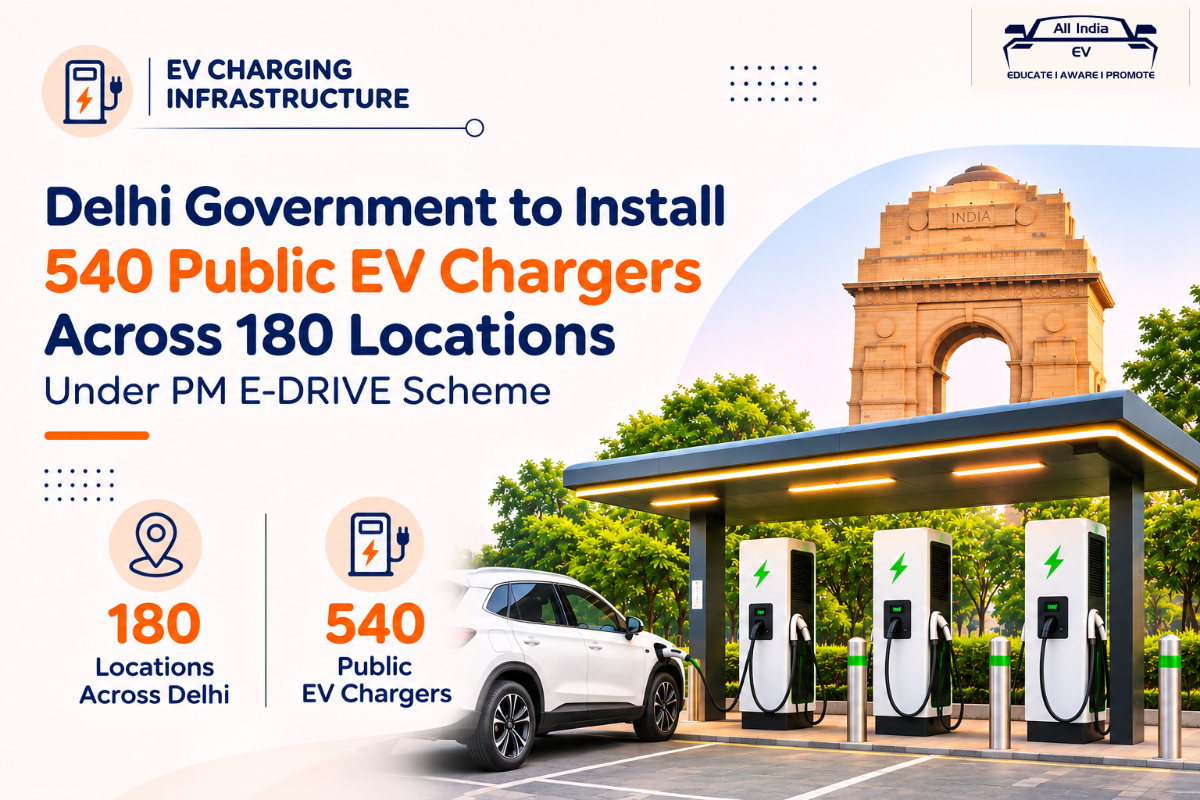
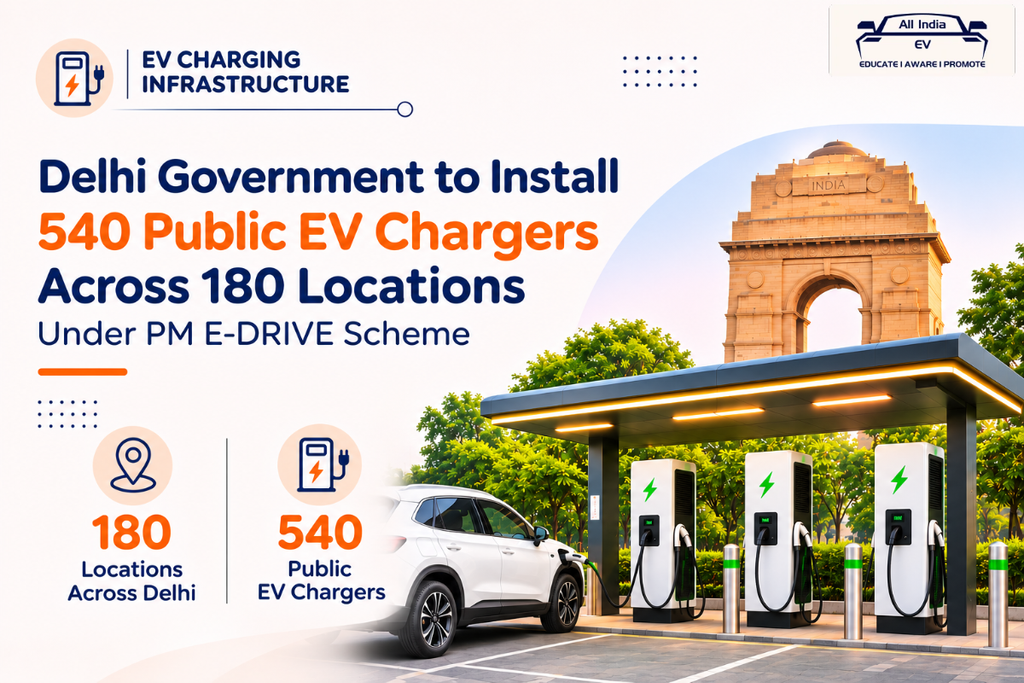
The Delhi government is strengthening its electric vehicle (EV) charging infrastructure with plans to install 540 public EV chargers across 180 locations in the national capital. The initiative, estimated to cost approximately ₹62 crore, aims to improve charging accessibility, support the growing number of electric vehicles and accelerate the transition towards cleaner mobility in Delhi.
The project will be implemented under the central government’s PM E-DRIVE scheme, with Delhi Transco Limited (DTL) taking responsibility for coordinating the development and operation of the charging network. According to officials, DTL has initiated the process of appointing operators who will be responsible for installing and operationalising the charging stations.
Three Types of EV Chargers to Be Installed at Each Location
The proposed charging infrastructure will follow the configuration approved by the Ministry of Heavy Industries. Each of the 180 selected locations will have three chargers designed to support different categories of electric vehicles.
The charging facilities will include:
- 12 kW Charger: Equipped with two charging guns, this charger will cater to electric two-wheelers and three-wheelers.
- 60 kW Charger: Featuring two charging guns, it will support N1 goods carriers weighing up to 3.5 tonnes, electric four-wheelers and private electric cars.
- 120 kW Fast Charger: Each location will also feature a 120 kW fast charger with two charging guns to support faster charging requirements.
This combination is expected to accommodate personal electric vehicle owners as well as commercial operators, including electric goods carriers and high-utilisation fleets.
180 Charging Locations Divided into Two Packages
To streamline implementation, the 180 selected locations have been divided into two geographical packages, each covering 90 sites.
Package 1 will primarily cover western and northern Delhi, while Package 2 will focus on southern Delhi, New Delhi and eastern parts of the capital.
The shortlisted locations in Central Delhi include areas around Inderlok, Pratap Nagar, Shahi Idgah, Kamla Market and Lok Nayak Jai Prakash (LNJP) Hospital. Two additional co-located charging sites have also been identified at Rajghat.
The geographical distribution is intended to improve access to public charging facilities across different parts of the city.
Delhi EV Policy 2026 to Drive Charging Demand
The charging infrastructure expansion is closely linked to the Delhi EV Policy 2026, which introduces phased electrification requirements for different vehicle categories.
Under the policy, only electric three-wheelers belonging to the L5 category and electric N1 goods carriers will be eligible for new registrations in Delhi from January 1, 2027. The requirement will extend to electric two-wheelers from April 1, 2028.
These registration requirements are expected to increase demand for public charging facilities, particularly for commercial vehicles and frequently used electric mobility segments.
Additionally, the Commission for Air Quality Management (CAQM) has prescribed a target of establishing 32,062 EV charging points across Delhi by December 2029.
PM E-DRIVE Scheme Supports India’s EV Charging Expansion
The project will receive support under the PM Electric Drive Revolution in Innovative Vehicle Enhancement (PM E-DRIVE) scheme, which has a total approved outlay of ₹10,900 crore over two years.
The scheme includes a dedicated allocation of ₹2,000 crore for developing public fast-charging infrastructure. It also proposes 22,100 additional fast public chargers for electric four-wheelers across cities and highways, along with 1,800 high-capacity chargers for electric buses and trucks.
The Ministry of Heavy Industries intends to provide an 80% capital subsidy on eligible upstream electricity infrastructure required for public fast-charging stations under the scheme.
Strengthening Delhi’s Electric Mobility Ecosystem
Delhi continues to face air pollution challenges, with road transportation contributing significantly to the city’s emissions. Expanding electric mobility is therefore an important part of the government’s strategy to improve urban air quality.
The installation of 540 public chargers is expected to address one of the major challenges facing EV adoption: the availability of accessible and reliable charging facilities.
However, the success of the initiative will depend on timely installation, consistent charger availability, reliable electricity supply and convenient payment facilities.
With the ₹62 crore charging infrastructure project, Delhi is taking another step towards building a more accessible EV ecosystem. The expansion will also help prepare the capital for upcoming vehicle electrification requirements and support the long-term growth of electric mobility in India.