

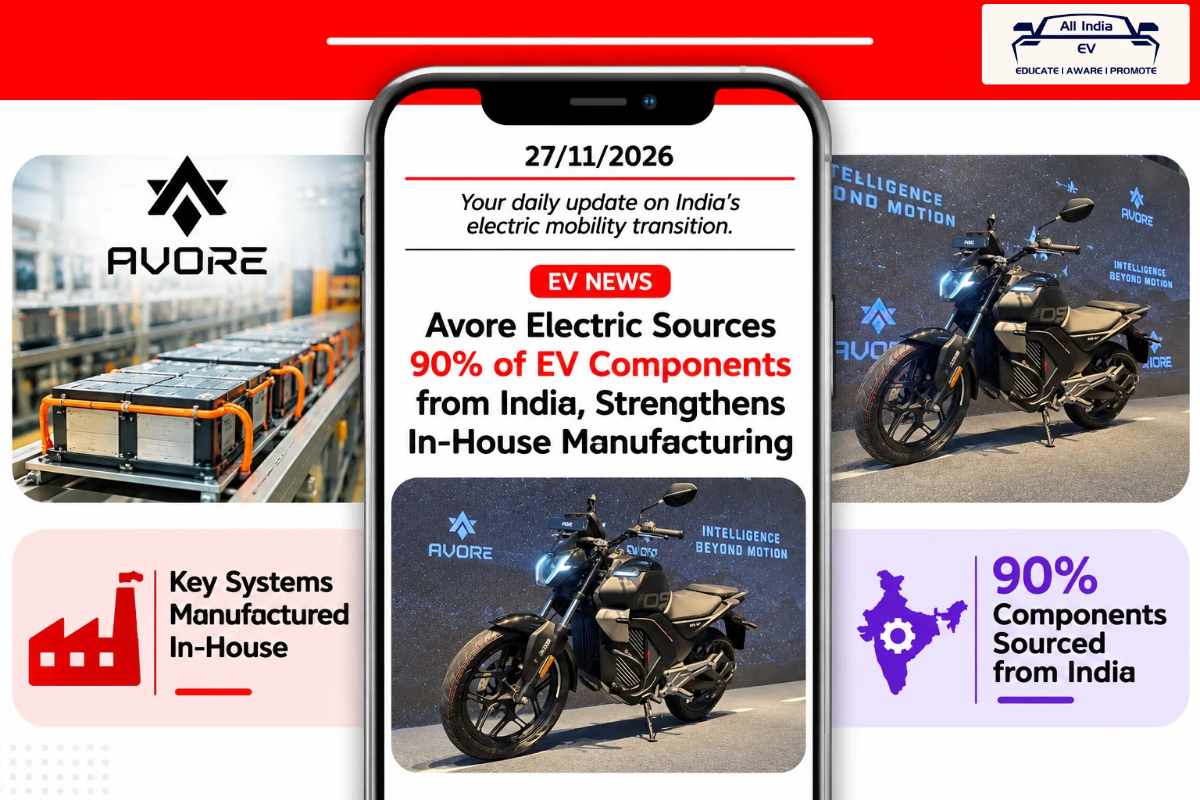
Avore Electric, the electric motorcycle brand from Samarth E-Mobility, has localised 90% of its electric vehicle components through Indian suppliers as it looks to strengthen domestic manufacturing capabilities and reduce dependence on imported components. The company is also manufacturing several critical EV systems in-house, including battery packs, motors, motor controllers and digital displays.
The development highlights Avore Electric’s focus on building a stronger domestic EV manufacturing ecosystem while improving control over product quality, technology development and production processes.
90% Component Localisation Strengthens Domestic Supply Chain
Avore Electric’s localisation strategy combines domestic component sourcing with in-house manufacturing of important vehicle systems. The company is producing several critical components internally, allowing it to maintain greater control over engineering, performance and integration.
Its in-house manufacturing capabilities include electric motors, battery packs, motor controllers and digital displays. The company also manufactures rare-earth-free motors, along with its signature tank lights and position lamps.
By developing these systems internally and sourcing other components from Indian suppliers, Avore Electric aims to reduce its dependence on external vendors and imported assemblies. The approach is expected to strengthen its manufacturing capabilities and support the development of electric motorcycles designed for the Indian market.
Focus on MSME Suppliers and Automotive-Grade Quality
An important part of Avore Electric’s localisation programme involves working with Indian Micro, Small and Medium Enterprises (MSMEs). The company is collaborating with domestic vendors to improve their manufacturing processes and help them meet automotive-grade quality requirements.
To maintain consistency and reliability, Avore Electric follows Advanced Product Quality Planning (APQP) and Production Part Approval Process (PPAP) practices. These frameworks help validate component designs, engineering specifications and manufacturing tolerances before components enter production.
The company’s manufacturing operations are also aligned with internationally recognised quality standards, including IATF 16949 and ISO 9001.
Its quality management system incorporates Failure Mode and Effects Analysis (FMEA), Statistical Process Control (SPC) and Poka-yoke mechanisms. These practices help identify potential manufacturing defects, monitor production variations and prevent assembly errors.
Advanced Testing Across Battery and Motor Production
Avore Electric has also introduced dedicated testing procedures across its battery and motor manufacturing operations to maintain product reliability.
The battery manufacturing line includes automated cell grading and sorting, laser marking, wire bonding and charge-discharge testing. These processes help ensure that battery components meet the required manufacturing and performance standards.
Similarly, the motor production line incorporates controlled thermal processes and precision bearing assembly. Each motor undergoes dynamometer testing to evaluate its performance before being integrated into the vehicle.
The company also maintains traceability across components, sub-assemblies and software versions. This tracking system extends from component sourcing and manufacturing to after-sales support, helping maintain quality oversight throughout the product lifecycle.
Strengthening India’s Electric Two-Wheeler Manufacturing Ecosystem
Avore Electric’s 90% localisation achievement reflects the growing focus among Indian EV manufacturers on developing domestic supply chains and reducing import dependency.
By combining in-house engineering, local sourcing and collaboration with MSME suppliers, the company aims to build a more integrated manufacturing ecosystem for electric motorcycles.
The strategy could also support the development of domestic component suppliers by encouraging them to adopt advanced production techniques and international automotive quality standards.
As India’s electric two-wheeler market continues to evolve, greater localisation of critical EV components will remain important for strengthening manufacturing capabilities, improving supply-chain resilience and supporting the country’s broader electric mobility ambitions.