

Move Could Lower EV Entry Costs and Spark New Growth, But Challenges Remain
India’s electric vehicle (EV) industry is experiencing a fresh wave of innovation as automakers increasingly adopt the Battery-as-a-Service (BaaS) model a financing and ownership structure aimed at making EVs more affordable and appealing to a wider range of buyers. Once a niche idea, BaaS is gaining traction among major players as EV adoption in India continues to grow.
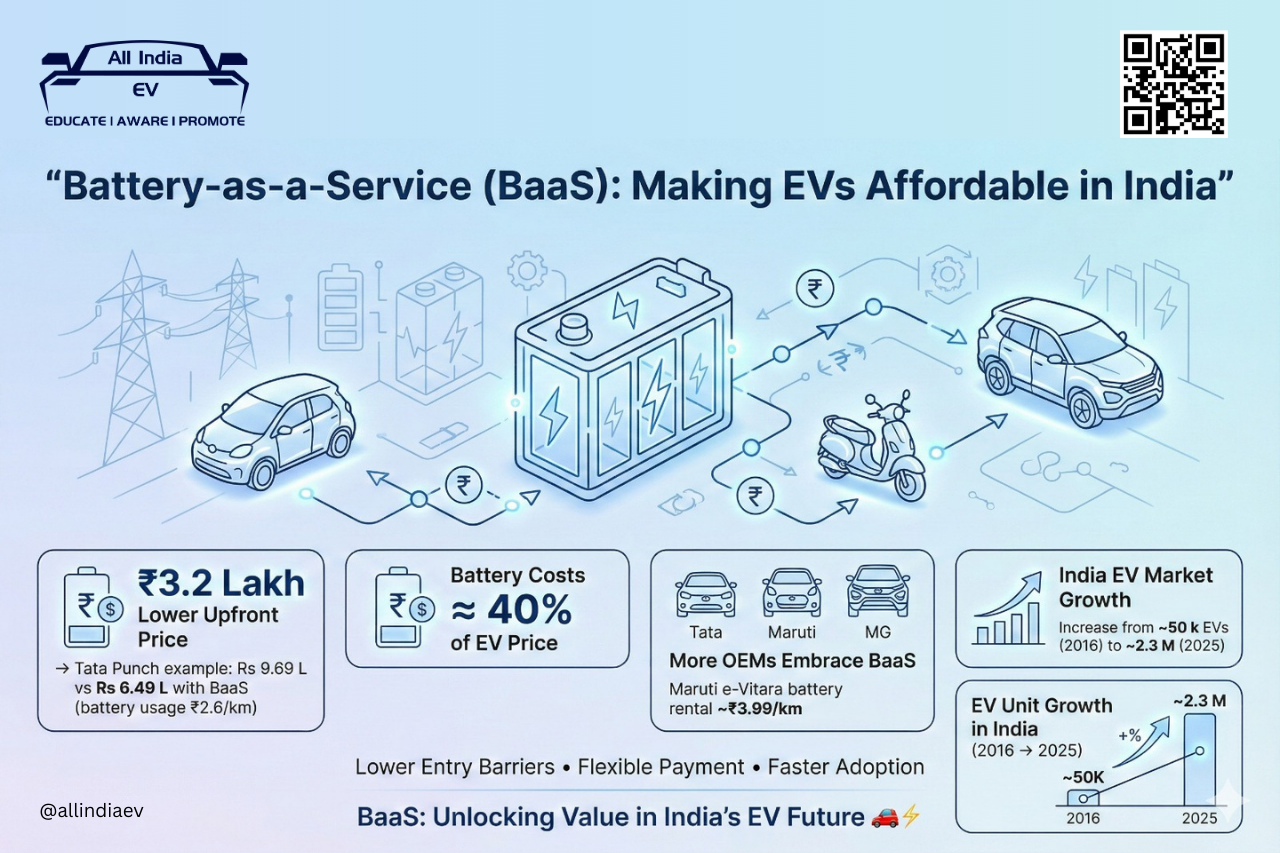
Battery-as-a-Service allows buyers to purchase an electric vehicle at a significantly lower upfront cost by separating the battery one of the most expensive components of an EV from the vehicle’s purchase price. Instead of owning the battery outright, customers pay a usage fee typically on a per-kilometre basis or as a periodic subscription for the battery’s use over time. Charging costs are separate from the battery usage payment.
From Resistance to Adoption: How BaaS Took Hold
The BaaS journey in India’s EV market has been an evolving one. Initially, one of the country’s largest EV makers, Tata Motors, was reportedly sceptical about the model in the context of passenger vehicles, questioning its financial viability and consumer appeal. However, by early 2026, the company had reversed its stance announcing BaaS options alongside the launch of the facelifted Tata Punch EV on February 20.
Just days earlier, Maruti Suzuki India, India’s largest automaker, unveiled its new eVitara EV, offering customers the option to adopt BaaS reinforcing the growing industry acceptance of the model. These moves followed earlier experiments by brands like JSW MG Motor, which had introduced BaaS for its Windsor EV charging customers a monthly or per-kilometre fee for battery usage while reducing the vehicle’s sticker price.
Substantial Upfront Savings for Buyers
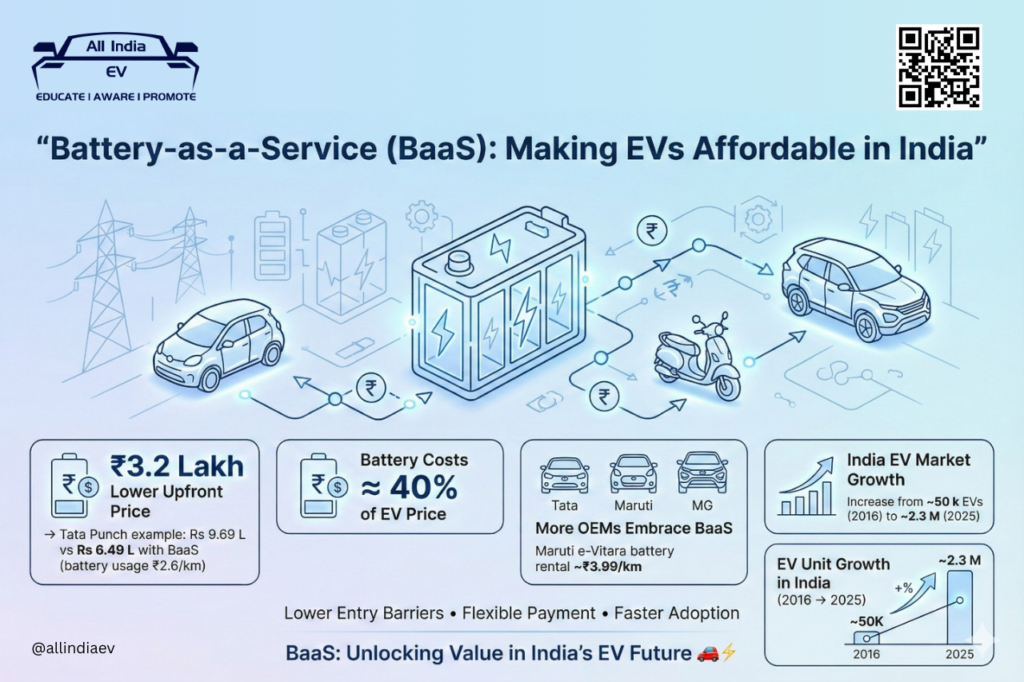
The financial appeal of BaaS is clear. For instance, the Tata Punch EV is priced at ₹9.69 lakh (ex-showroom, Mumbai), but when the battery cost is excluded under a BaaS plan, the vehicle’s base price drops to around ₹6.49 lakh, with a usage charge of ₹2.6 per kilometre. That equates to an upfront reduction of over ₹3 lakh for buyers opting into the BaaS plan.
Industry experts and company executives believe this reduction in entry price can significantly widen the pool of potential EV customers particularly among first-time EV buyers who are often deterred by high upfront costs. Partho Banerjee, Senior Executive Officer for Marketing & Sales at Maruti Suzuki, stated that the intent behind BaaS is to “reduce the entry barrier to electric mobility” and to align purchase plans with different driving needs.
More EV News

BaaS: A Confidence Booster with Psychological Impact
The BaaS model is not just about price it also addresses consumer psychology. Many potential EV buyers are concerned about battery performance, long-term degradation, and replacement costs. BaaS places the responsibility for battery health and longevity on the service provider, thereby reducing perceived risk and boosting buyer confidence.
Puneet Gupta, Director at S&P Global Mobility, has noted that one of the hardest challenges for EV sales today is attracting initial footfall to showrooms. The BaaS model, by showcasing lower entry prices and predictable ongoing payment structures, has the potential to generate greater consumer interest and engagement.
Market Realities and Consumer Preferences
Despite its promise, BaaS is still in its early stages in India and has its limitations. Industry observers acknowledge that not all buyers prefer not owning the battery, especially in a market where vehicle ownership has long been associated with owning the complete product. According to experts familiar with consumer behaviour, some buyers may hesitate to adopt BaaS due to the possibility of changes in pricing or policy in the future.
Another complexity lies in taxation: renting the battery under a BaaS arrangement may attract an 18 % GST rate, compared with the 5 % GST rate on full EV purchases. This discrepancy could add to the cost burden for users and influence purchase decisions.
Industry Outlook and Future Prospects
Despite these hurdles, the broader outlook for BaaS remains optimistic. India aims to achieve a 30 % share of electric vehicles in total vehicle sales by 2030, up from a small but rapidly growing share today. EV sales have reportedly surged from about 50,000 in 2016 to around 2.3 million in 2025, reflecting strong market momentum.
With more automakers experimenting with BaaS and the potential for dedicated battery swap and service networks to expand across the country, the model could evolve into a key enabler of EV adoption particularly among cost-sensitive buyers in smaller cities and emerging markets.
As the model matures, innovations in battery swapping infrastructure, collaborative financing arrangements, and supportive policy frameworks could further drive BaaS adoption and reshape India’s EV landscape in the years ahead.