


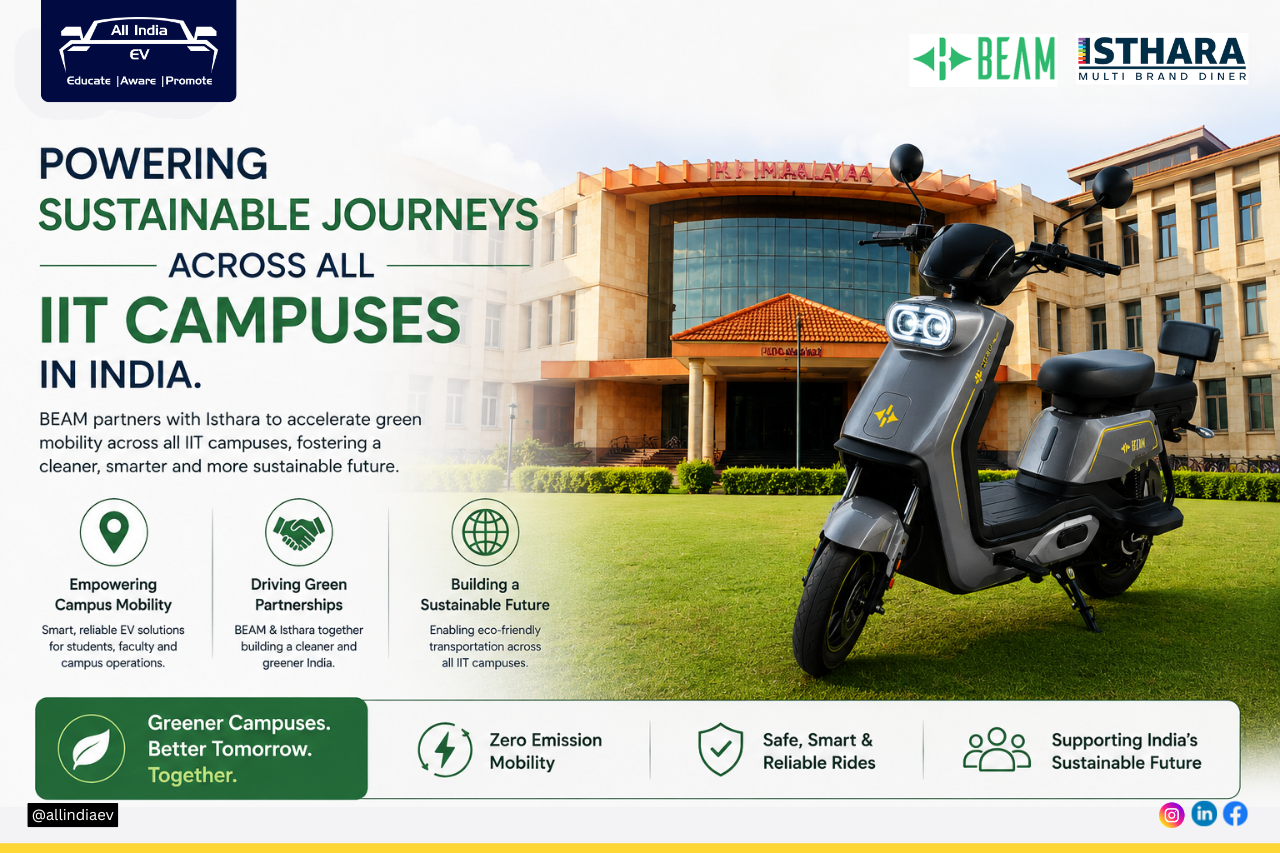
BEAM has partnered with Isthara to introduce shared electric two-wheelers for first and last-mile mobility across IIT campuses in India, creating a cleaner, low-speed EV mobility layer for students, faculty and campus operations.
The partnership focuses on replacing short fossil-fuel-based commutes inside and around campuses with license-free, low-speed electric two-wheelers. The vehicles are designed for short-distance movement and offer a claimed range of 65 to 70 km per charge, making them suitable for daily intra-campus travel, hostel-to-classroom movement, food court access, library visits and other routine student commutes.
India currently has 23 IITs, according to the Ministry of Education’s response in Lok Sabha. That makes the rollout important not just as a campus mobility project, but as a possible template for clean mobility deployment across large educational institutions.
The move also fits into a bigger market shift. In FY2024-25, India recorded over 20.37 lakh EV sales, with electric two-wheelers accounting for 59.4% of total EV sales. High-speed e-2W data alone crossed 12.09 lakh units, even as low-speed e-2Ws remain outside some Vahan-based datasets.
For BEAM, the IIT campus use case is almost tailor-made. The company has positioned its scooters around a ~25 km/h top speed, ~70 km range, and no-license convenience. In an earlier All India EV interaction, BEAM said its product architecture is aimed at India’s short-distance mobility pattern, where many daily trips are only 2 to 5 km and average usage can sit around 15 to 25 km per day.
That is exactly where campuses become interesting. IITs are not just academic institutions, they are mini mobility ecosystems. Students move between hostels, departments, labs, cafeterias, libraries, sports facilities and gates throughout the day. In many campuses, these short trips are still served by petrol two-wheelers, shared autos, walking, or informal commute options.
By combining BEAM’s shared EV fleet with Isthara’s campus-facing operating network, the partnership aims to create a cleaner and more structured mobility system. Isthara already operates across food courts, educational institutions, corporates, malls and expressways, giving the partnership a stronger on-ground deployment angle.
More EV News

The biggest benefit is not only zero tailpipe emissions. It is convenience. A low-speed shared EV can reduce parking load, lower fuel dependence, improve last-mile access and make movement easier for students who may not own a personal vehicle. The model also avoids the over-engineering problem seen in many urban mobility deployments, where high-speed vehicles are used for very short trips.
For IIT campuses, this could become an early example of how India’s premium educational institutions can move from sustainability statements to actual mobility transition. Cleaner campus transport may look small on paper, but when replicated across 23 IITs and later across other universities, it can become a serious demand cluster for low-speed EVs, battery swapping, fleet management, telematics and campus charging infrastructure.
The BEAM-Isthara partnership is therefore not just another EV collaboration. It is a signal that India’s next layer of EV adoption may come from controlled mobility environments: campuses, tech parks, townships, industrial zones and institutional spaces.
For India’s EV ecosystem, that is a quiet but important shift.
Why This Matters
This partnership brings three things together: a defined mobility use case, a captive user base and a low-speed EV format built for short trips. That combination can make campus mobility one of the cleanest entry points for shared electric two-wheelers in India.
Follow us on 𝐈𝐧𝐬𝐭𝐚𝐠𝐫𝐚𝐦: https://lnkd.in/gv3WizBK
Follow us in 𝐘𝐨𝐮𝐓𝐮𝐛𝐞: https://lnkd.in/g6XgiqNA
Join our 𝐖𝐡𝐚𝐭𝐬𝐀𝐩𝐩 𝐜𝐨𝐦𝐦𝐮𝐧𝐢𝐭𝐲: https://lnkd.in/gq-a2q5b