
All India EVAll India EVAll India EV
Notification
Font ResizerAa
  • Home
  • EV News
  • EV Launch
  • Market Insights
  • Investments & Funding
  • Guest Articles
  • EV Engineering
  • Contact
Reading: Bihar Bans E-Rickshaws on Highways, Citing Safety Risks; drivers fear loss of income
Share
All India EVAll India EV
Font ResizerAa
  • Home
  • EV News
  • EV Launch
  • Market Insights
  • Guest Articles
  • EV Engineering
  • Contact
Search
  • Home
    • Home 1
    • Home 2
    • Home 3
    • Home 4
    • Home 5
  • Home
  • Categories
    • Electric
  • Categories
  • Shows
    • Rap
  • More Foxiz
    • Blog Index
    • Contact
  • Bookmarks
    • Customize Interests
    • My Bookmarks
  • More Foxiz
    • Blog Index
    • Sitemap
Have an existing account? Sign In
Follow US
Bihar Bans E-Rickshaws
Home » Blog » Bihar Bans E-Rickshaws on Highways, Citing Safety Risks; drivers fear loss of income
EV News

Bihar Bans E-Rickshaws on Highways, Citing Safety Risks; drivers fear loss of income

Sunita
By
Sunita
Last updated: 21 January 2026
Share
5 Min Read
SHARE

The decision affects thousands of drivers and passengers, raising concerns over job security and access to affordable transport, particularly in rural communities.

Contents
  • Safety concerns cited
  • Ban extended to ‘jugaad’ vehicles
  • Drivers and commuters express concern
  • Impact on daily mobility

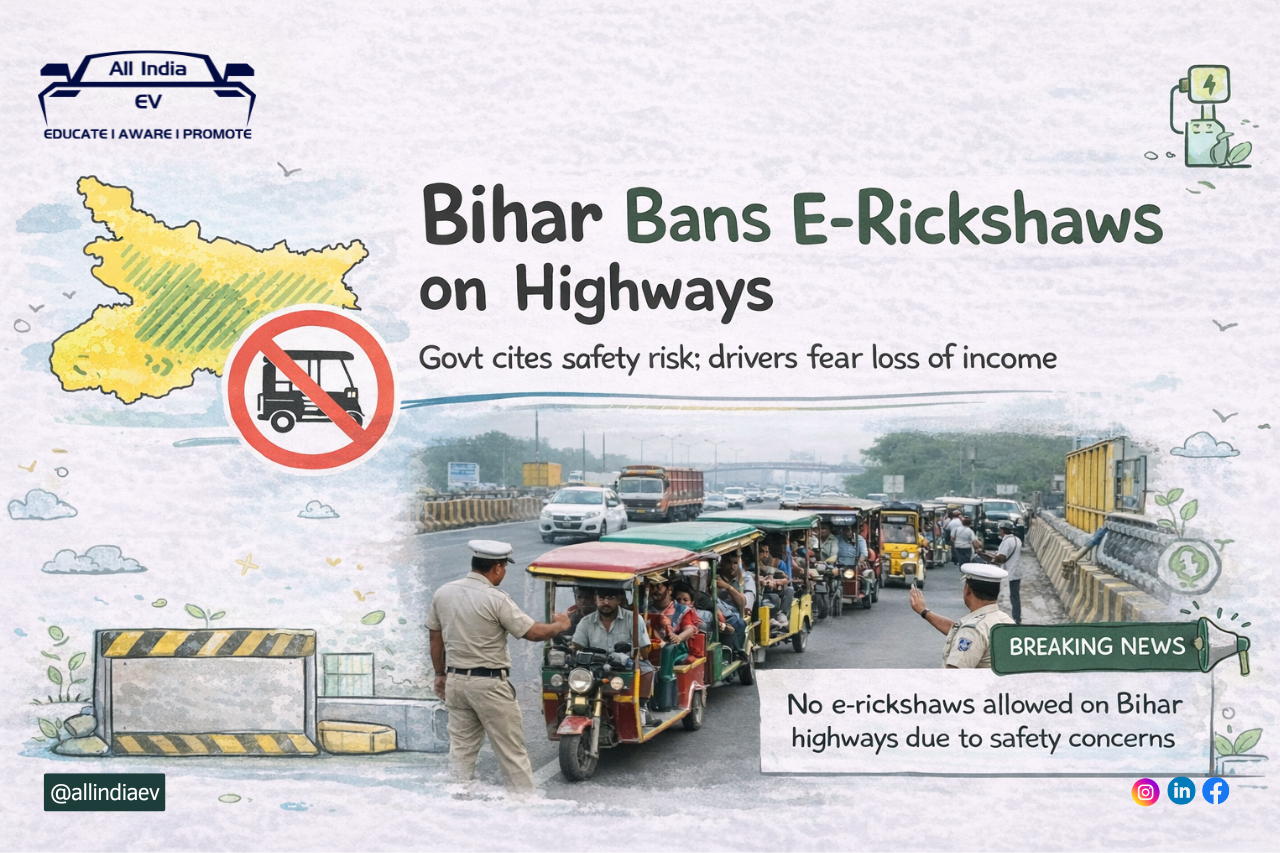
The Bihar government has imposed a statewide ban on the movement of e-rickshaws on national and state highways, citing serious safety concerns. The order, issued by the transport department, directs district transport officers to enforce the restriction with immediate effect.

According to the notification, nearly 10,000 km of highways across Bihar have been declared off-limits for e-rickshaws. This includes 3,617 km of state highways and 6,389 km of national highways. In the capital city of Patna, the ban will apply to major arterial routes such as the New Bypass, Bihta–Sarmera Road, Patna–Gaya Road, and the Phulwarisharif–Danapur–Bihta Road, officials said.


Safety concerns cited

Explaining the rationale behind the decision, Bihar transport minister Shravan Kumar said highways are designed for high-speed vehicular traffic and are unsuitable for slow-moving vehicles like e-rickshaws.

“Highways are meant for trucks, buses and cars. The presence of slow-moving e-rickshaws significantly increases the risk of accidents,” the minister said. He added that e-rickshaws lack robust braking systems required to handle sudden stops or sharp turns at high speeds, posing a threat to both passengers and other road users.

The transport department’s order further noted that the low speed and lightweight structure of e-rickshaws make them vulnerable on highways, often leading to collisions and damage to life and property.


Ban extended to ‘jugaad’ vehicles

Alongside e-rickshaws, the government has also announced a complete ban on jugaad vehicles on highways. These improvised vehicles—typically assembled using motorcycle engines, wooden planks and scrap materials—are widely used in rural areas for transporting people and goods.

More EV News
Exicom Tele-Systems is set to Launch IPO on February 27, Targeting INR 329 Crore Fundraise
5 million miles: A Leap Towards Sustainable Electric Vehicles
October Sees Record Growth in Electric Two-Wheeler Sales
Tata and HPCL Aim to Establish 5,000 EV Charging Stations Nationwide by 2024
Amazon All-Electric Global Last Mile Fleet Program In India

Officials said jugaad vehicles usually operate without registration, insurance or fitness certificates, in direct violation of the Motor Vehicles Act. “These vehicles do not meet any technical or safety standards. Their braking systems are unreliable and basic safety features like headlights and indicators are often missing,” a senior transport official said.


Drivers and commuters express concern

While the government has defended the move on safety grounds, the ban has triggered widespread concern among e-rickshaw drivers and commuters, particularly in rural and semi-urban areas where these vehicles are a primary mode of transport.

Thousands of drivers fear a sharp loss of income, especially those who rely on highway-adjacent routes to ferry passengers. Many said they were already struggling due to intensified enforcement drives in recent months and worry that the new restriction could further erode their livelihoods.

Himanshu Kumar, general secretary of the E-rickshaw Drivers’ Association, criticised the decision, calling it politically motivated.
“This decision is completely politically motivated. Other auto and cab associations want e-rickshaws to be removed from the roads altogether. There are around 18,000–20,000 e-rickshaws in Patna district, and nearly 8,000 of them will be directly affected. Across Bihar, more than three lakh e-rickshaws are operating,” he said.


Impact on daily mobility

Passengers have also raised concerns about the impact on daily commuting. Rajesh Gupta, a resident of Patna’s Kankarbagh area, said people living along bypass stretches would face serious difficulties. “Autos don’t operate inside many residential colonies. E-rickshaws are often the only option,” he said.

Highlighting affordability, Naubatpur resident Ramesh Sinha said e-rickshaws are crucial for low-income families. “If we have to go to Bairiya bus stand or Patna Junction with family and luggage, e-rickshaws are cheaper than autos,” he said.

With highways now closed to e-rickshaws, commuters fear being forced to depend on costlier or less convenient transport, while drivers worry about losing access to key routes that sustain their earnings—setting the stage for continued debate over safety versus livelihood in Bihar’s transport landscape.


Author’s comment:

The Bihar government’s decision to bar e-rickshaws and jugaad vehicles from highways underscores a growing policy dilemma: how to balance road safety with affordable mobility and livelihoods. While the safety rationale is hard to ignore on high-speed corridors, the ban risks disproportionately affecting low-income drivers and commuters who depend on e-rickshaws for last-mile connectivity.

Unless accompanied by alternative routes, designated lanes, or rehabilitation measures for drivers, the move could deepen transport inequities even as it seeks to make highways safer.
All India EV Community

Click here for more such EV Updates

Loading

Mahindra Last Mile Mobility Limited Collaborates with Attero for Sustainable EV Battery Recycling Initiative
Has India Fallen Behind in the EV Race? Sales Data Shows a Concerning Trend
Bhavish Aggarwal Pledges More Ola Electric Shares — Rising Founder Risk Concerns Investors
India’s Battery Waste Management Rules 2022: A Big Push for Sustainability
EKA Mobility Secures Additional Mitsui Investment To Accelerate EV Growth

Sign Up For Daily Newsletter

Be keep up! Get the latest breaking news delivered straight to your inbox.
Loading
By signing up, you agree to our Terms of Use and acknowledge the data practices in our Privacy Policy. You may unsubscribe at any time.
Share This Article
Facebook Whatsapp Whatsapp LinkedIn Copy Link Print
Leave a Comment

Leave a Reply Cancel reply

Your email address will not be published. Required fields are marked *

Follow US
XFollow
InstagramFollow
YoutubeSubscribe
LinkedInFollow
Haryana cabinet approves new rules: No petrol, diesel vehicles for cab aggregators in NCR
21 May 2026
Ultraviolette and Bolt.Earth Expand Type-6 DC Fast Charging Infrastructure Across India
Ultraviolet and Bolt. Earth Expand Type-6 DC Fast Charging Infrastructure Across India
21 May 2026
What: India’s finance ministry has directed public sector banks, insurers, and financial institutions to reduce operational spending and accelerate adoption of electric vehicles across official fleets. The move is part of a wider austerity push linked to rising global economic uncertainty and fuel-related risks. The Number: The directive impacts major public institutions including State Bank of India, Bank of Baroda, and Life Insurance Corporation of India, covering millions of employees and thousands of operational vehicles nationwide. The Impact: The policy signals a new phase of institutional fleet electrification in India, where EV adoption is now being tied directly to fiscal discipline, fuel import management, and public-sector operational efficiency. The Core News India’s finance ministry has formally instructed state-run financial institutions to implement strict expenditure controls while simultaneously accelerating EV adoption for official transport operations. The directive from the Department of Financial Services asks organisations to replace petrol and diesel vehicles used at head offices and branch operations with electric vehicles “as far as possible.” The order comes amid growing concern over the economic impact of prolonged geopolitical instability in West Asia, which threatens to increase crude oil prices, widen India’s import bill, and pressure the rupee. Alongside the EV transition mandate, the government has also pushed virtual meetings, reduced foreign travel, and tighter administrative spending controls across public-sector institutions. For India’s EV ecosystem, the directive is strategically important because it expands demand visibility beyond state transport undertakings and government departments into the financial sector itself. PSU banks and insurers operate one of the country’s largest distributed office networks, including regional offices, branch fleets, field operations, and administrative mobility services. Even a phased transition could create a sizeable procurement pipeline for electric passenger vehicles, charging infrastructure providers, and fleet management companies. Breaking Down the Update • The Department of Financial Services issued the austerity and EV adoption directive to PSU banks, insurers, and financial institutions. • The government wants petrol and diesel vehicles used in official operations to be progressively replaced by EVs wherever operationally feasible. • The policy push follows Prime Minister Narendra Modi’s appeal for fuel conservation and controlled discretionary spending amid global energy uncertainty. • The directive also mandates greater use of video conferencing to reduce travel-related operational expenditure. • The move could indirectly support domestic EV OEMs, leasing firms, and charging infrastructure operators through institutional procurement demand. • The banking and insurance sector may emerge as a new enterprise fleet electrification category in India’s EV transition roadmap. How PSU banks EV adoption will help Indian EV Market The expansion of PSU banks EV adoption could create a strong institutional demand layer for India’s electric mobility sector. Public sector banks and insurers operate thousands of branch offices across urban, semi-urban, and rural India. Their transition to EV fleets can generate predictable procurement volumes for domestic automakers, especially in the electric sedan, compact SUV, and commercial mobility segments. Beyond vehicle sales, the policy may also accelerate deployment of workplace charging infrastructure at bank headquarters, zonal offices, and regional branches. This can support charger utilisation economics while helping normalise EV infrastructure in tier-2 and tier-3 cities. Another important impact is signalling. When large state-linked financial institutions adopt EVs as operational assets rather than pilot projects, it improves confidence across the broader enterprise mobility market. Private banks, NBFCs, and insurance firms could eventually follow similar fleet transition models to reduce long-term fuel and maintenance costs. PSU banks EV adoption also aligns with India’s larger energy security strategy. Lower petroleum consumption in institutional fleets directly supports efforts to reduce crude import dependence while stabilising operational expenditure during periods of volatile global oil prices. Conclusion & Next Steps The government’s push toward PSU banks EV adoption reflects a broader shift where EV deployment is increasingly being linked with macroeconomic resilience rather than only sustainability targets. Execution, however, will depend on procurement timelines, charging infrastructure readiness, and operational suitability across
India directs state-run banks, insurance firms to cut costs, shift to EVs
21 May 2026
All India EV: Edition 49
What all happened in April 2026?
Click Here
All India EV

Daily EV Industry updates for you…

Categories

  • EV News
  • EV Launch
  • Investments & Funding
  • Market Insights
  • Guest Articles
  • EV Engineering

Quick Links

  • Community
  • Content Services
  • Branding Services
  • My EV Charger
  • Substack

© Developed and Managed by “The Energy Log”

Welcome Back!

Sign in to your account

Username or Email Address
Password

Lost your password?

Not a member? Sign Up