
All India EVAll India EVAll India EV
Notification
Font ResizerAa
  • Home
  • EV News
  • EV Launch
  • Market Insights
  • Investments & Funding
  • Guest Articles
  • EV Engineering
  • Contact
Reading: Boosting Property Value in Tier-2 & 3 Cities with EV Charging
Share
All India EVAll India EV
Font ResizerAa
  • Home
  • EV News
  • EV Launch
  • Market Insights
  • Guest Articles
  • EV Engineering
  • Contact
Search
  • Home
    • Home 1
    • Home 2
    • Home 3
    • Home 4
    • Home 5
  • Home
  • Categories
    • Electric
  • Categories
  • Shows
    • Rap
  • More Foxiz
    • Blog Index
    • Contact
  • Bookmarks
    • Customize Interests
    • My Bookmarks
  • More Foxiz
    • Blog Index
    • Sitemap
Have an existing account? Sign In
Follow US
Home » Blog » Boosting Property Value in Tier-2 & 3 Cities with EV Charging
EV News

Boosting Property Value in Tier-2 & 3 Cities with EV Charging

Sunita
By
Sunita
Last updated: 17 June 2025
Share
4 Min Read
SHARE

Contents
  • EV Charging: A Hidden Catalyst for Property Growth?
  • A New Wave of Investment Opportunity
  • Corporates and Urbanization Fuel the Trend
  • The Road Ahead: Challenges & Collaborative Action

Tier-2 & 3 Cities See Property Value Rise with EV Charging Boom

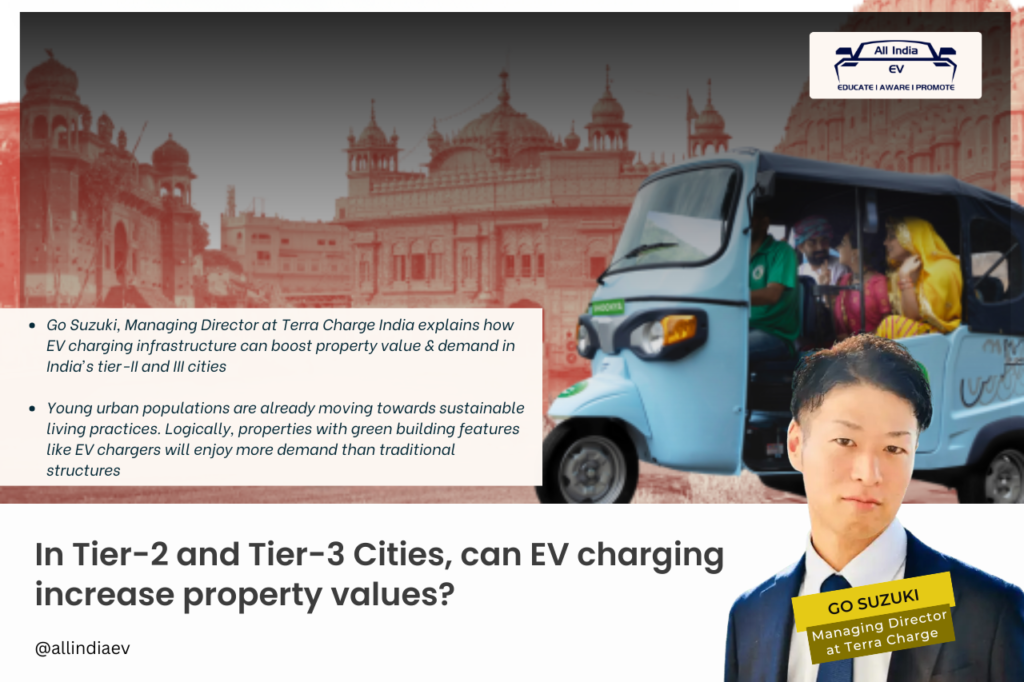
As India’s electric vehicle (EV) momentum continues to surge, the spotlight is now shifting beyond metro cities. At India EV, we’ve been closely observing how Tier-II and Tier-III cities are fast emerging as the new frontier for EV adoption—and real estate is beginning to feel the ripple effect.

While cities like Delhi, Mumbai, and Bengaluru remain at the forefront of EV growth, urban centres such as Lucknow, Jaipur, Coimbatore, Thiruvananthapuram, and Surat are not far behind. These rising EV hotspots are not only witnessing growing demand for clean mobility but are also experiencing a change in how consumers and developers perceive real estate value.

EV Charging: A Hidden Catalyst for Property Growth?

Our research indicates that the presence of EV charging infrastructure is becoming a value-add feature in residential and commercial properties. In fact, properties that integrate charging facilities are starting to command a premium, with some studies showing a 3% to 10% increase in valuation.

As younger populations in these emerging cities lean into sustainability, EV ownership is rising steadily. With it comes the demand for convenient and accessible charging solutions—making properties with inbuilt charging points increasingly attractive.


A New Wave of Investment Opportunity

From the perspective of India EV, this is a golden opportunity for developers and investors. The competition for sustainable features like EV charging is significantly lower in Tier-II and III markets compared to metros. Developers who seize this early-mover advantage stand to gain from increased demand, higher property valuations, and fresh revenue streams.

More EV News

Citroën becomes the first multinational carmaker to export EVs from India
Only 12 States, UTs Commit to Payment Security Mechanism for Faster E-Bus Deployment
Biliti Electric Begins Building Electric Three-Wheeler Production Plant in Hyderabad
Kanpur to Become Major EV Manufacturing Hub with ₹700-Crore Investment
India Set to Reach 123 Million EVs by 2032: A Game-Changer for the Indian Automotive Landscape

The integration of EV charging can also unlock new business avenues, such as collaborations with Charging Point Operators (CPOs), electric mobility startups, OEMs, and advertisers. Forward-thinking developers could explore these partnerships to monetize charging infrastructure and create future-proof developments tailored to a new generation of eco-conscious consumers.


Corporates and Urbanization Fuel the Trend

With many corporations expanding their footprint into Tier-II and III cities, the real estate landscape is rapidly evolving. These regions offer lower operational costs, improved quality of life, and now, increasingly, the promise of sustainable infrastructure—a key criterion for many companies with CSR and ESG mandates.

EV-ready properties can play a decisive role in attracting corporate tenants looking to align with India’s green growth mission. As urban planning strategies begin to incorporate clean mobility infrastructure, we see a strategic alignment between national policy goals and real estate development in these regions.


The Road Ahead: Challenges & Collaborative Action

However, challenges remain. For EV charging to significantly enhance property value, accessibility and reliability of infrastructure must be improved. Gaps in the ecosystem—such as lack of standardisation, uneven grid readiness, and absence of incentives—need urgent attention.We believe that a collaborative push from the government, private real estate stakeholders, CPOs, and investors is essential to build a robust EV ecosystem. Strengthening this synergy can unlock not just environmental but also economic value for India’s rapidly urbanising Tier-II and III cities.


Join All India EV Community

Click here for more such EV Updates

Prime Minister Gets a Glimpse of TVS Motor’s Breakthroughs in Mobility
chargeMOD Collaborates with A Plus Charge to Propel EV Charging Infrastructure
Maharashtra leads India with over 3 lakh e-bikes, 40k registered in the last 50 days
Arctic Batteries: Advancing Energy Storage in Environmental Obstacles
India Competes with China in Underwater Mineral Exploration for EVs and Solar Panels

Sign Up For Daily Newsletter

Be keep up! Get the latest breaking news delivered straight to your inbox.
Loading
By signing up, you agree to our Terms of Use and acknowledge the data practices in our Privacy Policy. You may unsubscribe at any time.
Share This Article
Facebook Whatsapp Whatsapp LinkedIn Copy Link Print
1 Comment
  • Akanksha Mali says:
    11 April 2025 at 16:38

    Wow! EV chargers are making homes more valuable now, In small cities too! At Nikol EV, we love seeing this EV magic spreading everywhere, Excited to support a smarter, greener India.

    Checkout our website here- http://www.nikolev.in
    Contact- 8485853574

    Reply

Leave a Reply Cancel reply

Your email address will not be published. Required fields are marked *

Follow US
XFollow
InstagramFollow
YoutubeSubscribe
LinkedInFollow
What: India’s finance ministry has directed public sector banks, insurers, and financial institutions to reduce operational spending and accelerate adoption of electric vehicles across official fleets. The move is part of a wider austerity push linked to rising global economic uncertainty and fuel-related risks. The Number: The directive impacts major public institutions including State Bank of India, Bank of Baroda, and Life Insurance Corporation of India, covering millions of employees and thousands of operational vehicles nationwide. The Impact: The policy signals a new phase of institutional fleet electrification in India, where EV adoption is now being tied directly to fiscal discipline, fuel import management, and public-sector operational efficiency. The Core News India’s finance ministry has formally instructed state-run financial institutions to implement strict expenditure controls while simultaneously accelerating EV adoption for official transport operations. The directive from the Department of Financial Services asks organisations to replace petrol and diesel vehicles used at head offices and branch operations with electric vehicles “as far as possible.” The order comes amid growing concern over the economic impact of prolonged geopolitical instability in West Asia, which threatens to increase crude oil prices, widen India’s import bill, and pressure the rupee. Alongside the EV transition mandate, the government has also pushed virtual meetings, reduced foreign travel, and tighter administrative spending controls across public-sector institutions. For India’s EV ecosystem, the directive is strategically important because it expands demand visibility beyond state transport undertakings and government departments into the financial sector itself. PSU banks and insurers operate one of the country’s largest distributed office networks, including regional offices, branch fleets, field operations, and administrative mobility services. Even a phased transition could create a sizeable procurement pipeline for electric passenger vehicles, charging infrastructure providers, and fleet management companies. Breaking Down the Update • The Department of Financial Services issued the austerity and EV adoption directive to PSU banks, insurers, and financial institutions. • The government wants petrol and diesel vehicles used in official operations to be progressively replaced by EVs wherever operationally feasible. • The policy push follows Prime Minister Narendra Modi’s appeal for fuel conservation and controlled discretionary spending amid global energy uncertainty. • The directive also mandates greater use of video conferencing to reduce travel-related operational expenditure. • The move could indirectly support domestic EV OEMs, leasing firms, and charging infrastructure operators through institutional procurement demand. • The banking and insurance sector may emerge as a new enterprise fleet electrification category in India’s EV transition roadmap. How PSU banks EV adoption will help Indian EV Market The expansion of PSU banks EV adoption could create a strong institutional demand layer for India’s electric mobility sector. Public sector banks and insurers operate thousands of branch offices across urban, semi-urban, and rural India. Their transition to EV fleets can generate predictable procurement volumes for domestic automakers, especially in the electric sedan, compact SUV, and commercial mobility segments. Beyond vehicle sales, the policy may also accelerate deployment of workplace charging infrastructure at bank headquarters, zonal offices, and regional branches. This can support charger utilisation economics while helping normalise EV infrastructure in tier-2 and tier-3 cities. Another important impact is signalling. When large state-linked financial institutions adopt EVs as operational assets rather than pilot projects, it improves confidence across the broader enterprise mobility market. Private banks, NBFCs, and insurance firms could eventually follow similar fleet transition models to reduce long-term fuel and maintenance costs. PSU banks EV adoption also aligns with India’s larger energy security strategy. Lower petroleum consumption in institutional fleets directly supports efforts to reduce crude import dependence while stabilising operational expenditure during periods of volatile global oil prices. Conclusion & Next Steps The government’s push toward PSU banks EV adoption reflects a broader shift where EV deployment is increasingly being linked with macroeconomic resilience rather than only sustainability targets. Execution, however, will depend on procurement timelines, charging infrastructure readiness, and operational suitability across
India directs state-run banks, insurance firms to cut costs, shift to EVs
20 May 2026
Uttar Pradesh To Get 714 New EV Charging Stations Under Centre’s Rs 500 Crore Infrastructure Push
20 May 2026
China’s EV slowdown could trigger the industry’s biggest global reset
20 May 2026
All India EV: Edition 49
What all happened in April 2026?
Click Here
All India EV

Daily EV Industry updates for you…

Categories

  • EV News
  • EV Launch
  • Investments & Funding
  • Market Insights
  • Guest Articles
  • EV Engineering

Quick Links

  • Community
  • Content Services
  • Branding Services
  • My EV Charger
  • Substack

© Developed and Managed by “The Energy Log”

Welcome Back!

Sign in to your account

Username or Email Address
Password

Lost your password?

Not a member? Sign Up