

The Holy Grail of EVs as India’s Soaring Demand Poised to Double by 2030, Driving the Future of Mobility and Creating a Supply Gap
As electric vehicles (EVs) rapidly move into the mainstream and global automakers pivot away from internal combustion engines (ICEs), attention has largely focused on the availability of rare earth elements. However, an equally critical factor is emerging — the global race to secure copper, a metal now seen as the backbone of the EV revolution.
Copper’s role in EV manufacturing is irreplaceable. In a typical battery electric vehicle (BEV), copper accounts for 4–5% of the total weight, but represents a much higher share of raw material costs due to its superior conductivity, durability, malleability, and cost-effectiveness compared to alternatives like steel or aluminium.
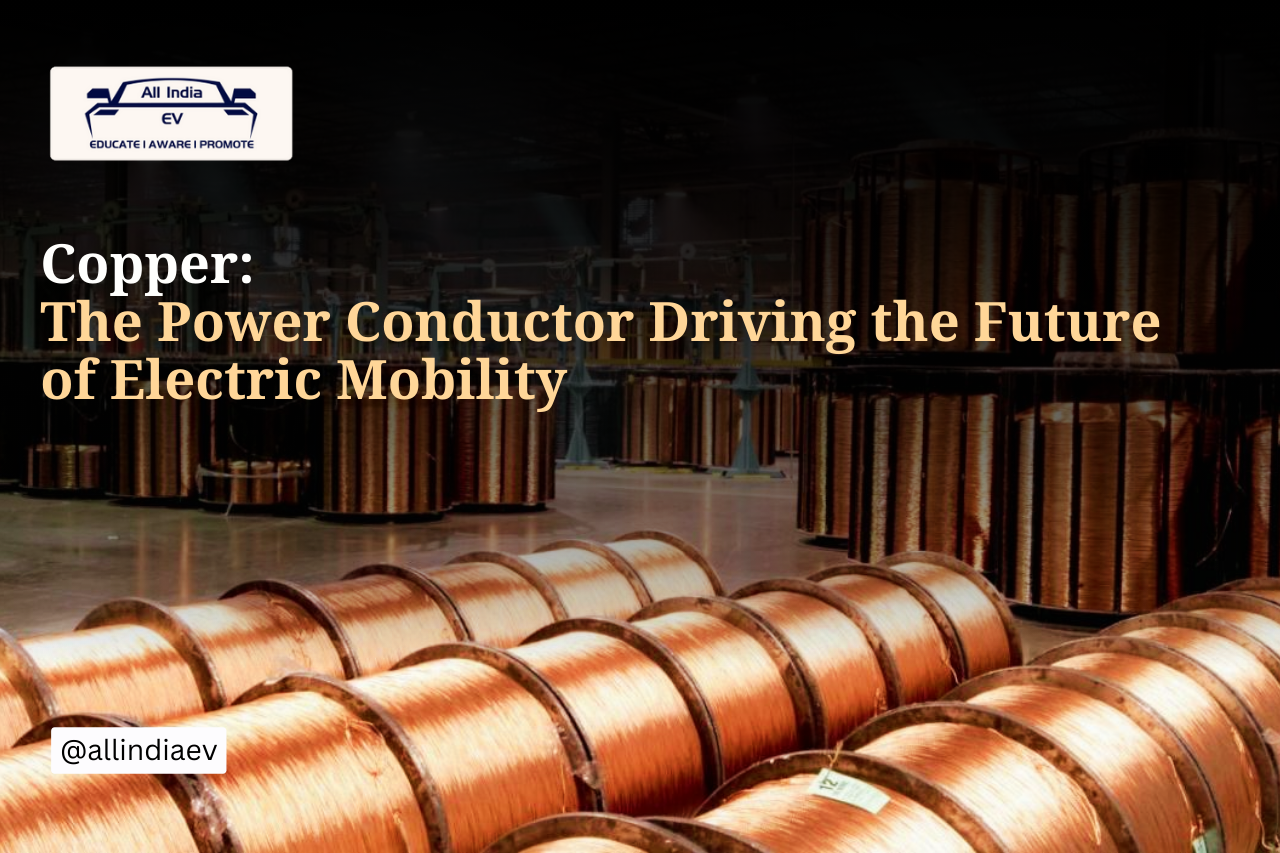
From battery packs to electric motor windings, inverters, wiring harnesses, charging cables, busbars, and charging infrastructure, copper is present in almost every critical EV component. Its 59.6 million Siemens per meter (MS/m) electrical conductivity outperforms aluminium’s 37.8 MS/m, meaning aluminium wires must be 63% thicker to match copper’s capacity — adding both weight and bulk. This strength-to-weight advantage enables automakers to design lighter, more efficient vehicles without compromising safety.
In electric motors, copper’s magnetic properties directly influence efficiency, performance, and range, while its thermal conductivity prevents overheating. A fully electric car can contain up to a mile of copper wiring, powering everything from propulsion systems to infotainment and safety features.
Batteries, the most expensive EV component, also depend heavily on copper. Lithium-ion batteries use it in current collectors and electrodes, enabling efficient electricity transfer and withstanding repeated charging cycles without significant degradation. This extends both battery life and vehicle performance.
The copper requirement for EVs far exceeds that of conventional vehicles. An ICE car typically uses 23–30 kg of copper, whereas BEVs require 60–83 kg. Hybrid and plug-in hybrid models also use significantly more than ICEs. As a result, the EV sector’s copper consumption is projected to grow at a CAGR of 14.3% through 2034, outpacing other clean energy technologies like solar and wind.
More EV News
For India, this demand surge poses both an opportunity and a challenge. Backed by government subsidies and the Production-Linked Incentive (PLI) scheme, the nation is pushing for mass EV adoption. However, copper demand in India is expected to double to around 1.5 million tonnes annually by 2030, while current production is just ~555,000 tonnes. Without intervention, this could create a supply gap of nearly 1 million tonnes per year.
India is already feeling the pressure. In FY24, the country posted a $6.8 billion trade deficit in copper and related products, with imports rising 21% in value. Experts warn that without a national copper strategy, rising dependency on imports could hinder India’s EV transition.
To address this, analysts recommend incentivising domestic copper smelting, refining, and fabrication through capital subsidies or expanded PLI benefits. Strengthening the supply chain would also attract private investment and new players into the sector.
Maximising underutilised domestic capacity is another urgent priority. The closure of Vedanta’s Sterlite copper plant in Tuticorin, Tamil Nadu, in 2018 led to the loss of 46% of India’s copper production capacity, turning the nation into a net importer of refined copper. Experts argue that reopening the 400,000-tonne smelter, with environmental and operational safeguards in place, could significantly ease supply pressures.
Industry observers stress that copper will be to EVs what oil was to petrol cars — a strategic resource that determines competitiveness and production capacity. They urge policymakers, industry stakeholders, and environmental bodies to collaborate on a long-term copper sourcing plan, ensuring that India’s EV ambitions are not stalled by a metal shortage.With the EV market set to expand rapidly and copper at its core, securing this “holy grail” of green mobility will be critical for India to maintain momentum in its journey toward a cleaner, electrified transport future.