

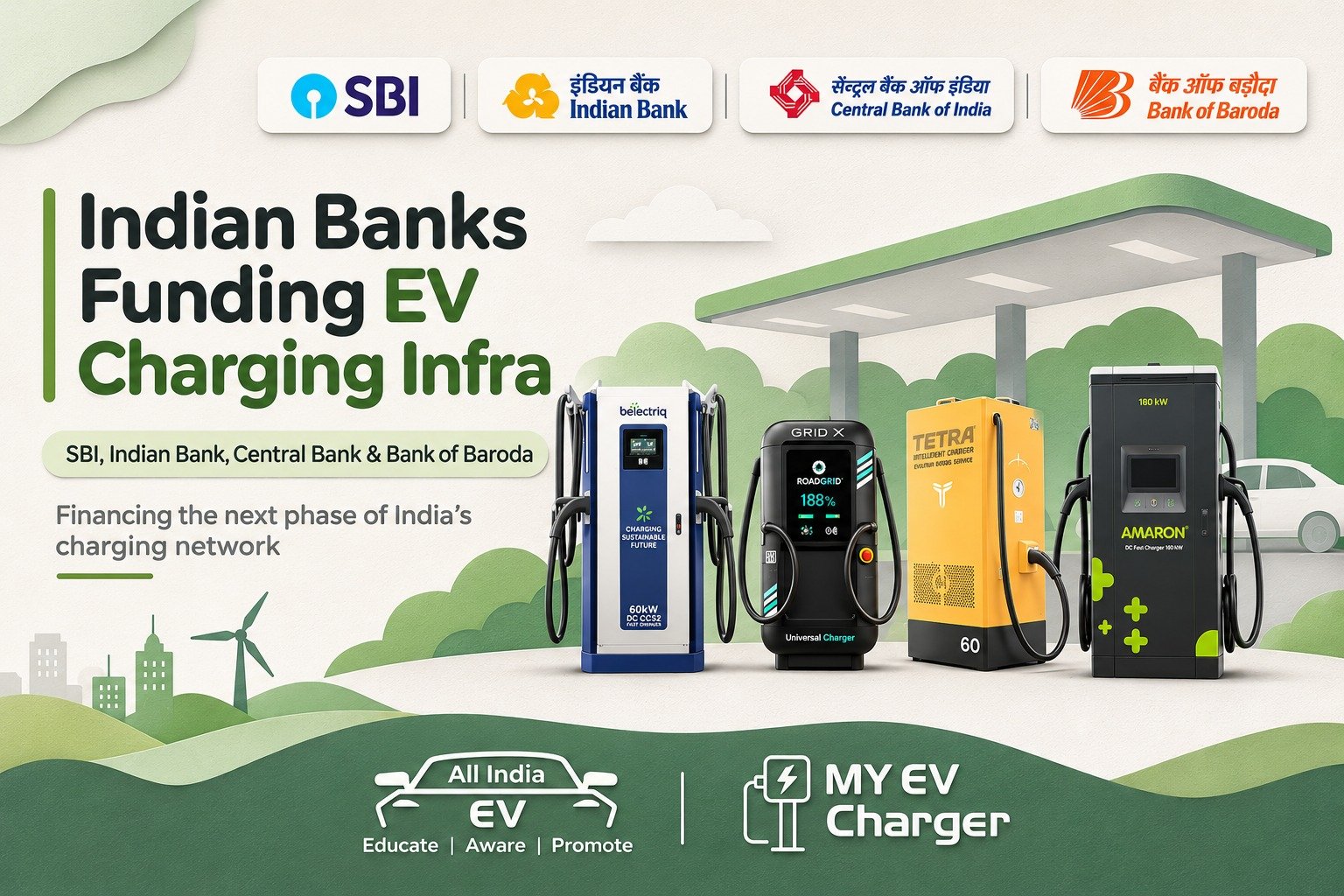
From SBI and Indian Bank to Bank of Baroda, public-sector lenders now offer dedicated loans for EV charging stations. Access to capital, however, is only one part of the infrastructure challenge.
India’s EV industry has spent years debating one problem: the country needs more chargers. Manufacturers want them to drive adoption, operators want higher utilisation to justify investment, and buyers want reliable charging before they switch.
A less discussed question sits underneath: who pays to build them?
A public charging station is much more than a charger. Operators must fund land, a power connection, transformers, civil works, installation, software and maintenance. For a high-capacity hub, the bill can run into crores. Smaller operators without a revenue track record have found it hard to borrow against that.
That is starting to change. On 19 November 2026, Bank of Baroda announced bob Green PLUG, a loan of above ₹10 lakh and up to ₹5 crore for charging stations, battery-swapping facilities and related infrastructure. It is not alone. State Bank of India, Indian Bank and Central Bank of India already run dedicated schemes, and Bank of India finances charging through a partnership with Tata Power Solar.
Taken together, these products show that EV charging is becoming a recognised category in India’s formal lending system.
Who Is Lending
Bank of Baroda: bob Green PLUG. The newest scheme offers term or demand loans from above ₹10 lakh to ₹5 crore, repayable over up to 120 months, including a moratorium of up to 12 months. Reported interest rates range from 8.15% to 9.60% a year, depending on the borrower’s credit rating. The long tenure matters. A new charging hub rarely earns its full potential in year one, and a ten-year repayment window gives traffic time to build.
State Bank of India: SBI EV Mitra. Listed by SBI since at least December 2024, EV Mitra covers public, captive and battery-swapping stations, including sites at petrol pumps, hotels, restaurants and offices. Loans run from above ₹10 lakh to ₹5 crore, with a minimum 25% promoter contribution and repayment over up to eight years, including up to nine months’ moratorium. Unusually, SBI lets amenities such as cafeterias and restrooms count towards project cost, capped at 25% of the project or ₹1 crore, whichever is lower. For highway operators building a proper stop rather than a lone charger, that is useful.
Indian Bank: IND Green Charge. This scheme has one of the highest published ceilings, from above ₹10 lakh to ₹10 crore. It covers public, captive and fleet charging, run directly or through franchises, at locations from highways to residential societies. Terms include a 25% promoter contribution, up to 96 months’ repayment with a six-month moratorium, interest of 9.00% to 9.25%, and no processing charges. Indian Bank has also said it plans to lend ₹100 crore under the scheme in FY2026-27. That is the only lending target any bank has attached to charging so far.
Central Bank of India: Cent EV Connect. Loans range from ₹11 lakh to ₹10 crore for public, captive and battery-swapping stations, with a 25% promoter contribution. Eligible applicants include MSMEs, fuel stations, hotels, offices and housing societies. The bank requires chargers to be ARAI-certified and compliant with Automotive Industry Standards. It does not publish an interest rate, so borrowers must get terms directly from the bank.
Bank of India. Through its partnership with Tata Power Solar, announced in January 2026, Bank of India offers UDYAM-registered MSMEs loans of up to ₹30 crore for rooftop solar or EV charging, with access to MSE-GIFT interest subvention.
The Schemes at a Glance
| Bank | Scheme | Loan range | Repayment | Interest rate |
| Bank of Baroda | bob Green PLUG | Above ₹10 lakh to ₹5 crore | Up to 10 years | 8.15% to 9.60% (reported) |
| Indian Bank | IND Green Charge | Above ₹10 lakh to ₹10 crore | Up to 8 years | 9.00% to 9.25% |
| Central Bank of India | Cent EV Connect | ₹11 lakh to ₹10 crore | Confirm with bank | Confirm with bank |
| State Bank of India | SBI EV Mitra | Above ₹10 lakh to ₹5 crore | Up to 8 years | Rating-linked |
| Bank of India | With Tata Power Solar | Up to ₹30 crore | Confirm with bank | Confirm with bank |
Approval, final interest rate, collateral, moratorium and eligibility depend on each lender’s terms and project assessment.
Beyond the Big Banks
Charging finance is also appearing outside the largest lenders. The Jalgaon Peoples Co-operative Bank includes EV charging stations under its JP Trade Finance Loan Scheme, with published floating rates of 9.75% and 10.75%. It is not a dedicated EV product, but it shows charging entering regional credit menus, where small local operators often bank. Limits and conditions need to be confirmed with the bank.
The Small Industries Development Bank of India (SIDBI) has supported EV financing for MSMEs through Mission 50K-EV4ECO, which names fleet operators, aggregators and leasing companies and references charging alongside vehicle purchase. It should not be read as an open loan window for every standalone station; current eligibility needs confirmation with SIDBI.
The Indian Renewable Energy Development Agency (IREDA) is moving the other way. IREDA has financed EV fleets, manufacturing, battery swapping and charging in the past. But its financing norms dated 1 October 2026 say green mobility lending, including charging infrastructure, has been on hold since a Board decision of 25 March 2026, subject to periodic review. Past activity is not current availability, and operators should plan accordingly.
The Catch: A Loan Scheme Is Not a Viable Station
Most of these schemes ask the promoter to put in at least 25% of project cost. On a ₹1 crore project, that means ₹25 lakh of the operator’s own money, with up to ₹75 lakh borrowed if approved. That is before working capital, costs the bank will not finance, or any extra security. An established company can manage it. A first-time entrepreneur may not.
The bigger hurdle is repayment.
- A charger earns money only when vehicles plug in.
- At 9% over eight years, ₹75 lakh of debt costs roughly ₹13 lakh a year to service.
Assuming a net margin of about ₹5 per kWh after electricity costs, a station would need to sell around 720 kWh every day just to cover the loan, before rent, staff and maintenance.
For a single 120 kW fast charger, that is about six hours of full-power use daily.
That is why utilisation, not installed capacity, decides whether a charging project is bankable. A fleet depot serving a committed operator can show that kind of demand. A standalone public station betting on future traffic finds it much harder.
Practical hurdles add to the risk. Securing land on a long lease, getting enough sanctioned load, upgrading transformers and working through distribution-company timelines can all delay commissioning. A station approved for a loan can still sit idle for months, eating into its moratorium before it earns a rupee.
Banks will also need to treat charging models differently. A highway hub, a fleet depot and a captive office installation carry very different risks, and lending to them as one asset class would serve none of them well.
What Comes Next
Bank financing gives entrepreneurs an option beyond self-funding and strategic investors. It could bring petrol pump owners, hotels, restaurants and commercial landlords into charging as an add-on business. It gives compliant charger makers a route into bank-funded projects. And it lets established operators expand without relying only on equity.
But the measure of success will not be the headline loan limits. It will be how many loans are sanctioned, how much money is actually disbursed, how many stations are commissioned with it, and whether those stations repay on time. No bank has published those figures yet.
Indian banks are now willing to treat EV charging as a business worth lending to. That is a real shift. The next milestone is not another scheme launch. It is proof that these loans are building charging stations that stay open, stay busy and pay back what they borrowed.