

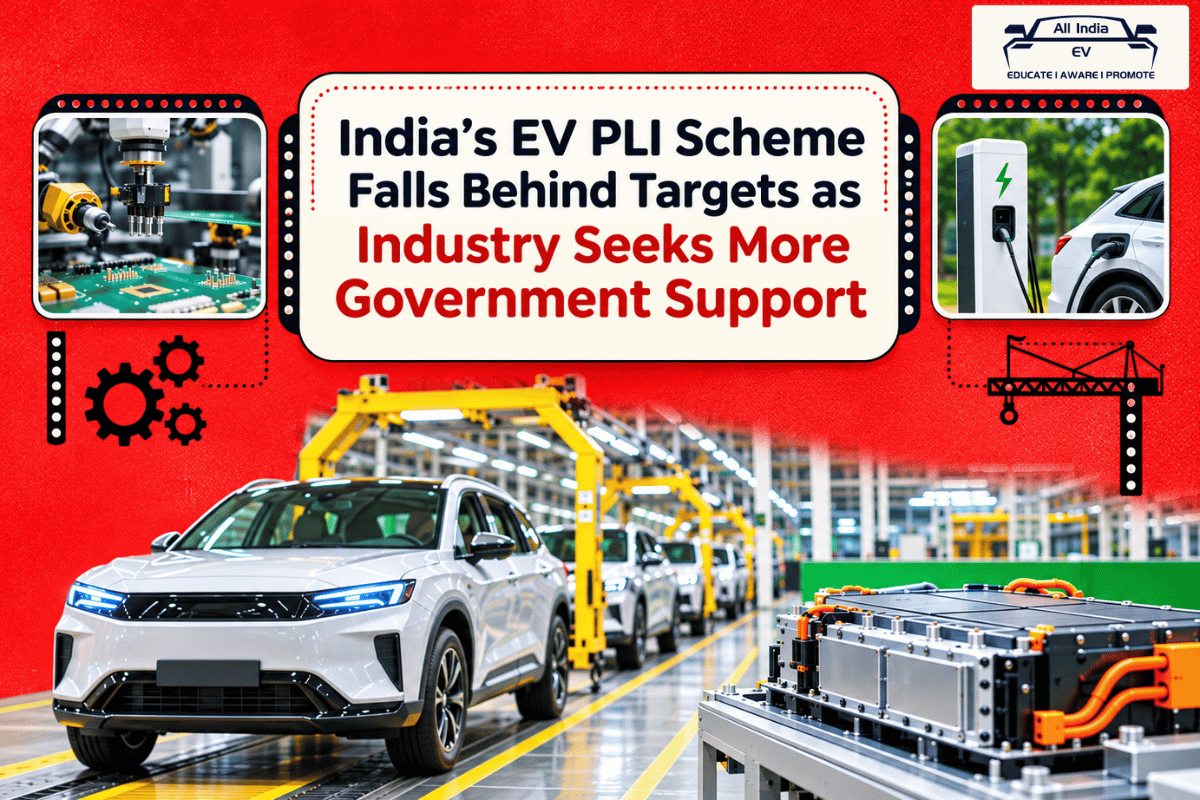
India’s Production Linked Incentive (PLI) scheme has delivered significant results in electronics manufacturing, but its impact on the electric vehicle (EV) industry remains below expectations. A recent assessment by NITI Aayog highlights the gap between investment commitments and actual sales, employment generation and battery manufacturing capacity, indicating the need for a more inclusive policy approach to accelerate India’s electric mobility transition.
The PLI scheme was introduced to strengthen domestic manufacturing, reduce dependence on imports, encourage technological development and position India as a global manufacturing hub. While the electronics sector has achieved remarkable progress, the automobile and auto components sector is yet to deliver similar results.
EV PLI Scheme Struggles to Meet Sales and Employment Targets
According to the NITI Aayog assessment, the automobile PLI scheme generated cumulative incremental sales of ₹52,414 crore by FY2025-26, significantly below its targeted ₹2.31 lakh crore. Although eligible manufacturers invested substantially in expanding production facilities and developing electric vehicle capabilities, the overall sales performance remained below expectations.
The scheme supported the production of approximately 13.61 lakh eligible vehicles across different segments, including electric two-wheelers, three-wheelers, passenger vehicles and electric buses.
Employment generation has also remained a challenge. By March 2026, the scheme had created approximately 67,820 direct jobs against its target of more than 1.48 lakh positions.
Major automobile manufacturers, including Tata Motors, Mahindra & Mahindra, Bajaj Auto and TVS Motor, have benefited from the programme. However, smaller manufacturers and electric-first companies such as Ather Energy, River and Euler Motors have faced difficulties meeting the eligibility requirements.
NITI Aayog has identified high investment requirements, turnover thresholds and technological qualification criteria as major barriers limiting participation from smaller EV manufacturers.
Electronics PLI Scheme Offers a Successful Model
India’s electronics manufacturing sector demonstrates how targeted government incentives can accelerate domestic production. Under the Large Scale Electronics Manufacturing PLI scheme, locally manufactured mobile phones now account for more than 99% of phones sold in India.
This represents significant progress compared with 26% domestic manufacturing in FY2014-15. India has also emerged as the world’s second-largest mobile phone manufacturer.
The electronics PLI programme recorded cumulative sales approximately 22 times higher than the automobile PLI scheme. Its employment generation was also nearly 2.5 times higher.
Interestingly, the automobile PLI scheme attracted ₹44,326 crore in cumulative investments by March 2026, compared with ₹20,580 crore under the large-scale electronics manufacturing scheme.
The difference highlights the capital-intensive nature of automobile and EV manufacturing, where developing advanced technologies and domestic supply chains requires longer investment cycles.
Strict Localisation Requirements Create Challenges
One of the major challenges for EV manufacturers is the automobile PLI scheme’s requirement of at least 50% Domestic Value Addition (DVA).
Although the requirement aims to strengthen India’s domestic manufacturing ecosystem, meeting the localisation threshold can be difficult because several critical EV components, including advanced batteries and specialised electronic systems, still depend on imported technologies and materials.
The scheme covers battery electric vehicles, hydrogen fuel cell vehicles and advanced automotive technology components across two-wheelers, three-wheelers, passenger vehicles and commercial vehicles.
However, industry participants believe that more flexible eligibility conditions could encourage greater participation from emerging EV manufacturers and component suppliers.
Battery Manufacturing PLI Scheme Also Faces Delays
India’s Advanced Chemistry Cell (ACC) Battery PLI scheme, launched with an investment outlay of ₹18,100 crore, was designed to establish 50 GWh of domestic battery manufacturing capacity along with 5 GWh of niche battery capacity.
However, progress has remained slower than anticipated. By March 2026, only 1.4 GWh of manufacturing capacity had been developed, with commercial production yet to begin. The programme had attracted ₹4,570 crore in cumulative investments and generated approximately 1,245 direct jobs.
Limited domestic expertise in advanced battery technologies, dependence on imported machinery and a shortage of locally available raw materials such as lithium and cobalt continue to affect progress.
Need for More Inclusive EV Manufacturing Policies
The NITI Aayog assessment highlights the importance of redesigning incentive programmes according to individual industry requirements. More flexible localisation targets, wider participation from smaller manufacturers, stronger battery technology development and improved supply-chain capabilities could help India’s EV sector achieve its manufacturing ambitions.
For India’s electric mobility industry, the next phase of government support will need to focus not only on attracting investments but also on encouraging actual production, sales, employment and exports.
A more inclusive PLI framework could help domestic EV manufacturers compete effectively, reduce import dependence and strengthen India’s position in the global electric vehicle market.