
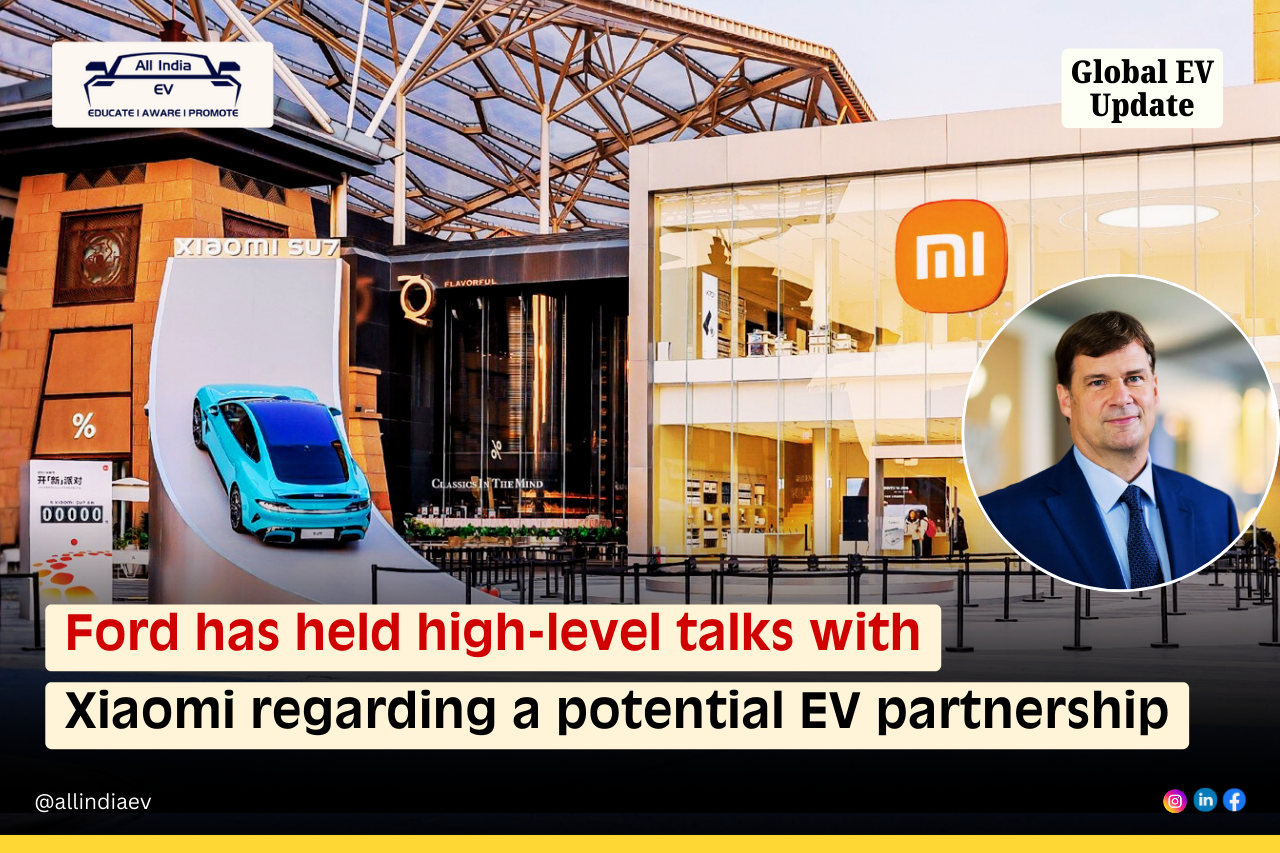

Exploring whether consumer-tech software stacks can compress EV development cycles globally
This reported engagement between Ford Motor Company and Xiaomi is less about factories and more about capability arbitrage. As EV differentiation shifts from hardware to software, legacy OEMs are testing whether consumer-tech platforms can accelerate time-to-market—without surrendering control of the vehicle stack.
Deal Facts
- Partners: Ford Motor Company; Xiaomi
- Deal Type: Exploratory talks; no formal JV or partnership announced
- Scope: Not disclosed — reportedly focused on EV-related collaboration
- Geography: Not disclosed — discussions reported without market specificity
- Timeline: Talks reported in late January–early February 2026; no milestones announced
- Investment: Not disclosed — no capex, equity, or licensing figures made public
- Ownership Structure: Not disclosed — no JV entity confirmed
- What’s Being Built/Delivered: Not disclosed — no product, platform, or program named
- Status: Ford later played down/denied the talks publicly, underscoring exploratory nature
Why the gaps matter: Without clarity on scope, geography, and ownership, this remains a capability scouting exercise, not an execution-ready alliance. The absence of disclosed deliverables limits downstream planning for suppliers, integrators, and regulators.
What Each Partner Brings
Ford Motor Company
- Vehicle systems & compliance: Decades of homologation, safety engineering, manufacturing scale, and global regulatory navigation.
- Market access: Established dealer networks, fleet relationships, and brand trust across North America and Europe.
Xiaomi
- Software velocity: Consumer-grade OS, UX, and device-to-cloud integration optimized for rapid iteration.
- Ecosystem leverage: Experience building sticky platforms across phones, IoT, and now vehicles—where software defines user value.
The Operating Model
If this collaboration ever solidifies, the most plausible structure is modular integration, not co-manufacturing. Xiaomi’s value would likely sit above the vehicle OS layer—infotainment, human–machine interface, connected services, app ecosystems—while Ford retains vehicle control units, safety-critical software, and homologation authority. This preserves Ford’s liability and compliance posture while borrowing Xiaomi’s speed in consumer experience.
In India specifically, execution would hinge on local data rules, cybersecurity audits, and supplier localization. Any Xiaomi software stack would need India-hosted data, auditability for OTA updates, and tight API boundaries with Tier-1 ECUs. Expect pilot programs (limited trims or fleets) before any mass rollout—if at all.
More EV News

Integration & Execution Risks
- Stack boundary creep: Blurred lines between infotainment and vehicle control can create safety and liability conflicts.
- Data sovereignty: India’s data localization and consent regimes complicate cloud architectures.
- Brand dilution: A consumer-tech UX may overshadow OEM brand identity if not tightly curated.
- Update cadence mismatch: Smartphone-style OTA velocity can clash with automotive validation cycles.
- Geopolitical exposure: China-linked software in Western OEMs faces scrutiny, audits, and potential restrictions.
Who Wins / Who Gets Squeezed
Who Wins
- Software integrators: If OEMs standardize modular OS layers, integration specialists gain leverage.
- Consumers: Faster feature rollouts, better UX, and ecosystem continuity across devices.
Who Gets Squeezed
- Legacy infotainment vendors: Proprietary, slow-moving stacks risk displacement.
- Mid-tier OEMs: Those without scale or software partners may lag on experience-led differentiation.
Next 90 Days: What to Track
- [OEM] Any clarification from Ford on scope boundaries (infotainment vs. vehicle controls).
- [CPO] Signals from charge point operators on software interoperability requirements.
- [Supplier] Tier-1 responses—especially infotainment and telematics vendors—on roadmap adjustments.
- [Fleet] Pilot programs hinting at fleet-first deployments to de-risk consumer launches.
- [Investor] Capital allocation language around software margins vs. hardware capex.
- [Policy] Regulatory commentary on foreign software stacks in connected vehicles.
Conversation Starters
- Where should OEMs draw the hard boundary between consumer-tech UX and safety-critical control?
- Can smartphone-style ecosystems coexist with automotive homologation discipline?
- Does India become a testbed for modular EV software, or a compliance bottleneck?