

Dr. Graham Dudgeon and Vijayalayan R of MathWorks Discuss the Role of Bidirectional Charging Amid Rising EV Penetration
- The Growing Strain on India’s Power Grid
- What Is Bidirectional Charging and Why It Matters
- How Bidirectional Charging Protects Grid Stability
- The Engineering Behind Bidirectional Charging
- Evaluating EV Charging’s Impact on the Grid
- India’s Position in the V2G Transition
- The Road Ahead for India
- Comment by the Author
India’s electric vehicle (EV) revolution is accelerating at an unprecedented pace, bringing the country closer to its clean mobility goals—but also posing new challenges for power grid stability. As EV adoption surges alongside renewable energy integration, experts are increasingly pointing to bidirectional charging as a critical solution to manage future electricity demand and protect grid reliability.
According to the VAHAN Dashboard (Telangana RTO), EV sales in India have grown more than 11.5 times since FY2020, and by the end of FY2025, India is expected to have around 6.2 million EVs on its roads. This rapid expansion mirrors global trends. In the United States, a similar rise in EV adoption has led the Department of Energy to project a 20–50% increase in national electricity consumption for EV charging by 2050.
While this transition marks a major win for sustainability, it also introduces complexity for power systems that were not designed to handle millions of mobile energy consumers plugging in at unpredictable times and locations.
The Growing Strain on India’s Power Grid
As EV numbers rise, distribution infrastructure will face higher loads, particularly during peak hours. Unmanaged charging could lead to localized transformer overloads, voltage fluctuations, and higher grid stress—especially in dense urban areas.
At the same time, India is rapidly expanding renewable energy capacity, which brings variability in power generation due to solar and wind intermittency. Managing fluctuating supply and demand simultaneously will require smarter, more flexible grid solutions.
This is where bidirectional charging enters the picture.
More EV News

What Is Bidirectional Charging and Why It Matters
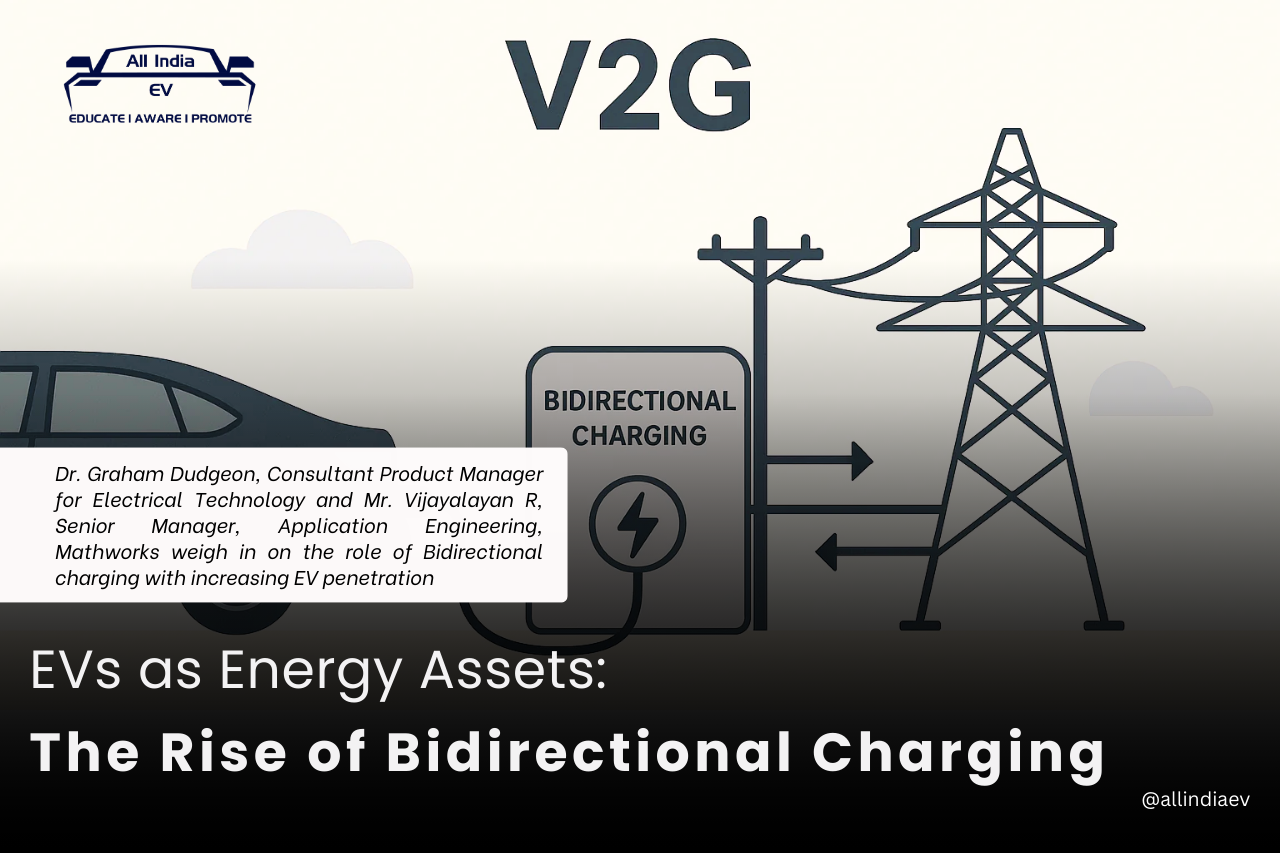
Bidirectional charging allows EVs not only to draw power from the grid but also to send electricity back when needed. Through technologies such as Vehicle-to-Grid (V2G) and Vehicle-to-Home (V2H), EVs can act as distributed energy resources.
A fully charged EV battery typically stores far more energy than required for daily driving. When aggregated across thousands—or eventually millions—of vehicles, these batteries represent a massive, untapped energy storage network.
In effect, EVs parked in homes, offices, and parking lots can function as flexible, mobile power plants, supplying electricity back to the grid during peak demand and absorbing excess power during low-demand periods.
How Bidirectional Charging Protects Grid Stability
Bidirectional charging offers several grid-level benefits:
- Peak load management by supplying stored energy during high-demand periods
- Voltage and frequency regulation at the distribution level
- Better utilization of renewable energy, reducing curtailment
- Deferred investments in grid infrastructure by flattening demand curves
For India, where peak demand is rising sharply during summer months, V2G-enabled EVs could provide a buffer that stabilizes the grid without adding new fossil-fuel-based peaking plants.
The Engineering Behind Bidirectional Charging
Enabling two-way power flow requires bidirectional power converters combined with advanced digital control systems. These converters regulate voltage and current, allowing electricity to flow safely between the EV battery and the grid.
Design engineers rely heavily on simulation-based development to build and validate these systems. Using detailed behavioral models, engineers simulate the battery, power electronics, control algorithms, and grid interaction long before physical deployment.
Desktop simulation tools help engineers:
- Test grid compliance under different operating conditions
- Predict charging behavior based on user patterns
- Develop control strategies for large-scale EV integration
- Build predictive maintenance systems to improve uptime
This approach reduces development risks and ensures reliability as bidirectional charging scales.
Evaluating EV Charging’s Impact on the Grid
Before large-scale deployment, utilities must understand how EV charging—and discharging—will affect grid behavior. System-level simulation studies play a crucial role here.
Global technology providers are already demonstrating this approach. For example, Lumen Freedom, a leading wireless EV charging manufacturer, has developed flexible charging systems designed for future grid needs. Engineers used model-based design tools such as MATLAB® and Simulink® to simulate communications, power electronics, and control logic.
These simulations allow engineers to predict real-world grid interactions, helping utilities plan for high EV penetration without compromising stability or reliability.
India’s Position in the V2G Transition
Globally, Japan and several European countries are already running commercial V2G pilots, often integrated with renewable energy systems. The United States is expanding trials across utilities, corporate campuses, and residential communities.
India is still in the early stages—but the foundation is forming. The country’s fast-growing EV market, coupled with smart city initiatives and renewable energy expansion, creates strong momentum for bidirectional charging adoption.
However, scaling V2G in India will require addressing several challenges:
- Grid readiness in high-density urban areas
- Standardized communication protocols for bidirectional chargers
- Availability of home and workplace charging, especially in shared parking spaces
- Clear commercial models for utilities and EV owners
- Incentives for EV owners to supply energy back to the grid
Without these enablers, bidirectional charging may remain limited to pilots rather than becoming a mainstream grid solution.
The Road Ahead for India
With the right mix of policy support, pilot programs, and industry–utility collaboration, bidirectional charging can become a cornerstone of India’s grid modernization strategy.
As EV adoption accelerates, EVs must be viewed not just as loads on the grid, but as assets—capable of supporting grid resilience, improving renewable integration, and enhancing energy security.
Bidirectional charging offers India a unique opportunity to leapfrog traditional grid challenges, turning millions of EVs into a distributed energy network that supports both clean mobility and power system stability. If implemented strategically, it could play a defining role in shaping India’s sustainable energy future.
Comment by the Author
India’s EV growth presents a defining moment for the power sector. Bidirectional charging has the potential to transform EVs from passive electricity consumers into active grid assets, helping balance peak demand, support renewable energy, and enhance grid resilience. As EV adoption accelerates, timely policy clarity, utility preparedness, and industry collaboration will be crucial to ensure that India’s power grid evolves in step with its clean mobility ambitions—turning a potential challenge into a long-term strategic advantage.