
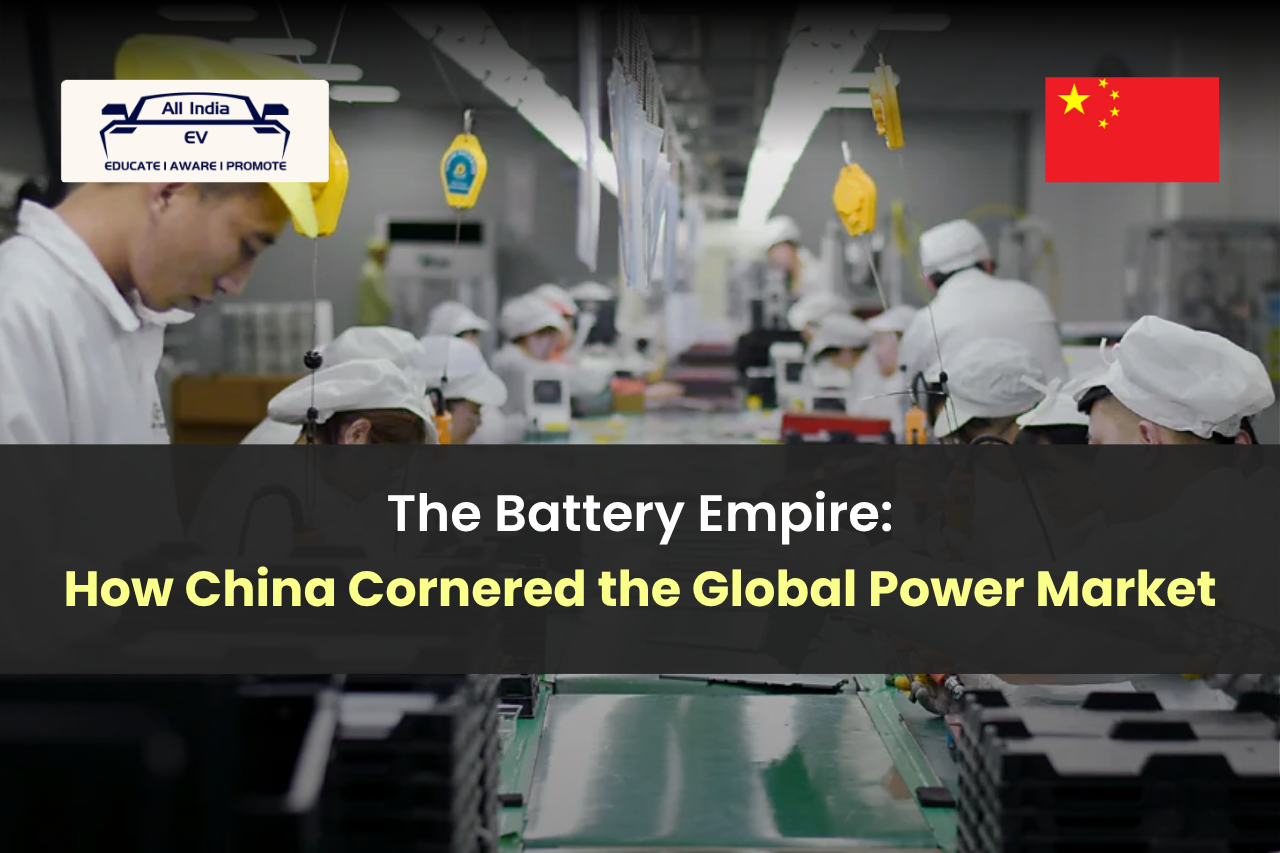


From Two Makers to Global Powerhouse: How China Grew to Produce Over 75% of the World’s Lithium-Ion Cells in Just 20 Years and Transformed the EV Battery Industry
- A Green Push That Started at the 2008 Beijing Olympics
- From Two Battery Makers to World Leaders: BYD and CATL
- The Global Origins of Lithium-Ion Batteries
- China’s Strategic Vision: EVs as a Technological Leapfrog
- The U.S. Missed Its Window — and China Took the Lead
- 2012–2020: The Era That Supercharged China’s Battery Industry
- Key measures included:
- 1. Huge consumer subsidies
- 2. Scaling production
- 3. Market protection through a “Chinese-only” battery whitelist
- 4. “Made in China 2025”
- 5. Dual-credit system (2017)
- The CATL Explosion: From Startup to Global Titan
- China’s Domestic Market: A Giant Economic “Walled Garden”
- Manufacturing Culture: Survival, Speed, and Scale
- A Complete Supply Chain — From Mines to Megafactories
- Global Impact: China Shapes the Future of Mobility
- Why India Watches China Closely
- Conclusion: How China Won the EV Battery Race
China’s dominance in the global electric-vehicle (EV) battery sector did not happen overnight. It has been a two-decade journey shaped by policy ambition, industrial strategy, massive state investment, and a uniquely competitive manufacturing ecosystem. Today, China controls more than 75% of global lithium-ion battery production, hosts six of the world’s ten largest battery manufacturers, and has built a clean-tech ecosystem unmatched in scale or efficiency.
But how exactly did a country that barely had two EV battery companies in the early 2000s grow into the world’s clean-tech powerhouse? The answer lies in a mix of policy vision, industrial coordination, and strategic market protection, as originally highlighted in reporting by the BBC.
A Green Push That Started at the 2008 Beijing Olympics
The seeds of China’s EV battery revolution were planted long before the world cared about electric mobility. During the 2008 Beijing Olympics, the Chinese government deployed around 50 battery-powered buses to ferry athletes and officials across the city.
This fleet, painted in white, blue, and green, represented far more than eco-friendly transportation for a global event. It marked China’s first experimental leap into lithium-ion battery systems for large vehicles—a project that became the foundation of a future global industry.
- These buses were considered groundbreaking at a time when diesel still dominated Beijing’s roads.
- The project required China to develop EV battery technology almost from scratch.
Researchers at the Beijing New Materials Development Centre were asked to assess the nation’s lithium-ion capabilities for the Olympics. What they found was sobering.
“China’s lithium-battery industry was very small,” said Mo Ke, then a researcher and now founder of RealLi Research.
“There were only two EV battery producers.”
Those two companies—Mengguli and Wanxiang—powered the early Olympic e-buses, but China knew this modest start had to evolve into something far bigger.
More EV News
From Two Battery Makers to World Leaders: BYD and CATL
In the early 2000s, CATL didn’t exist as an independent entity. It was simply a department within ATL, a Japanese-owned company making small batteries for consumer electronics.
BYD—now one of the world’s largest EV and battery manufacturers—was then known mainly as a battery supplier for Nokia and Motorola phones. Its entry into the auto industry came later.
Fast forward two decades:
- CATL is the world’s No.1 EV battery maker.
- BYD is No.2 globally and the world’s largest EV manufacturer.
China transformed itself from an industry beginner to a global superpower.
The Global Origins of Lithium-Ion Batteries
China’s rise began on a foundation of global scientific breakthroughs. The lithium-ion battery was not invented in China. It emerged from the work of:
- Stanley Whittingham (British-American)
- John Goodenough (American)
- Akira Yoshino (Japanese)
Their collective discovery in the 1970s–1980s laid the groundwork for the first viable lithium-ion battery, commercialized by Sony in 1991.
By the early 2000s:
- Japan owned 93% of the global lithium-ion market.
- South Korea was rapidly climbing.
- China was barely visible.
The world changed quickly.
China’s Strategic Vision: EVs as a Technological Leapfrog
In 2006, China unveiled a 15-year national science and technology plan highlighting new-energy vehicles (NEVs) as a strategic priority. The government believed EVs could help China:
- Leapfrog Western automakers, who dominated combustion engines
- Build a new high-tech manufacturing ecosystem
- Reduce reliance on imported oil
- Address pollution in major cities
According to analyst Xie Yanmei:
“Chinese policymakers saw EVs as a blank field where everyone started from scratch. It was their opportunity to leapfrog the West.”
This wasn’t just an environmental initiative—it was an industrial revolution strategy.
The U.S. Missed Its Window — and China Took the Lead
The BBC’s reporting also highlights how early U.S. leadership in clean-energy innovation did not translate into long-term dominance.
Why the U.S. fell behind:
- American companies lobbied against California’s Zero-Emission Vehicle (ZEV) mandates, watering them down.
- In the 2000s, U.S. EV startups made technical progress but were devastated by the 2008 financial crisis.
- The Obama administration’s clean-tech funding arrived too late for many innovators.
- Several U.S. battery companies—including A123 Systems—were acquired by Chinese firms, transferring intellectual property to China.
Meanwhile, China launched a massive 4-trillion-yuan stimulus plan during the financial crisis, prioritizing:
- Clean energy
- Battery development
- EV R&D
- Renewable technologies
China sprinted forward as the U.S. stumbled.
2012–2020: The Era That Supercharged China’s Battery Industry
These eight years were transformational. China deployed aggressive policies that fueled dizzying growth.
Key measures included:
1. Huge consumer subsidies
- In 2014 alone, China spent nearly 10 billion yuan on EV subsidies.
- Over the next eight years, tax exemptions totaled 200 billion yuan.
2. Scaling production
EV sales and production grew more than threefold in 2014–15.
3. Market protection through a “Chinese-only” battery whitelist
In 2015, China ruled that only batteries from 57 approved firms qualified for EV subsidies.
All 57 were Chinese companies.
This forced foreign battery makers like Samsung SDI and LG Chem out of the Chinese market, despite already having factories in China.
4. “Made in China 2025”
NEVs were declared a national priority sector for innovation and investment.
5. Dual-credit system (2017)
Automakers were required to produce EVs or purchase credits, driving manufacturers to increase EV production rapidly.
The CATL Explosion: From Startup to Global Titan
China’s 2015 rules instantly turned CATL into a favored supplier. As Chinese automakers rushed to comply with the whitelist, CATL’s customer base exploded.
By 2017:
- CATL became the world’s largest EV battery producer, overtaking Panasonic.
- It has remained No.1 ever since.
CATL’s success is also due to:
- Mastery of large-scale production
- Aggressive cost control
- Vertical integration into mining, chemical processing, and recycling
China’s Domestic Market: A Giant Economic “Walled Garden”
One of China’s greatest advantages has been its enormous internal market. Today:
- China sells more EVs than the rest of the world combined.
- Its domestic market is protected and incentivized in ways that foreign competitors cannot easily penetrate.
Government actions included:
- Mandating EV production
- Giving subsidies only for vehicles with domestic batteries
- Building the world’s largest charging network
This allowed Chinese companies to grow at hyperspeed while competitors struggled to match scale.
Manufacturing Culture: Survival, Speed, and Scale
According to industry consultant Song Xin:
“Chinese companies have strong survival instincts. They aggressively innovate to stay competitive. This is the foundation of the industry’s growth.”
Chinese manufacturing excels at:
- Rapid prototyping
- Cost reduction
- Scaling production
- Localizing supply chains
- Coordinated government-industry problem solving
This industrial environment allowed companies like BYD and CATL to achieve:
- Faster production cycles
- Cheaper batteries
- Continuous innovation
A Complete Supply Chain — From Mines to Megafactories
China now controls:
- 60% of global lithium processing
- 70% of cobalt refining
- More than 80% of anode and cathode material production
Its EV battery supply chain is integrated, efficient, and heavily supported by state financing.
This gives China:
- Lower production costs
- Limited exposure to global supply disruptions
- The ability to scale battery output faster than any other nation
Global Impact: China Shapes the Future of Mobility
China’s dominance has global consequences:
1. Falling global EV prices
Chinese manufacturing scale is pushing EV prices downward worldwide.
2. Geopolitical tensions
The U.S. and Europe are now attempting to counter Chinese dominance through industrial policies, tariffs, and incentives.
3. Accelerated innovation
China’s CATL now leads in next-generation technologies such as:
- LFP batteries
- Sodium-ion batteries
- M3P chemistry
- Ultra-fast-charging cells
Why India Watches China Closely
India’s EV mission shares similarities with China’s early approach:
- Strong policy direction
- Localization targets
- Battery manufacturing incentives
- Charging infrastructure expansion
However, the scale of China’s ecosystem remains unmatched. India can draw lessons from:
- China’s long-term vision
- Early investment in R&D
- Supply chain integration
- Protecting strategic industries
- Encouraging fierce local competition
Conclusion: How China Won the EV Battery Race
China’s position as the global EV battery superpower is the result of:
- Bold policy decisions
- Massive subsidies
- Strict market protection
- Technological investment
- Strong manufacturing capabilities
- A fast-growing domestic EV market
China didn’t just join the battery race—it reshaped it.
As the world races toward the 2050 net-zero target, China remains the undisputed leader in clean-tech battery production—years ahead of global competitors.
Comment by the Author
China’s rise to dominance in the global EV battery industry is not the result of a single breakthrough, but the outcome of two decades of coordinated vision, bold policymaking, and relentless industrial ambition. From leveraging the 2008 Olympics as a proving ground to strategically nurturing homegrown battery giants like CATL and BYD, China consistently played the long game while other countries hesitated or diverted priorities.
As highlighted by BBC’s original reporting, the country built a vast domestic market, fortified supply chains, and protected local innovators at critical moments — an approach that allowed it to surge far ahead of global competitors.
Today, China stands not just as a manufacturing leader, but as the ecosystem builder of the world’s most powerful clean-tech engine, shaping the trajectory of the EV revolution for decades to come.