
All India EVAll India EVAll India EV
Notification
Font ResizerAa
  • Home
  • EV News
  • EV Launch
  • Market Insights
  • Investments & Funding
  • Guest Articles
  • EV Engineering
  • Contact
Reading: India’s EV Adoption Faces Threat as New Building Code Proposes Basement Charging Restrictions
Share
All India EVAll India EV
Font ResizerAa
  • Home
  • EV News
  • EV Launch
  • Market Insights
  • Guest Articles
  • EV Engineering
  • Contact
Search
Follow US
Basement Charging
Home » Blog » India’s EV Adoption Faces Threat as New Building Code Proposes Basement Charging Restrictions
EV News

India’s EV Adoption Faces Threat as New Building Code Proposes Basement Charging Restrictions

Sunita
By
Sunita
Last updated: 15 October 2025
Share
4 Min Read
SHARE

Experts Warn New Fire Safety Rules Restricting EV Charging to Ground Floors or Limited Basement Areas Could Undermine Government Incentives and Impact EV Sales in Major Indian Cities

Contents
  • Urban impact could be severe
  • Industry demands wider consultation

India’s ambition to achieve 30% electric vehicle (EV) adoption by 2030 could face a major roadblock. The proposed amendments to the National Building Code (NBC) include restrictions on parking and charging EVs in basements of residential and commercial complexes, citing fire safety concerns.

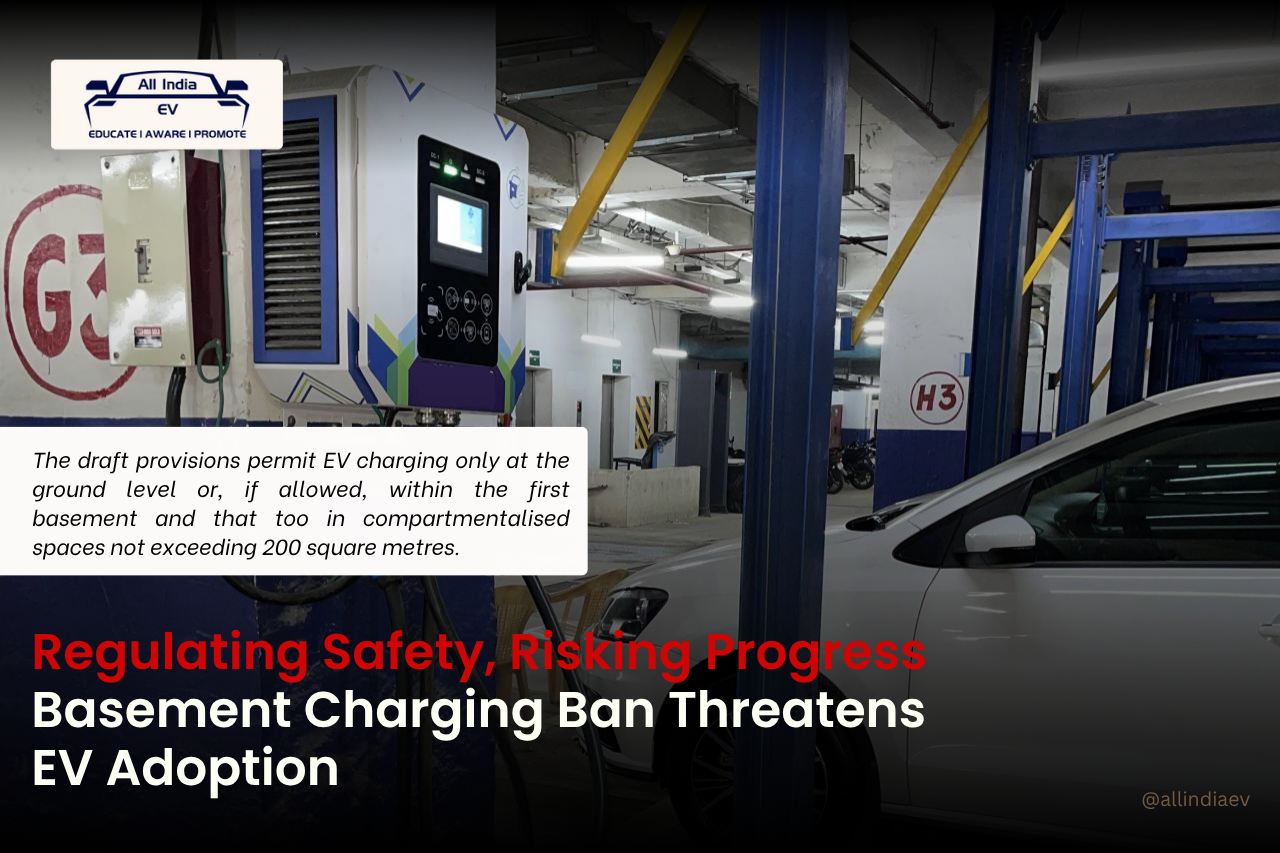
According to the draft provisions, EV charging will be allowed only at the ground level or, in specific cases, within the first basement — and even then, only in compartmentalised spaces not exceeding 200 square metres. Experts warn that these limitations could significantly hamper EV adoption in urban areas, where most vehicles are parked in multi-level basements due to limited surface space.


India’s EV ecosystem has witnessed exponential growth in recent years. Annual EV sales surged from 50,000 units in 2016 to over 2 million in 2024, with India now home to 5.45 million EVs, accounting for around 9% of the global total. However, the share of EVs in India’s total vehicle population remains modest at 7.66%, compared to the global average of 16.5%.

With initiatives such as the PM E-Drive scheme and state-level incentives, industry forecasts predict that annual EV sales could touch 17 million by 2030, led predominantly by two-wheelers. But stakeholders warn that the NBC’s proposed changes could derail this upward trajectory.

“If consumers believe they can’t park or charge EVs at home, they simply won’t buy them. It directly contradicts government efforts to accelerate EV adoption,” said an executive from an EV charging infrastructure firm, requesting anonymity.


Urban impact could be severe

The proposed amendments have raised alarm bells in metropolitan cities like Mumbai, Delhi, and Bengaluru, where multi-level underground parking is standard for both residential and commercial buildings. Restricting charging in basements could discourage real estate developers from integrating EV-ready infrastructure in new projects.

More EV News

Montra Electric
Montra Electric to Unveil State-of-the-Art eHCV (Trucks) Manufacturing Facility in Manesar
Bolt.Earth, Mahindra Last Mile Mobility Collaborate to ease EV charging for 3-wheelers
InterGlobe Partners with Archer Aviation to Bring Electric Air Taxis to India
How to Boost Your EV Range When Temperatures Fall
Rivian and AT&T Establish Green Partnership to Create a Carbon-Neutral Vehicle Fleet

According to industry estimates, India will need over 1.3 million public and private charging stations by 2030 to meet its national EV goals. Experts say the NBC’s current draft does not reflect the reality of urban India, where space constraints make underground parking essential.

“Parking restrictions like these don’t align with how Indian cities function. High-rises dominate metros, and their parking is largely underground,” said Awadhesh Jha, Chairman of the Indian Charge Point Operators Association.

He added that global data shows EVs are statistically safer than petrol or diesel vehicles when it comes to fire incidents, arguing that the NBC draft “ignores this evidence.”


Industry demands wider consultation

Industry experts have also questioned the lack of stakeholder engagement in drafting the amendments. The Bureau of Indian Standards (BIS), which governs the NBC, reportedly introduced the proposal without extensive consultation with the EV or real estate sectors.

“EVs in India already meet stringent safety and certification norms set by ARAI (Automotive Research Association of India). We’ve recommended that BIS engage with technical bodies to assess actual risk before finalising the provisions,” said the founder of a Hyderabad-based EV charger manufacturer, whose firm has submitted detailed feedback to BIS. As India pushes toward its clean mobility goals, the EV industry believes that balanced regulation, not restrictive policies, will be key to maintaining the country’s EV growth momentum.

Join All India EV Community

Click here for more such EV Updates

Reasons Behind Indian Railways' Limitations on Lithium and Li-ion Battery Transport in Leased Train Compartments
Reasons Behind Indian Railways’ Limitations on Lithium and Li-ion Battery Transport in Leased Train Compartments
Tesla Strategic Move into India: A $2-$3 Billion Investment in Local EV Production
Parliamentary Panel Proposes Annual Cap on New Non-EV Registrations in Delhi-NCR to Tackle Pollution
Ampace’s JP30: A New Era of Power in Battery Technology
India’s EV Growth: From Vision to 8 Crore by 2030

Sign Up For Daily Newsletter

Be keep up! Get the latest breaking news delivered straight to your inbox.
Loading
By signing up, you agree to our Terms of Use and acknowledge the data practices in our Privacy Policy. You may unsubscribe at any time.
Share This Article
Facebook Whatsapp Whatsapp LinkedIn Copy Link Print
Leave a Comment

Leave a Reply Cancel reply

Your email address will not be published. Required fields are marked *

Follow US
XFollow
InstagramFollow
YoutubeSubscribe
LinkedInFollow
Honda QC3 Electric Scooter Unveiled: Honda Raises the Bar with 145 km Range, Faster Charging and Premium Features
28 July 2026
River Mobility rolls out 50,000th Indie scooter, retail network grows to 75 stores
28 July 2026
Kia Syros EV vs Tata Nexon EV: Whose top spec trim offers better value?
28 July 2026
All India EV: Edition 51
What all happened in June 2026?
Click Here
All India EV
India's EV Industry Desk

All India EV is a media, market research and market intelligence platform tracking the companies, technologies, capital and market shifts shaping India's electric mobility ecosystem.

News Categories

  • EV News
  • EV Launch
  • Market Insights
  • Investments & Funding
  • EV Engineering
  • Guest Articles

Follow the Network

Instagram Follow daily EV updates LinkedIn Join the industry conversation WhatsApp Join the AIEV community

Contact the Desk

Business & Editorial
ankit.sharma@allindiaev.com allindiaev@gmail.com
Website
www.allindiaev.com
Based In
New Delhi, India

© 2026 All India EV. All rights reserved.

Aware Educate Promote

Welcome Back!

Sign in to your account

Username or Email Address
Password

Lost your password?